

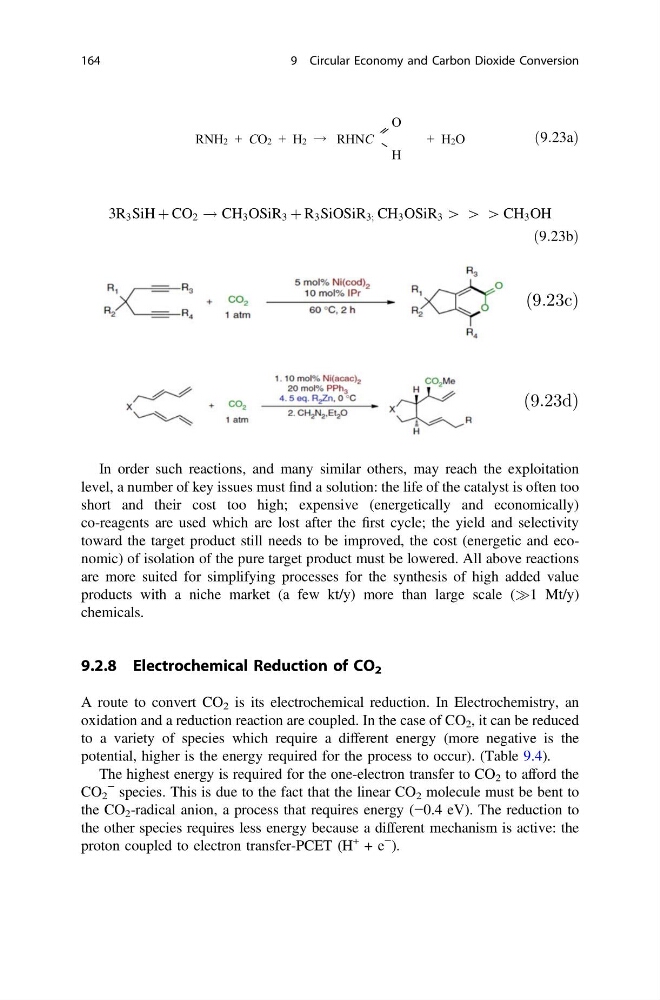
ð9:23aÞ
3R 3 SiH þ CO 2 ! CH 3 OSiR 3 þ R 3 SiOSiR 3; CH 3 OSiR 3 [ [ [ CH 3 OH
ð9:23bÞ
ð9:23cÞ
ð9:23dÞ
In order such reactions, and many similar others, may reach the exploitation
level, a number of key issues must find a solution: the life of the catalyst is often too
short and their cost too high; expensive (energetically and economically)
co-reagents are used which are lost after the first cycle; the yield and selectivity
toward the target product still needs to be improved, the cost (energetic and economic) of isolation of the pure target product must be lowered. All above reactions
are more suited for simplifying processes for the synthesis of high added value
products with a niche market (a few kt/y) more than large scale ()1 Mt/y)
chemicals.
9.2.8 Electrochemical Reduction of CO 2
A route to convert CO 2 is its electrochemical reduction. In Electrochemistry, an
oxidation and a reduction reaction are coupled. In the case of CO 2 , it can be reduced
to a variety of species which require a different energy (more negative is the
potential, higher is the energy required for the process to occur). (Table 9.4).
The highest energy is required for the one-electron transfer to CO 2 to afford the
CO 2
− species. This is due to the fact that the linear CO 2 molecule must be bent to
the CO 2 -radical anion, a process that requires energy (−0.4 eV). The reduction to
the other species requires less energy because a different mechanism is active: the
proton coupled to electron transfer-PCET (H
+ + e
− ).
164
9 Circular Economy and Carbon Dioxide Conversion
3R 3 SiH þ CO 2 ! CH 3 OSiR 3 þ R 3 SiOSiR 3; CH 3 OSiR 3 [ [ [ CH 3 OH
ð9:23bÞ
ð9:23cÞ
ð9:23dÞ
In order such reactions, and many similar others, may reach the exploitation
level, a number of key issues must find a solution: the life of the catalyst is often too
short and their cost too high; expensive (energetically and economically)
co-reagents are used which are lost after the first cycle; the yield and selectivity
toward the target product still needs to be improved, the cost (energetic and economic) of isolation of the pure target product must be lowered. All above reactions
are more suited for simplifying processes for the synthesis of high added value
products with a niche market (a few kt/y) more than large scale ()1 Mt/y)
chemicals.
9.2.8 Electrochemical Reduction of CO 2
A route to convert CO 2 is its electrochemical reduction. In Electrochemistry, an
oxidation and a reduction reaction are coupled. In the case of CO 2 , it can be reduced
to a variety of species which require a different energy (more negative is the
potential, higher is the energy required for the process to occur). (Table 9.4).
The highest energy is required for the one-electron transfer to CO 2 to afford the
CO 2
− species. This is due to the fact that the linear CO 2 molecule must be bent to
the CO 2 -radical anion, a process that requires energy (−0.4 eV). The reduction to
the other species requires less energy because a different mechanism is active: the
proton coupled to electron transfer-PCET (H
+ + e
− ).
164
9 Circular Economy and Carbon Dioxide Conversion