

for producing fuels for the transport sectors, including avio and navy, while
recycling large quantities of C. Challenges are the difficulty to drive selectivity
toward a single species. Catalysts based on iron-nanoparticle@carbon-nanotube
(Fe@CNT) seem to have quite good potential [50] to drive the reaction under quasi
C-neutral conditions even within the actual energy system frame. Indium-modified
zeolites [51] give high yield (>78%) of Cn hydrocarbons with low methane
selectivity. Cn olefins can be produced (54% light olefins with >50% conversion
CO 2 ) adding K
+ as co-catalyst [50, 52].
Such reactions could be exploited even today if excess-hydrogen is used.
Flared-H 2 amounts at ca. 8 Gm
3 /y, as it represents an average 5.54% of the total
flared gases (150–179 Gm
3 ) which cause the emission of over 450 Mt/yCO 2 [53].
Once renewable, low-cost hydrogen will be available, the conversion of CO 2 into
Cn hydrocarbons or olefins may become an option economically and energetically
viable, possibly clustering processes and operations for an efficient use of materials
and even waste gases, with much benefit for the environment and our society.
9.2.7 Other Reactions
CO 2 can be used for the synthesis of a variety of compounds containing either the
carboxylic –CO 2 – or the carbonylic –CO– moiety. The use of CO 2 would allow to
implement more direct syntheses, reducing waste production and even energy
consumption, considered that the co-reagents are energetic molecules. Examples of
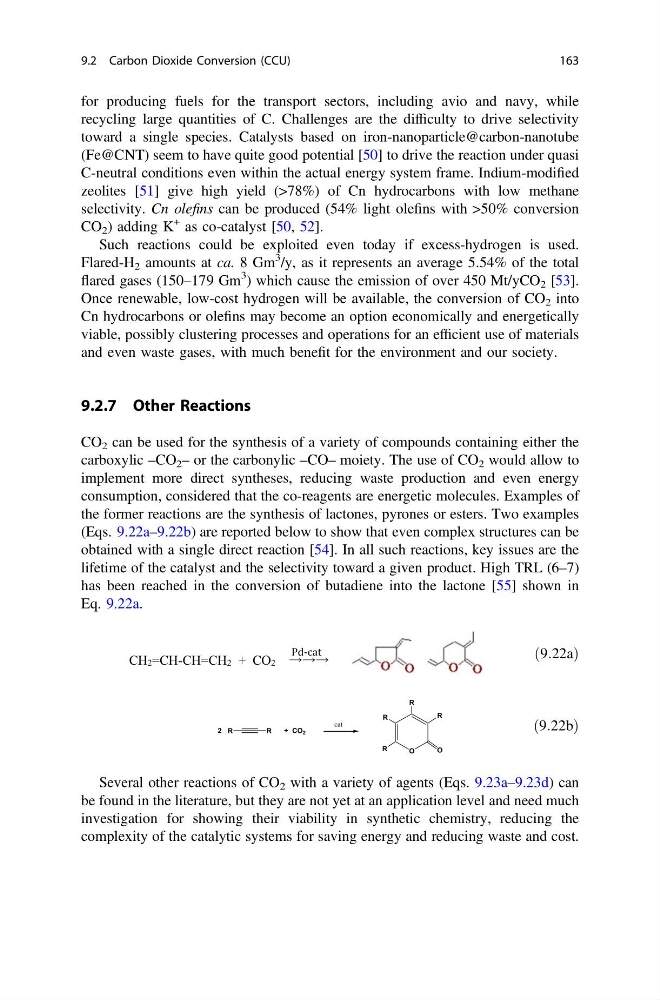
the former reactions are the synthesis of lactones, pyrones or esters. Two examples
(Eqs. 9.22a–9.22b) are reported below to show that even complex structures can be
obtained with a single direct reaction [54]. In all such reactions, key issues are the
lifetime of the catalyst and the selectivity toward a given product. High TRL (6–7)
has been reached in the conversion of butadiene into the lactone [55] shown in
Eq. 9.22a.
ð9:22aÞ
ð9:22bÞ
Several other reactions of CO 2 with a variety of agents (Eqs. 9.23a–9.23d) can
be found in the literature, but they are not yet at an application level and need much
investigation for showing their viability in synthetic chemistry, reducing the
complexity of the catalytic systems for saving energy and reducing waste and cost.
9.2 Carbon Dioxide Conversion (CCU)
163
recycling large quantities of C. Challenges are the difficulty to drive selectivity
toward a single species. Catalysts based on iron-nanoparticle@carbon-nanotube
(Fe@CNT) seem to have quite good potential [50] to drive the reaction under quasi
C-neutral conditions even within the actual energy system frame. Indium-modified
zeolites [51] give high yield (>78%) of Cn hydrocarbons with low methane
selectivity. Cn olefins can be produced (54% light olefins with >50% conversion
CO 2 ) adding K
+ as co-catalyst [50, 52].
Such reactions could be exploited even today if excess-hydrogen is used.
Flared-H 2 amounts at ca. 8 Gm
3 /y, as it represents an average 5.54% of the total
flared gases (150–179 Gm
3 ) which cause the emission of over 450 Mt/yCO 2 [53].
Once renewable, low-cost hydrogen will be available, the conversion of CO 2 into
Cn hydrocarbons or olefins may become an option economically and energetically
viable, possibly clustering processes and operations for an efficient use of materials
and even waste gases, with much benefit for the environment and our society.
9.2.7 Other Reactions
CO 2 can be used for the synthesis of a variety of compounds containing either the
carboxylic –CO 2 – or the carbonylic –CO– moiety. The use of CO 2 would allow to
implement more direct syntheses, reducing waste production and even energy
consumption, considered that the co-reagents are energetic molecules. Examples of
the former reactions are the synthesis of lactones, pyrones or esters. Two examples
(Eqs. 9.22a–9.22b) are reported below to show that even complex structures can be
obtained with a single direct reaction [54]. In all such reactions, key issues are the
lifetime of the catalyst and the selectivity toward a given product. High TRL (6–7)
has been reached in the conversion of butadiene into the lactone [55] shown in
Eq. 9.22a.
ð9:22aÞ
ð9:22bÞ
Several other reactions of CO 2 with a variety of agents (Eqs. 9.23a–9.23d) can
be found in the literature, but they are not yet at an application level and need much
investigation for showing their viability in synthetic chemistry, reducing the
complexity of the catalytic systems for saving energy and reducing waste and cost.
9.2 Carbon Dioxide Conversion (CCU)
163