

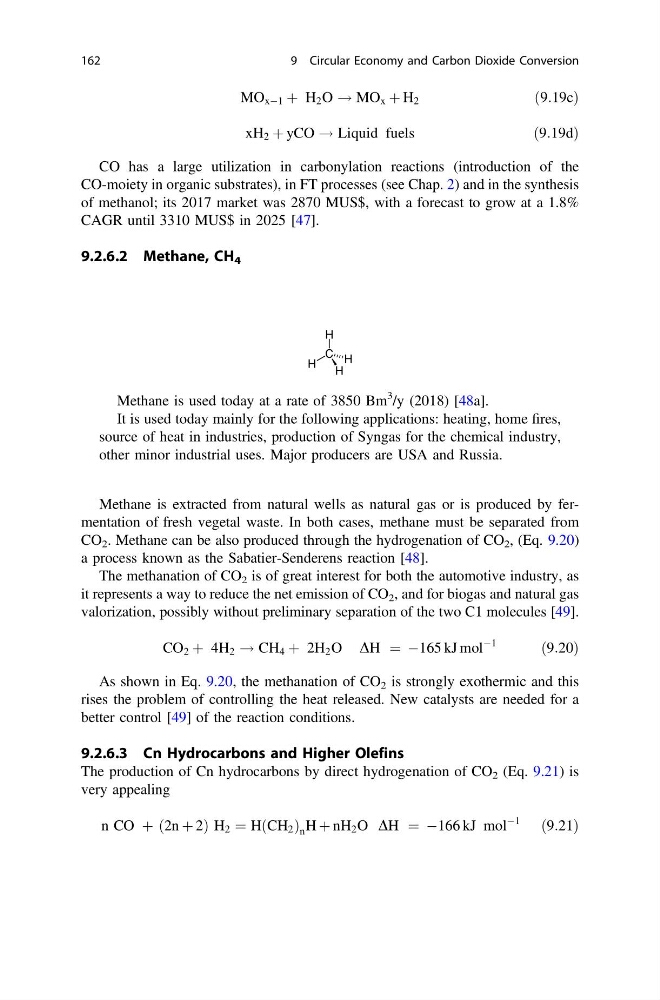
MO xÀ1 þ H 2 O ! MO x þ H 2
ð9:19cÞ
xH 2 þ yCO ! Liquid fuels
ð9:19dÞ
CO has a large utilization in carbonylation reactions (introduction of the
CO-moiety in organic substrates), in FT processes (see Chap. 2) and in the synthesis
of methanol; its 2017 market was 2870 MUS$, with a forecast to grow at a 1.8%
CAGR until 3310 MUS$ in 2025 [47].
9.2.6.2 Methane, CH 4
H
C
H
H
H
Methane is used today at a rate of 3850 Bm
3 /y (2018) [48a].
It is used today mainly for the following applications: heating, home fires,
source of heat in industries, production of Syngas for the chemical industry,
other minor industrial uses. Major producers are USA and Russia.
Methane is extracted from natural wells as natural gas or is produced by fermentation of fresh vegetal waste. In both cases, methane must be separated from
CO 2 . Methane can be also produced through the hydrogenation of CO 2 , (Eq. 9.20)
a process known as the Sabatier-Senderens reaction [48].
The methanation of CO 2 is of great interest for both the automotive industry, as
it represents a way to reduce the net emission of CO 2 , and for biogas and natural gas
valorization, possibly without preliminary separation of the two C1 molecules [49].
CO 2 þ 4H 2 ! CH 4 þ 2H 2 O DH ¼ À165 kJ mol
À1
ð9:20Þ
As shown in Eq. 9.20, the methanation of CO 2 is strongly exothermic and this
rises the problem of controlling the heat released. New catalysts are needed for a
better control [49] of the reaction conditions.
9.2.6.3 Cn Hydrocarbons and Higher Olefins
The production of Cn hydrocarbons by direct hydrogenation of CO 2 (Eq. 9.21) is
very appealing
n CO þ 2n þ 2
ð
ÞH 2 ¼ H CH 2
ð
Þ n H þ nH 2 O DH ¼ À166 kJ mol
À1
ð9:21Þ
162
9 Circular Economy and Carbon Dioxide Conversion
ð9:19cÞ
xH 2 þ yCO ! Liquid fuels
ð9:19dÞ
CO has a large utilization in carbonylation reactions (introduction of the
CO-moiety in organic substrates), in FT processes (see Chap. 2) and in the synthesis
of methanol; its 2017 market was 2870 MUS$, with a forecast to grow at a 1.8%
CAGR until 3310 MUS$ in 2025 [47].
9.2.6.2 Methane, CH 4
H
C
H
H
H
Methane is used today at a rate of 3850 Bm
3 /y (2018) [48a].
It is used today mainly for the following applications: heating, home fires,
source of heat in industries, production of Syngas for the chemical industry,
other minor industrial uses. Major producers are USA and Russia.
Methane is extracted from natural wells as natural gas or is produced by fermentation of fresh vegetal waste. In both cases, methane must be separated from
CO 2 . Methane can be also produced through the hydrogenation of CO 2 , (Eq. 9.20)
a process known as the Sabatier-Senderens reaction [48].
The methanation of CO 2 is of great interest for both the automotive industry, as
it represents a way to reduce the net emission of CO 2 , and for biogas and natural gas
valorization, possibly without preliminary separation of the two C1 molecules [49].
CO 2 þ 4H 2 ! CH 4 þ 2H 2 O DH ¼ À165 kJ mol
À1
ð9:20Þ
As shown in Eq. 9.20, the methanation of CO 2 is strongly exothermic and this
rises the problem of controlling the heat released. New catalysts are needed for a
better control [49] of the reaction conditions.
9.2.6.3 Cn Hydrocarbons and Higher Olefins
The production of Cn hydrocarbons by direct hydrogenation of CO 2 (Eq. 9.21) is
very appealing
n CO þ 2n þ 2
ð
ÞH 2 ¼ H CH 2
ð
Þ n H þ nH 2 O DH ¼ À166 kJ mol
À1
ð9:21Þ
162
9 Circular Economy and Carbon Dioxide Conversion