

9.2.5.3 C–C Reduction Coupling
C–C reductive coupling of CO 2 to afford diols (ethene glycol, HO–CH 2 CH 2 –OH,
EG) and poly-ols (glycerol and others) is possible by electrochemical reduction
[41], even if at very low yield 0.50% (Toshiba). The interest in such process lays in
the large market of EG (expected to reach 22 Mt/y in 2020 [42]) used as
co-monomer in polymers such as polyesters and polyols. Its production from CO 2
would convert ca. 100 Mt/y of CO 2 into long-living materials. Electrochemically,
even other C2 molecules, such as glyoxylic acid –HO 2 C–CHO (World Market
(WM) 140 kt/y), glycolic acid –HO 2 C–CH 2 OH (WM 100 kt/y), acetic acid HO 2 C–
CH 3 (WM 15 Mt/y) can be produced.
9.2.6 CCU in the Production of Large Scale Fuels
We shall now discuss the potential conversion of CO 2 into fuels, targeting three
broad classes: CO, CH 4 , liquid hydrocarbons. Each has its own peculiarities, as the
reader will see.
9.2.6.1 Carbon Monoxide, CO
The reduction of CO 2 to CO requires high energy if carried out in the gas phase. As
discussed in Chap. 2, the production of CO + “O” may occur when CO 2 is irradiated with a wavelength lower than 160 nm or is heated above 1000 °C [43].
Binding of CO 2 to a metal center greatly favor the deoxygenation of CO 2 : the
η
2
C,O -co-ordinated species is able to transfer one oxygen atom to an oxophile intra(Eq. 9.17) or inter-molecularly (Eq. 9.18) at 30–60 °C [44].
LnM CO 2
ð
Þ! LnMO þ CO
! L ¼ ligand such as phosphines; PR 3 ; M ¼ Metal
ð
Þ ð 9:17Þ
LnM CO 2
ð
ÞþSub ! LnM CO
ð ÞþSub
¼ O Sub ¼ organic or inorganic substrate
ð
Þ
ð 9:18Þ
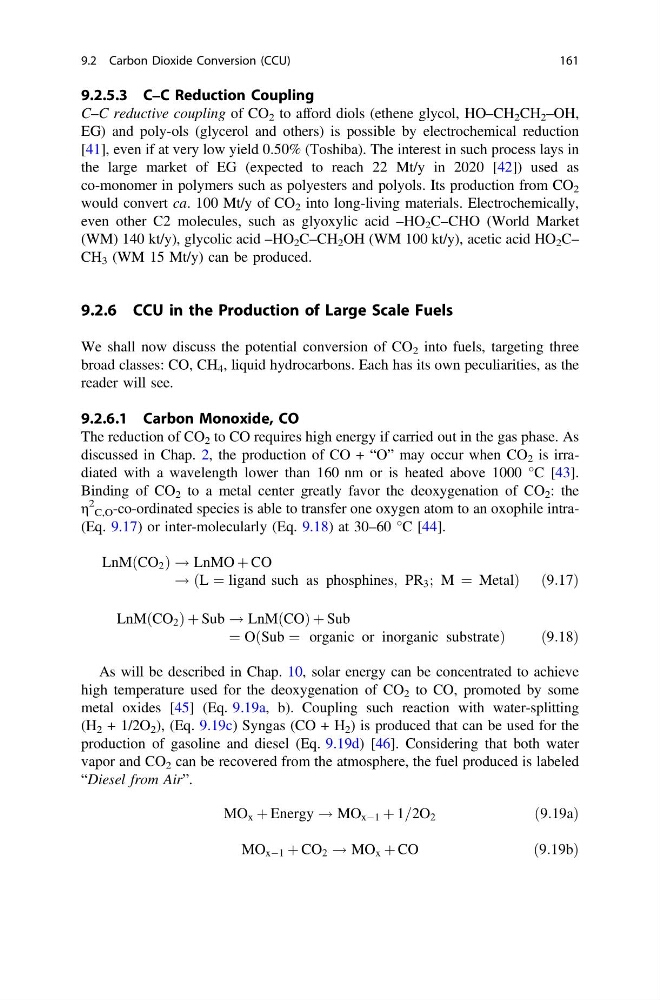
As will be described in Chap. 10, solar energy can be concentrated to achieve
high temperature used for the deoxygenation of CO 2 to CO, promoted by some
metal oxides [45] (Eq. 9.19a, b). Coupling such reaction with water-splitting
(H 2 + 1/2O 2 ), (Eq. 9.19c) Syngas (CO + H 2 ) is produced that can be used for the
production of gasoline and diesel (Eq. 9.19d) [46]. Considering that both water
vapor and CO 2 can be recovered from the atmosphere, the fuel produced is labeled
“Diesel from Air”.
MO x þ Energy ! MO xÀ1 þ 1=2O 2
ð9:19aÞ
MO xÀ1 þ CO 2 ! MO x þ CO
ð9:19bÞ
9.2 Carbon Dioxide Conversion (CCU)
161
C–C reductive coupling of CO 2 to afford diols (ethene glycol, HO–CH 2 CH 2 –OH,
EG) and poly-ols (glycerol and others) is possible by electrochemical reduction
[41], even if at very low yield 0.50% (Toshiba). The interest in such process lays in
the large market of EG (expected to reach 22 Mt/y in 2020 [42]) used as
co-monomer in polymers such as polyesters and polyols. Its production from CO 2
would convert ca. 100 Mt/y of CO 2 into long-living materials. Electrochemically,
even other C2 molecules, such as glyoxylic acid –HO 2 C–CHO (World Market
(WM) 140 kt/y), glycolic acid –HO 2 C–CH 2 OH (WM 100 kt/y), acetic acid HO 2 C–
CH 3 (WM 15 Mt/y) can be produced.
9.2.6 CCU in the Production of Large Scale Fuels
We shall now discuss the potential conversion of CO 2 into fuels, targeting three
broad classes: CO, CH 4 , liquid hydrocarbons. Each has its own peculiarities, as the
reader will see.
9.2.6.1 Carbon Monoxide, CO
The reduction of CO 2 to CO requires high energy if carried out in the gas phase. As
discussed in Chap. 2, the production of CO + “O” may occur when CO 2 is irradiated with a wavelength lower than 160 nm or is heated above 1000 °C [43].
Binding of CO 2 to a metal center greatly favor the deoxygenation of CO 2 : the
η
2
C,O -co-ordinated species is able to transfer one oxygen atom to an oxophile intra(Eq. 9.17) or inter-molecularly (Eq. 9.18) at 30–60 °C [44].
LnM CO 2
ð
Þ! LnMO þ CO
! L ¼ ligand such as phosphines; PR 3 ; M ¼ Metal
ð
Þ ð 9:17Þ
LnM CO 2
ð
ÞþSub ! LnM CO
ð ÞþSub
¼ O Sub ¼ organic or inorganic substrate
ð
Þ
ð 9:18Þ
As will be described in Chap. 10, solar energy can be concentrated to achieve
high temperature used for the deoxygenation of CO 2 to CO, promoted by some
metal oxides [45] (Eq. 9.19a, b). Coupling such reaction with water-splitting
(H 2 + 1/2O 2 ), (Eq. 9.19c) Syngas (CO + H 2 ) is produced that can be used for the
production of gasoline and diesel (Eq. 9.19d) [46]. Considering that both water
vapor and CO 2 can be recovered from the atmosphere, the fuel produced is labeled
“Diesel from Air”.
MO x þ Energy ! MO xÀ1 þ 1=2O 2
ð9:19aÞ
MO xÀ1 þ CO 2 ! MO x þ CO
ð9:19bÞ
9.2 Carbon Dioxide Conversion (CCU)
161