

The process of interest for CO 2 conversion is the reduction of CO 2 coupled to
oxidation of water to elemental oxygen (Eq. 9.24):
CO 2 þ H 2 O ¼ ‘‘H 2 CO’’ þ O 2
ð9:24Þ
Equation 9.24 is the elemental step often used to represent the natural
photosynthesis.
The electrochemical reduction of CO 2 can be coupled even to the conversion
(oxidation) of organics. Electrochemical syntheses have been used for the synthesis
of carboxylated species (we mention the following: carboxylation of halides to
carboxylic acids, double carboxylation of olefins to dicarboxylic acids) or for the
reduction to methanol and C2 (or even Cn) species with formation of C–C bonds
(etheneglycol, HOCH 2 CH 2 OH; ethene, CH 2 =CH 2 ). The two latter reactions have a
great industrial interest.
9.3 CCU and Clustering of Processes
The production of fuels is the sector that will use large volumes of CO 2 . The market
of chemicals is some 15 times smaller. On the other hand, it must be emphasized
that chemicals may have complex structures and processes on stream for their
synthesis are multistep, energy-consuming and waste-producing: the use of CO 2
may reduce the Carbon Footprint-CF of a process by avoiding up to 2–3 times the
amount of CO 2 fixed. This has been demonstrated by LCA studies [12] (see
Appendix F). Moreover, a one-step process avoids organic waste with respect to a
multi-step; reducing the production of organic waste means saving CO 2 emission as
the fate of most of organic waste is burning often without real utilization of the heat
produced. As we have already discussed, the conversion of CO 2 into energy
products requires energy and hydrogen, both not originated from fossil-C. However, only if perennial energy sources are used to power the process and hydrogen is
derived from water it makes sense to convert CO 2 into energy products for some
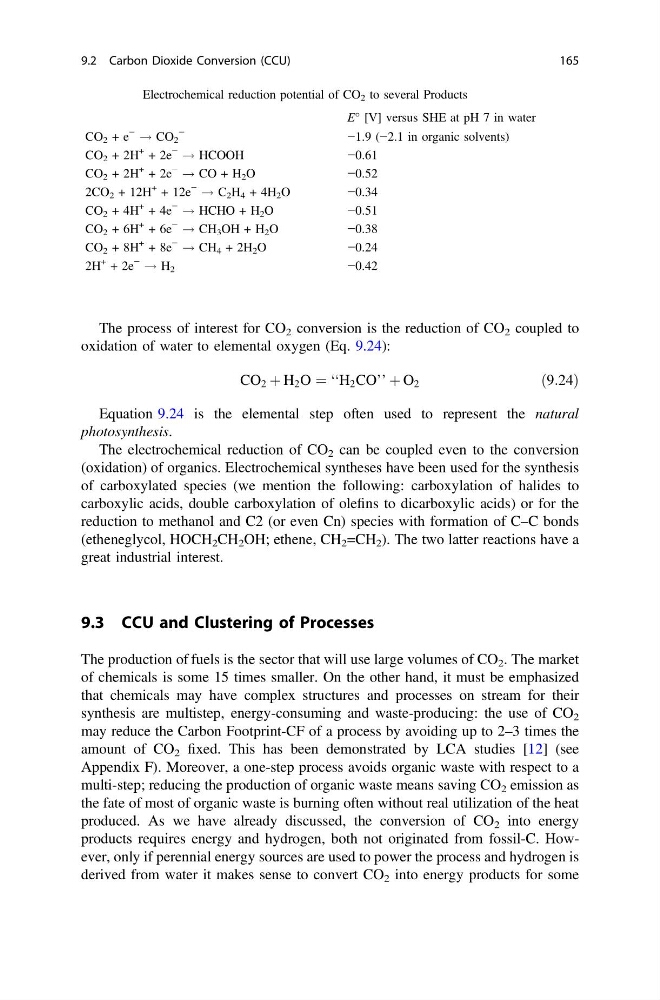
Table 9.4 Electrochemical reduction potential of CO 2 to several Products
E° [V] versus SHE at pH 7 in water
CO 2 + e
− ! CO 2
−
−1.9 (−2.1 in organic solvents)
CO 2 + 2H
+ + 2e
− ! HCOOH
−0.61
CO 2 + 2H
+ + 2e
− ! CO + H 2 O
−0.52
2CO 2 + 12H
+ + 12e
− ! C 2 H 4 + 4H 2 O
−0.34
CO 2 + 4H
+ + 4e
− ! HCHO + H 2 O
−0.51
CO 2 + 6H
+ + 6e
− ! CH 3 OH + H 2 O
−0.38
CO 2 + 8H
+ + 8e
− ! CH 4 + 2H 2 O
−0.24
2H
+ + 2e
− ! H 2
−0.42
9.2 Carbon Dioxide Conversion (CCU)
165
oxidation of water to elemental oxygen (Eq. 9.24):
CO 2 þ H 2 O ¼ ‘‘H 2 CO’’ þ O 2
ð9:24Þ
Equation 9.24 is the elemental step often used to represent the natural
photosynthesis.
The electrochemical reduction of CO 2 can be coupled even to the conversion
(oxidation) of organics. Electrochemical syntheses have been used for the synthesis
of carboxylated species (we mention the following: carboxylation of halides to
carboxylic acids, double carboxylation of olefins to dicarboxylic acids) or for the
reduction to methanol and C2 (or even Cn) species with formation of C–C bonds
(etheneglycol, HOCH 2 CH 2 OH; ethene, CH 2 =CH 2 ). The two latter reactions have a
great industrial interest.
9.3 CCU and Clustering of Processes
The production of fuels is the sector that will use large volumes of CO 2 . The market
of chemicals is some 15 times smaller. On the other hand, it must be emphasized
that chemicals may have complex structures and processes on stream for their
synthesis are multistep, energy-consuming and waste-producing: the use of CO 2
may reduce the Carbon Footprint-CF of a process by avoiding up to 2–3 times the
amount of CO 2 fixed. This has been demonstrated by LCA studies [12] (see
Appendix F). Moreover, a one-step process avoids organic waste with respect to a
multi-step; reducing the production of organic waste means saving CO 2 emission as
the fate of most of organic waste is burning often without real utilization of the heat
produced. As we have already discussed, the conversion of CO 2 into energy
products requires energy and hydrogen, both not originated from fossil-C. However, only if perennial energy sources are used to power the process and hydrogen is
derived from water it makes sense to convert CO 2 into energy products for some
Table 9.4 Electrochemical reduction potential of CO 2 to several Products
E° [V] versus SHE at pH 7 in water
CO 2 + e
− ! CO 2
−
−1.9 (−2.1 in organic solvents)
CO 2 + 2H
+ + 2e
− ! HCOOH
−0.61
CO 2 + 2H
+ + 2e
− ! CO + H 2 O
−0.52
2CO 2 + 12H
+ + 12e
− ! C 2 H 4 + 4H 2 O
−0.34
CO 2 + 4H
+ + 4e
− ! HCHO + H 2 O
−0.51
CO 2 + 6H
+ + 6e
− ! CH 3 OH + H 2 O
−0.38
CO 2 + 8H
+ + 8e
− ! CH 4 + 2H 2 O
−0.24
2H
+ + 2e
− ! H 2
−0.42
9.2 Carbon Dioxide Conversion (CCU)
165