

The molecular ester derivatives are stable and can be used for several
applications as: fungicides, herbicides, pesticides in agriculture or in the
cosmetic industry and other applications. Their market is difficult to size due
to the myriad of products. The carbamic moiety –NH–CO 2 – is the base of
polyurethanes (PU) which global market size was 55.2 BUS$ in 2018 and is
projected to reach 87.6 BUS$ by 2026, exhibiting a CAGR of 6.0%. They
find application as foams, packaging agents, thermal and sound insulators,
components of cars, in materials for furniture, toys, etc.
Carbamic acid is a labile species that dissociates into the free amine (RNH 2 ) and
CO 2 , unless it is stabilized by dimerization [29]. Conversely, carbamic acid esters
are stable entities used in several applications: cosmetics, agriculture, insecticides,
monomers for polymers (polyurethanes).
In principle they can be produced by reacting amines (primary or secondary
aliphatic amines) with CO 2 and an alkylating agent (Eq. 9.14) in presence of a base
(the latter can be the amine itself).
RR
0
NH þ R
00
X þ CO 2 þ B ! RR
0
NÀCO 2 R
00
þ BH
þ À
X
ð9:14Þ
Usually, polyurethanes are synthetized by reaction with diols [HO(CH 2 ) n OH,
n > 2] of di-isocyanates, OCN–R–NCO, (see DI9.1), obtained by thermal or catalytic conversion of primary amine carbamates (RHN–CO 2 R′ ! RNCO + R′OH).
Polymeric chains such as HOR″O[(O)C–NH–R–NHC(O)OR″O] n – are obtained.
(see also D9.1)
As isocyanates are supposed to be toxic, alternative routes to such compounds
are actively searched.
9.2.5 CCU and the Sustainable Production of Fuels
So far, in all reactions only an organic substrate and CO 2 have been used. Let us
analyze now cases in which CO 2 is reacted with hydrogen.
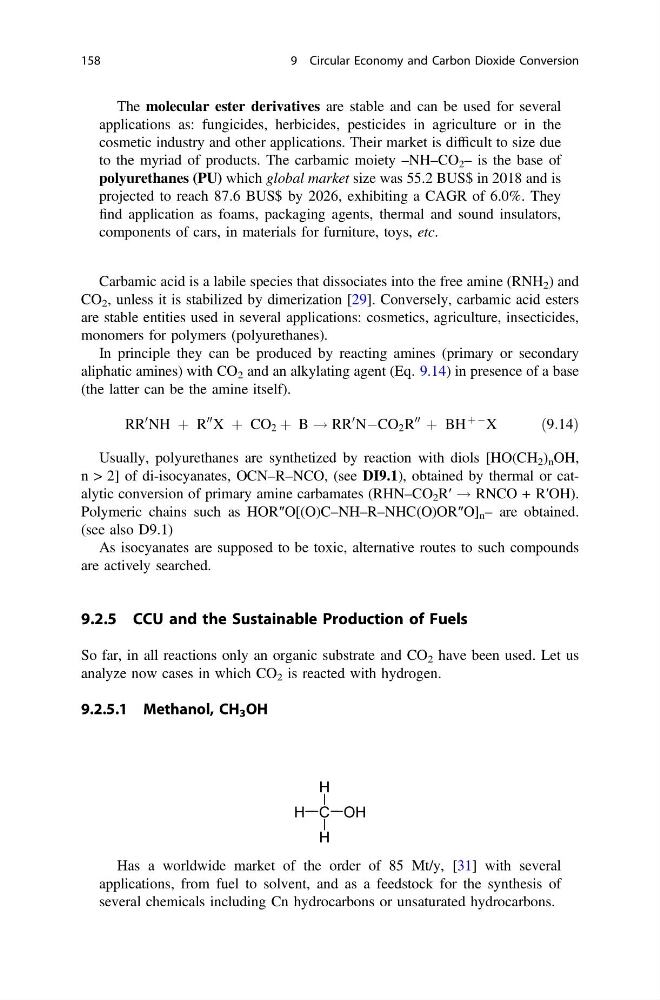
9.2.5.1 Methanol, CH 3 OH
Has a worldwide market of the order of 85 Mt/y, [31] with several
applications, from fuel to solvent, and as a feedstock for the synthesis of
several chemicals including Cn hydrocarbons or unsaturated hydrocarbons.
158
9 Circular Economy and Carbon Dioxide Conversion
applications as: fungicides, herbicides, pesticides in agriculture or in the
cosmetic industry and other applications. Their market is difficult to size due
to the myriad of products. The carbamic moiety –NH–CO 2 – is the base of
polyurethanes (PU) which global market size was 55.2 BUS$ in 2018 and is
projected to reach 87.6 BUS$ by 2026, exhibiting a CAGR of 6.0%. They
find application as foams, packaging agents, thermal and sound insulators,
components of cars, in materials for furniture, toys, etc.
Carbamic acid is a labile species that dissociates into the free amine (RNH 2 ) and
CO 2 , unless it is stabilized by dimerization [29]. Conversely, carbamic acid esters
are stable entities used in several applications: cosmetics, agriculture, insecticides,
monomers for polymers (polyurethanes).
In principle they can be produced by reacting amines (primary or secondary
aliphatic amines) with CO 2 and an alkylating agent (Eq. 9.14) in presence of a base
(the latter can be the amine itself).
RR
0
NH þ R
00
X þ CO 2 þ B ! RR
0
NÀCO 2 R
00
þ BH
þ À
X
ð9:14Þ
Usually, polyurethanes are synthetized by reaction with diols [HO(CH 2 ) n OH,
n > 2] of di-isocyanates, OCN–R–NCO, (see DI9.1), obtained by thermal or catalytic conversion of primary amine carbamates (RHN–CO 2 R′ ! RNCO + R′OH).
Polymeric chains such as HOR″O[(O)C–NH–R–NHC(O)OR″O] n – are obtained.
(see also D9.1)
As isocyanates are supposed to be toxic, alternative routes to such compounds
are actively searched.
9.2.5 CCU and the Sustainable Production of Fuels
So far, in all reactions only an organic substrate and CO 2 have been used. Let us
analyze now cases in which CO 2 is reacted with hydrogen.
9.2.5.1 Methanol, CH 3 OH
Has a worldwide market of the order of 85 Mt/y, [31] with several
applications, from fuel to solvent, and as a feedstock for the synthesis of
several chemicals including Cn hydrocarbons or unsaturated hydrocarbons.
158
9 Circular Economy and Carbon Dioxide Conversion