

O
H
H
H
R
+ CO 2
cat
O
C
O
H
H
R
H
O
ð9:10Þ
ð9:11Þ
ð9:12Þ
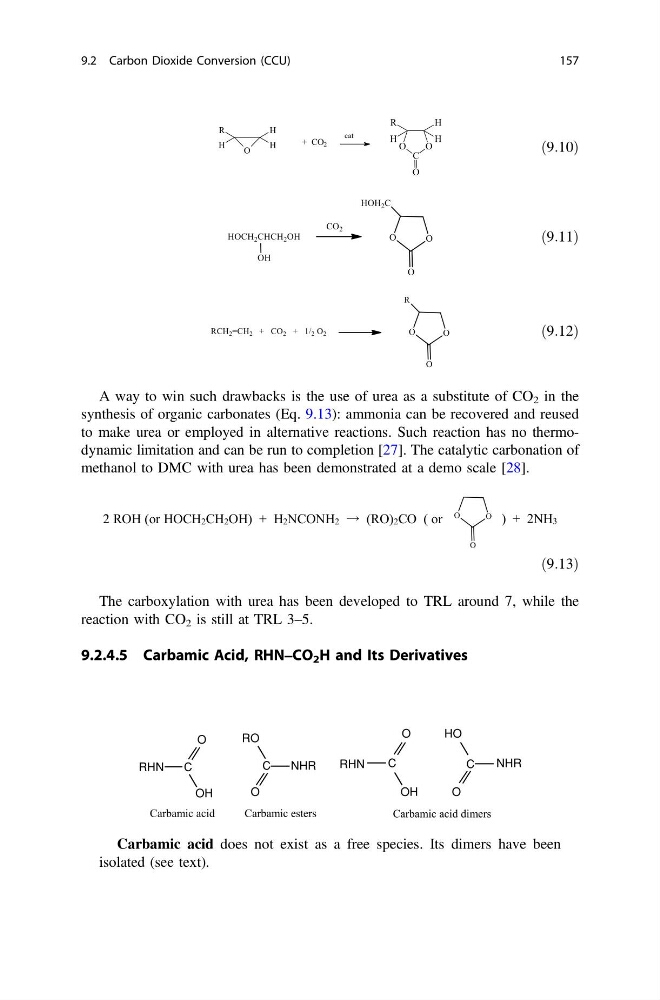
A way to win such drawbacks is the use of urea as a substitute of CO 2 in the
synthesis of organic carbonates (Eq. 9.13): ammonia can be recovered and reused
to make urea or employed in alternative reactions. Such reaction has no thermodynamic limitation and can be run to completion [27]. The catalytic carbonation of
methanol to DMC with urea has been demonstrated at a demo scale [28].
2 ROH (or HOCH2CH2OH) + H2NCONH2
(RO)2CO ( or
) + 2NH3
ð9:13Þ
The carboxylation with urea has been developed to TRL around 7, while the
reaction with CO 2 is still at TRL 3–5.
9.2.4.5 Carbamic Acid, RHN–CO 2 H and Its Derivatives
RHN
C
OH
RO
C
O
NHR
RHN
O
H O
C
O
NHR
C
OH
O
Carbamic acid dimers
Carbamic acid
Carbamic esters
Carbamic acid does not exist as a free species. Its dimers have been
isolated (see text).
9.2 Carbon Dioxide Conversion (CCU)
157
H
H
H
R
+ CO 2
cat
O
C
O
H
H
R
H
O
ð9:10Þ
ð9:11Þ
ð9:12Þ
A way to win such drawbacks is the use of urea as a substitute of CO 2 in the
synthesis of organic carbonates (Eq. 9.13): ammonia can be recovered and reused
to make urea or employed in alternative reactions. Such reaction has no thermodynamic limitation and can be run to completion [27]. The catalytic carbonation of
methanol to DMC with urea has been demonstrated at a demo scale [28].
2 ROH (or HOCH2CH2OH) + H2NCONH2
(RO)2CO ( or
) + 2NH3
ð9:13Þ
The carboxylation with urea has been developed to TRL around 7, while the
reaction with CO 2 is still at TRL 3–5.
9.2.4.5 Carbamic Acid, RHN–CO 2 H and Its Derivatives
RHN
C
OH
RO
C
O
NHR
RHN
O
H O
C
O
NHR
C
OH
O
Carbamic acid dimers
Carbamic acid
Carbamic esters
Carbamic acid does not exist as a free species. Its dimers have been
isolated (see text).
9.2 Carbon Dioxide Conversion (CCU)
157