

Such approach is still in its infancy as Turn Over Number-TON of 10–100 have
only recently been reached using Pd [19b–f]. Interestingly, ethene can be made
from CO 2 via electrolysis so that all carbons of the acrylic moiety could be derived
from CO 2 .
9.2.4.4 Linear and Cyclic Carbonates, (RO) 2 CO
Linear carbonates
Cyclic carbonates
R= Alkyl,Aryl
O
C
RO
RO
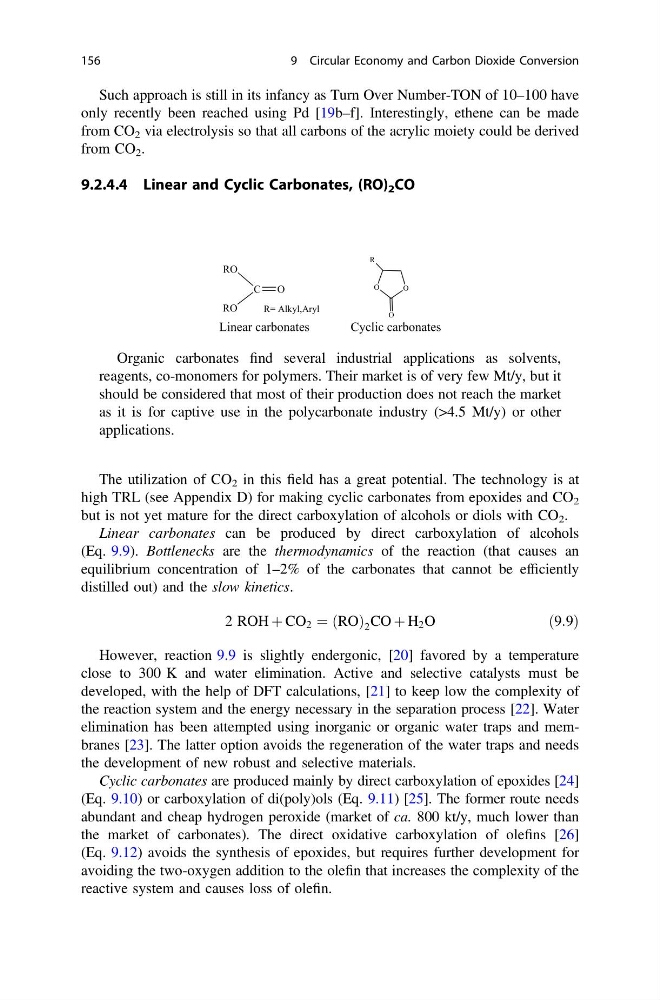
Organic carbonates find several industrial applications as solvents,
reagents, co-monomers for polymers. Their market is of very few Mt/y, but it
should be considered that most of their production does not reach the market
as it is for captive use in the polycarbonate industry (>4.5 Mt/y) or other
applications.
The utilization of CO 2 in this field has a great potential. The technology is at
high TRL (see Appendix D) for making cyclic carbonates from epoxides and CO 2
but is not yet mature for the direct carboxylation of alcohols or diols with CO 2 .
Linear carbonates can be produced by direct carboxylation of alcohols
(Eq. 9.9). Bottlenecks are the thermodynamics of the reaction (that causes an
equilibrium concentration of 1–2% of the carbonates that cannot be efficiently
distilled out) and the slow kinetics.
2 ROH þ CO 2 ¼ RO
ð Þ 2 CO þ H 2 O
ð9:9Þ
However, reaction 9.9 is slightly endergonic, [20] favored by a temperature
close to 300 K and water elimination. Active and selective catalysts must be
developed, with the help of DFT calculations, [21] to keep low the complexity of
the reaction system and the energy necessary in the separation process [22]. Water
elimination has been attempted using inorganic or organic water traps and membranes [23]. The latter option avoids the regeneration of the water traps and needs
the development of new robust and selective materials.
Cyclic carbonates are produced mainly by direct carboxylation of epoxides [24]
(Eq. 9.10) or carboxylation of di(poly)ols (Eq. 9.11) [25]. The former route needs
abundant and cheap hydrogen peroxide (market of ca. 800 kt/y, much lower than
the market of carbonates). The direct oxidative carboxylation of olefins [26]
(Eq. 9.12) avoids the synthesis of epoxides, but requires further development for
avoiding the two-oxygen addition to the olefin that increases the complexity of the
reactive system and causes loss of olefin.
156
9 Circular Economy and Carbon Dioxide Conversion
only recently been reached using Pd [19b–f]. Interestingly, ethene can be made
from CO 2 via electrolysis so that all carbons of the acrylic moiety could be derived
from CO 2 .
9.2.4.4 Linear and Cyclic Carbonates, (RO) 2 CO
Linear carbonates
Cyclic carbonates
R= Alkyl,Aryl
O
C
RO
RO
Organic carbonates find several industrial applications as solvents,
reagents, co-monomers for polymers. Their market is of very few Mt/y, but it
should be considered that most of their production does not reach the market
as it is for captive use in the polycarbonate industry (>4.5 Mt/y) or other
applications.
The utilization of CO 2 in this field has a great potential. The technology is at
high TRL (see Appendix D) for making cyclic carbonates from epoxides and CO 2
but is not yet mature for the direct carboxylation of alcohols or diols with CO 2 .
Linear carbonates can be produced by direct carboxylation of alcohols
(Eq. 9.9). Bottlenecks are the thermodynamics of the reaction (that causes an
equilibrium concentration of 1–2% of the carbonates that cannot be efficiently
distilled out) and the slow kinetics.
2 ROH þ CO 2 ¼ RO
ð Þ 2 CO þ H 2 O
ð9:9Þ
However, reaction 9.9 is slightly endergonic, [20] favored by a temperature
close to 300 K and water elimination. Active and selective catalysts must be
developed, with the help of DFT calculations, [21] to keep low the complexity of
the reaction system and the energy necessary in the separation process [22]. Water
elimination has been attempted using inorganic or organic water traps and membranes [23]. The latter option avoids the regeneration of the water traps and needs
the development of new robust and selective materials.
Cyclic carbonates are produced mainly by direct carboxylation of epoxides [24]
(Eq. 9.10) or carboxylation of di(poly)ols (Eq. 9.11) [25]. The former route needs
abundant and cheap hydrogen peroxide (market of ca. 800 kt/y, much lower than
the market of carbonates). The direct oxidative carboxylation of olefins [26]
(Eq. 9.12) avoids the synthesis of epoxides, but requires further development for
avoiding the two-oxygen addition to the olefin that increases the complexity of the
reactive system and causes loss of olefin.
156
9 Circular Economy and Carbon Dioxide Conversion