

9.2.4.3 Acrylic Acids, CH 2 =C(R)CO 2 H
R=H, acrylic acid
R=CH3, metacrylic acid
R=H, acrylic acid
R=CH 3 , metacrylic acid
The overall market of acrylic products was ca. 6.6 Mt/y (2017) with a
perspective annual growth of 6.3%/y and an estimated global value of 9.88
BUS$ by 2022.
The market of acrylic acids derivatives [19a] is built up by several different
compounds, such as
Acrylic Esters (Methyl Acrylate, Ethyl Acrylate, Butyl Acrylate, Ethyhexyl
Acrylate), Acrylic Polymers (Acrylic Elastomers, Super Absorbent Polymers,
Water Treatment Polymers, Ammonium Polyacrylate, Cyanopolyacrylate), End
Use (Diapers, Surface Coatings, Adhesives and Sealants, Plastic Additives, and
Water Treatment).
The production of acrylic acid is today based on the non-selective oxidation of
propane to propene and of the latter to acrylic acid, (Eq. 9.7) a route that has a low
CUF and produces a lot of organic waste and CO 2 due to the difficulty of driving
very selective oxidation processes.
CH 3 CH 2 CH 3 ! CH 3 CH¼CH 2 ! HO 2 CCH¼CH 2
ð9:7Þ
CH 2 ¼CH 2 þ CO 2 ! CH 2 ¼CHÀCO 2 H
ð9:8Þ
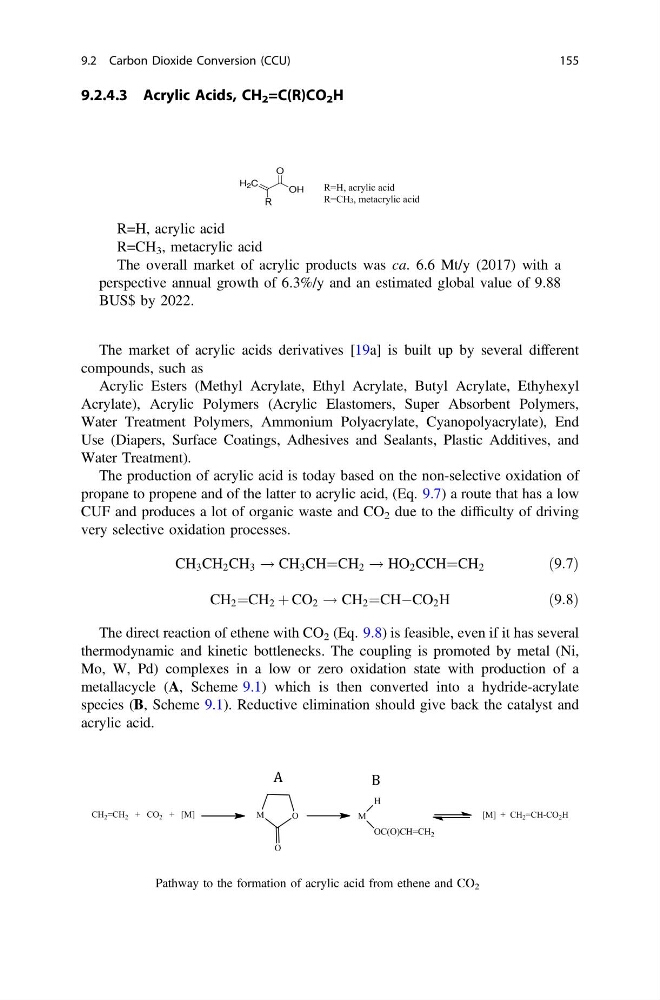
The direct reaction of ethene with CO 2 (Eq. 9.8) is feasible, even if it has several
thermodynamic and kinetic bottlenecks. The coupling is promoted by metal (Ni,
Mo, W, Pd) complexes in a low or zero oxidation state with production of a
metallacycle (A, Scheme 9.1) which is then converted into a hydride-acrylate
species (B, Scheme 9.1). Reductive elimination should give back the catalyst and
acrylic acid.
CH 2 =CH 2 + CO 2 + [M]
M
O
O
M
H
OC(O)CH=CH 2
[M] + CH 2 =CH-CO 2 H
A
B
Scheme 9.1 Pathway to the formation of acrylic acid from ethene and CO 2
9.2 Carbon Dioxide Conversion (CCU)
155
R=H, acrylic acid
R=CH3, metacrylic acid
R=H, acrylic acid
R=CH 3 , metacrylic acid
The overall market of acrylic products was ca. 6.6 Mt/y (2017) with a
perspective annual growth of 6.3%/y and an estimated global value of 9.88
BUS$ by 2022.
The market of acrylic acids derivatives [19a] is built up by several different
compounds, such as
Acrylic Esters (Methyl Acrylate, Ethyl Acrylate, Butyl Acrylate, Ethyhexyl
Acrylate), Acrylic Polymers (Acrylic Elastomers, Super Absorbent Polymers,
Water Treatment Polymers, Ammonium Polyacrylate, Cyanopolyacrylate), End
Use (Diapers, Surface Coatings, Adhesives and Sealants, Plastic Additives, and
Water Treatment).
The production of acrylic acid is today based on the non-selective oxidation of
propane to propene and of the latter to acrylic acid, (Eq. 9.7) a route that has a low
CUF and produces a lot of organic waste and CO 2 due to the difficulty of driving
very selective oxidation processes.
CH 3 CH 2 CH 3 ! CH 3 CH¼CH 2 ! HO 2 CCH¼CH 2
ð9:7Þ
CH 2 ¼CH 2 þ CO 2 ! CH 2 ¼CHÀCO 2 H
ð9:8Þ
The direct reaction of ethene with CO 2 (Eq. 9.8) is feasible, even if it has several
thermodynamic and kinetic bottlenecks. The coupling is promoted by metal (Ni,
Mo, W, Pd) complexes in a low or zero oxidation state with production of a
metallacycle (A, Scheme 9.1) which is then converted into a hydride-acrylate
species (B, Scheme 9.1). Reductive elimination should give back the catalyst and
acrylic acid.
CH 2 =CH 2 + CO 2 + [M]
M
O
O
M
H
OC(O)CH=CH 2
[M] + CH 2 =CH-CO 2 H
A
B
Scheme 9.1 Pathway to the formation of acrylic acid from ethene and CO 2
9.2 Carbon Dioxide Conversion (CCU)
155