

9.2.4.2 Carboxylic Acids, R–CO 2 H
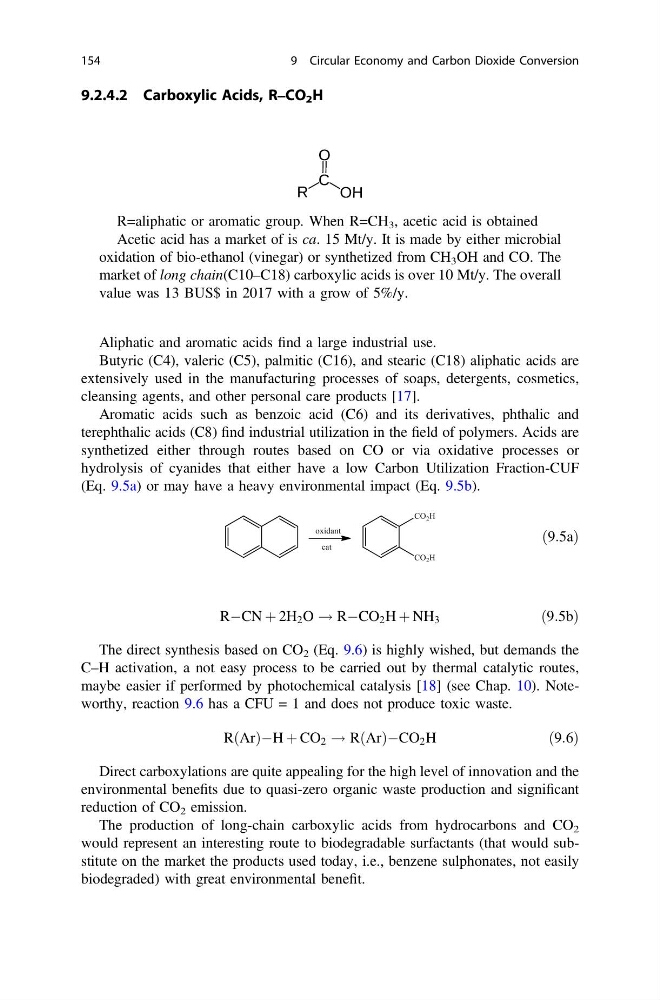
R=aliphatic or aromatic group. When R=CH 3 , acetic acid is obtained
Acetic acid has a market of is ca. 15 Mt/y. It is made by either microbial
oxidation of bio-ethanol (vinegar) or synthetized from CH 3 OH and CO. The
market of long chain(C10–C18) carboxylic acids is over 10 Mt/y. The overall
value was 13 BUS$ in 2017 with a grow of 5%/y.
Aliphatic and aromatic acids find a large industrial use.
Butyric (C4), valeric (C5), palmitic (C16), and stearic (C18) aliphatic acids are
extensively used in the manufacturing processes of soaps, detergents, cosmetics,
cleansing agents, and other personal care products [17].
Aromatic acids such as benzoic acid (C6) and its derivatives, phthalic and
terephthalic acids (C8) find industrial utilization in the field of polymers. Acids are
synthetized either through routes based on CO or via oxidative processes or
hydrolysis of cyanides that either have a low Carbon Utilization Fraction-CUF
(Eq. 9.5a) or may have a heavy environmental impact (Eq. 9.5b).
ð9:5aÞ
RÀCN þ 2H 2 O ! RÀCO 2 H þ NH 3
ð9:5bÞ
The direct synthesis based on CO 2 (Eq. 9.6) is highly wished, but demands the
C–H activation, a not easy process to be carried out by thermal catalytic routes,
maybe easier if performed by photochemical catalysis [18] (see Chap. 10). Noteworthy, reaction 9.6 has a CFU = 1 and does not produce toxic waste.
R Ar
ð ÞÀH þ CO 2 ! R Ar
ð ÞÀCO 2 H
ð9:6Þ
Direct carboxylations are quite appealing for the high level of innovation and the
environmental benefits due to quasi-zero organic waste production and significant
reduction of CO 2 emission.
The production of long-chain carboxylic acids from hydrocarbons and CO 2
would represent an interesting route to biodegradable surfactants (that would substitute on the market the products used today, i.e., benzene sulphonates, not easily
biodegraded) with great environmental benefit.
154
9 Circular Economy and Carbon Dioxide Conversion
R=aliphatic or aromatic group. When R=CH 3 , acetic acid is obtained
Acetic acid has a market of is ca. 15 Mt/y. It is made by either microbial
oxidation of bio-ethanol (vinegar) or synthetized from CH 3 OH and CO. The
market of long chain(C10–C18) carboxylic acids is over 10 Mt/y. The overall
value was 13 BUS$ in 2017 with a grow of 5%/y.
Aliphatic and aromatic acids find a large industrial use.
Butyric (C4), valeric (C5), palmitic (C16), and stearic (C18) aliphatic acids are
extensively used in the manufacturing processes of soaps, detergents, cosmetics,
cleansing agents, and other personal care products [17].
Aromatic acids such as benzoic acid (C6) and its derivatives, phthalic and
terephthalic acids (C8) find industrial utilization in the field of polymers. Acids are
synthetized either through routes based on CO or via oxidative processes or
hydrolysis of cyanides that either have a low Carbon Utilization Fraction-CUF
(Eq. 9.5a) or may have a heavy environmental impact (Eq. 9.5b).
ð9:5aÞ
RÀCN þ 2H 2 O ! RÀCO 2 H þ NH 3
ð9:5bÞ
The direct synthesis based on CO 2 (Eq. 9.6) is highly wished, but demands the
C–H activation, a not easy process to be carried out by thermal catalytic routes,
maybe easier if performed by photochemical catalysis [18] (see Chap. 10). Noteworthy, reaction 9.6 has a CFU = 1 and does not produce toxic waste.
R Ar
ð ÞÀH þ CO 2 ! R Ar
ð ÞÀCO 2 H
ð9:6Þ
Direct carboxylations are quite appealing for the high level of innovation and the
environmental benefits due to quasi-zero organic waste production and significant
reduction of CO 2 emission.
The production of long-chain carboxylic acids from hydrocarbons and CO 2
would represent an interesting route to biodegradable surfactants (that would substitute on the market the products used today, i.e., benzene sulphonates, not easily
biodegraded) with great environmental benefit.
154
9 Circular Economy and Carbon Dioxide Conversion