

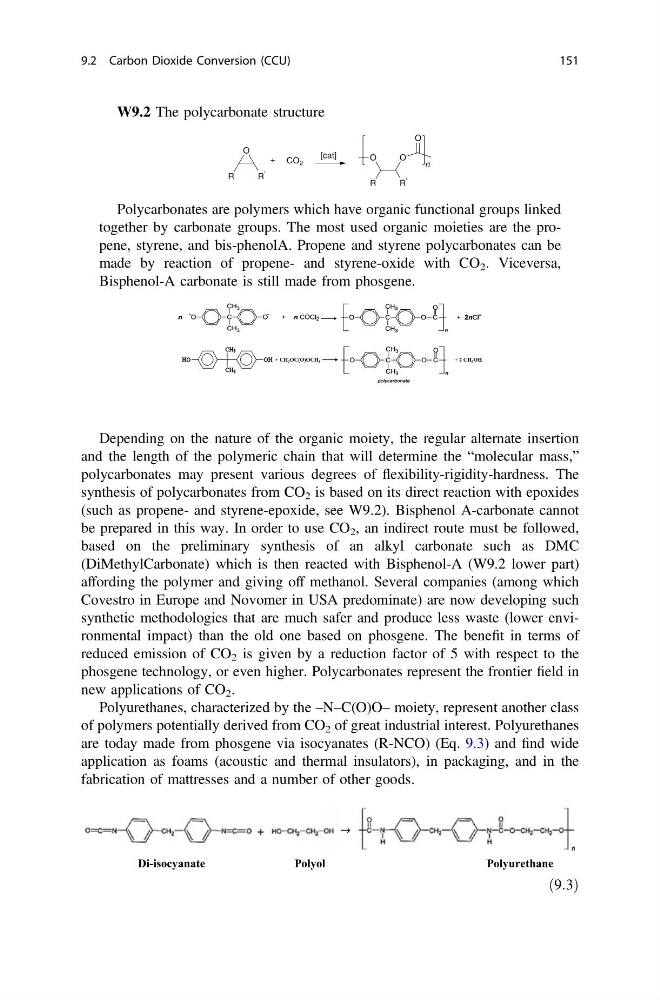
W9.2 The polycarbonate structure
Polycarbonates are polymers which have organic functional groups linked
together by carbonate groups. The most used organic moieties are the propene, styrene, and bis-phenolA. Propene and styrene polycarbonates can be
made by reaction of propene- and styrene-oxide with CO 2 . Viceversa,
Bisphenol-A carbonate is still made from phosgene.
Depending on the nature of the organic moiety, the regular alternate insertion
and the length of the polymeric chain that will determine the “molecular mass,”
polycarbonates may present various degrees of flexibility-rigidity-hardness. The
synthesis of polycarbonates from CO 2 is based on its direct reaction with epoxides
(such as propene- and styrene-epoxide, see W9.2). Bisphenol A-carbonate cannot
be prepared in this way. In order to use CO 2 , an indirect route must be followed,
based on the preliminary synthesis of an alkyl carbonate such as DMC
(DiMethylCarbonate) which is then reacted with Bisphenol-A (W9.2 lower part)
affording the polymer and giving off methanol. Several companies (among which
Covestro in Europe and Novomer in USA predominate) are now developing such
synthetic methodologies that are much safer and produce less waste (lower environmental impact) than the old one based on phosgene. The benefit in terms of
reduced emission of CO 2 is given by a reduction factor of 5 with respect to the
phosgene technology, or even higher. Polycarbonates represent the frontier field in
new applications of CO 2 .
Polyurethanes, characterized by the –N–C(O)O– moiety, represent another class
of polymers potentially derived from CO 2 of great industrial interest. Polyurethanes
are today made from phosgene via isocyanates (R-NCO) (Eq. 9.3) and find wide
application as foams (acoustic and thermal insulators), in packaging, and in the
fabrication of mattresses and a number of other goods.
Di-isocyanate
Polyol
Polyurethane
ð9:3Þ
9.2 Carbon Dioxide Conversion (CCU)
151
Polycarbonates are polymers which have organic functional groups linked
together by carbonate groups. The most used organic moieties are the propene, styrene, and bis-phenolA. Propene and styrene polycarbonates can be
made by reaction of propene- and styrene-oxide with CO 2 . Viceversa,
Bisphenol-A carbonate is still made from phosgene.
Depending on the nature of the organic moiety, the regular alternate insertion
and the length of the polymeric chain that will determine the “molecular mass,”
polycarbonates may present various degrees of flexibility-rigidity-hardness. The
synthesis of polycarbonates from CO 2 is based on its direct reaction with epoxides
(such as propene- and styrene-epoxide, see W9.2). Bisphenol A-carbonate cannot
be prepared in this way. In order to use CO 2 , an indirect route must be followed,
based on the preliminary synthesis of an alkyl carbonate such as DMC
(DiMethylCarbonate) which is then reacted with Bisphenol-A (W9.2 lower part)
affording the polymer and giving off methanol. Several companies (among which
Covestro in Europe and Novomer in USA predominate) are now developing such
synthetic methodologies that are much safer and produce less waste (lower environmental impact) than the old one based on phosgene. The benefit in terms of
reduced emission of CO 2 is given by a reduction factor of 5 with respect to the
phosgene technology, or even higher. Polycarbonates represent the frontier field in
new applications of CO 2 .
Polyurethanes, characterized by the –N–C(O)O– moiety, represent another class
of polymers potentially derived from CO 2 of great industrial interest. Polyurethanes
are today made from phosgene via isocyanates (R-NCO) (Eq. 9.3) and find wide
application as foams (acoustic and thermal insulators), in packaging, and in the
fabrication of mattresses and a number of other goods.
Di-isocyanate
Polyol
Polyurethane
ð9:3Þ
9.2 Carbon Dioxide Conversion (CCU)
151