

An alternative route to isocyanates which are believed to be carcinogenic is the
reaction of amines with organic carbonates, or the reaction of amines, CO 2, and
alcohols.
As mentioned above, polymers containing CO 2 can be considered a way to store
CO 2 for a few decades: CO 2 is given off when polymers are burned or destroyed.
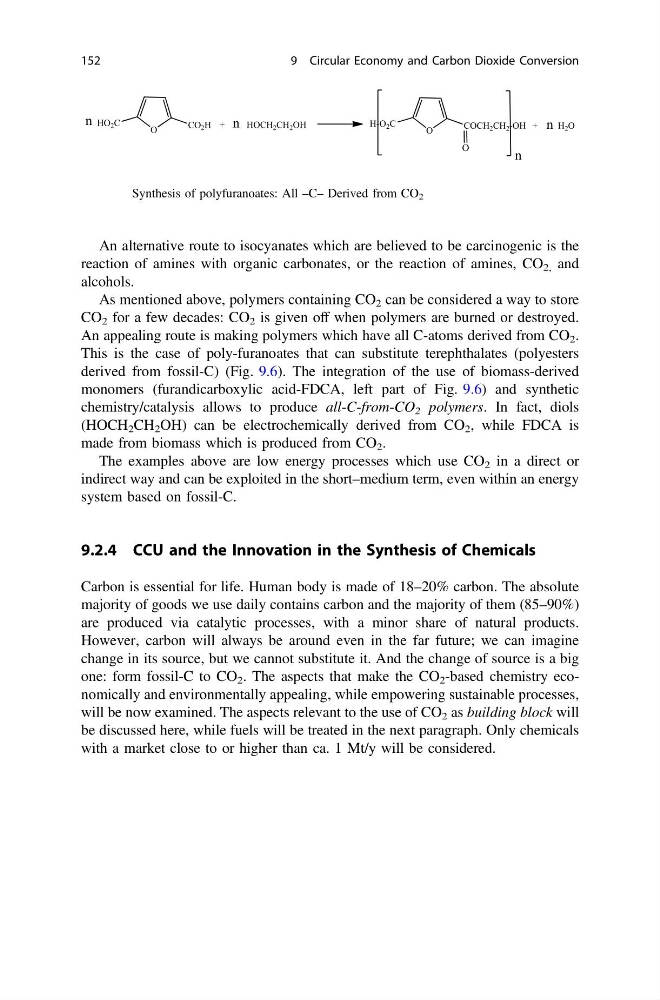
An appealing route is making polymers which have all C-atoms derived from CO 2 .
This is the case of poly-furanoates that can substitute terephthalates (polyesters
derived from fossil-C) (Fig. 9.6). The integration of the use of biomass-derived
monomers (furandicarboxylic acid-FDCA, left part of Fig. 9.6) and synthetic
chemistry/catalysis allows to produce all-C-from-CO 2 polymers. In fact, diols
(HOCH 2 CH 2 OH) can be electrochemically derived from CO 2 , while FDCA is
made from biomass which is produced from CO 2 .
The examples above are low energy processes which use CO 2 in a direct or
indirect way and can be exploited in the short–medium term, even within an energy
system based on fossil-C.
9.2.4 CCU and the Innovation in the Synthesis of Chemicals
Carbon is essential for life. Human body is made of 18–20% carbon. The absolute
majority of goods we use daily contains carbon and the majority of them (85–90%)
are produced via catalytic processes, with a minor share of natural products.
However, carbon will always be around even in the far future; we can imagine
change in its source, but we cannot substitute it. And the change of source is a big
one: form fossil-C to CO 2 . The aspects that make the CO 2 -based chemistry economically and environmentally appealing, while empowering sustainable processes,
will be now examined. The aspects relevant to the use of CO 2 as building block will
be discussed here, while fuels will be treated in the next paragraph. Only chemicals
with a market close to or higher than ca. 1 Mt/y will be considered.
n
O
CO 2 H
HO 2 C
HOCH 2 CH 2 OH
+ n
O
COCH 2 CH 2 -OH
H-O 2 C
O
n
+ n H 2 O
Fig. 9.6 Synthesis of polyfuranoates: All –C– Derived from CO 2
152
9 Circular Economy and Carbon Dioxide Conversion
reaction of amines with organic carbonates, or the reaction of amines, CO 2, and
alcohols.
As mentioned above, polymers containing CO 2 can be considered a way to store
CO 2 for a few decades: CO 2 is given off when polymers are burned or destroyed.
An appealing route is making polymers which have all C-atoms derived from CO 2 .
This is the case of poly-furanoates that can substitute terephthalates (polyesters
derived from fossil-C) (Fig. 9.6). The integration of the use of biomass-derived
monomers (furandicarboxylic acid-FDCA, left part of Fig. 9.6) and synthetic
chemistry/catalysis allows to produce all-C-from-CO 2 polymers. In fact, diols
(HOCH 2 CH 2 OH) can be electrochemically derived from CO 2 , while FDCA is
made from biomass which is produced from CO 2 .
The examples above are low energy processes which use CO 2 in a direct or
indirect way and can be exploited in the short–medium term, even within an energy
system based on fossil-C.
9.2.4 CCU and the Innovation in the Synthesis of Chemicals
Carbon is essential for life. Human body is made of 18–20% carbon. The absolute
majority of goods we use daily contains carbon and the majority of them (85–90%)
are produced via catalytic processes, with a minor share of natural products.
However, carbon will always be around even in the far future; we can imagine
change in its source, but we cannot substitute it. And the change of source is a big
one: form fossil-C to CO 2 . The aspects that make the CO 2 -based chemistry economically and environmentally appealing, while empowering sustainable processes,
will be now examined. The aspects relevant to the use of CO 2 as building block will
be discussed here, while fuels will be treated in the next paragraph. Only chemicals
with a market close to or higher than ca. 1 Mt/y will be considered.
n
O
CO 2 H
HO 2 C
HOCH 2 CH 2 OH
+ n
O
COCH 2 CH 2 -OH
H-O 2 C
O
n
+ n H 2 O
Fig. 9.6 Synthesis of polyfuranoates: All –C– Derived from CO 2
152
9 Circular Economy and Carbon Dioxide Conversion