

lower investment in safety measures will be necessary, including the use of special
materials, assuring longer life to plants with lower Operative Expenditure (OPEX)
(less corrosion of plants). Safety comes at expenses of reactivity. Phosgene is very
reactive and allows reaction going at room temperature, but generates difficult waste
and requires that plants are insulated in a dome linked to air treatment plants [12].
Transport of phosgene is banned and even the use of phosgene is prohibited in
several countries, after some serious cases of human poisoning. Therefore, new
synthetic methodologies are welcome and meet the industrial interest and CO 2 is
the ideal candidate in some applications. CO 2 can be the origin of CO (see DI 2.1)
through the Reverse Water Gas Shift reaction, which requires non-fossil H 2
(Eq. 9.2) whose production from fossil-C emits CO 2 . (see Chap. 2).
CO 2 þ H 2 ! CO + H 2 O ðRWGS)
ð9:2Þ
Therefore, while the substitution of COCl 2 with CO 2 would be possible as soon as
the right technologies are ready, the substitution of CO requires that PV-H 2 will
have a cost comparable to MR-H 2 or coprocessing of H 2 O–CO 2 may produce CO,
an even more difficult process.
9.2.3 CCU and the Sustainability of the Polymer Industry
CO 2 can be used as co-monomer in the production of polycarbonates-PC which are
made of alternate organic moieties and CO 2 (W9.2). The PC market is sized at ca.
4.5 Mt/y and such materials find a wide application in several fields, from medical
equipment, to CDs and DVDs, electronic industry, internal components of cars, and
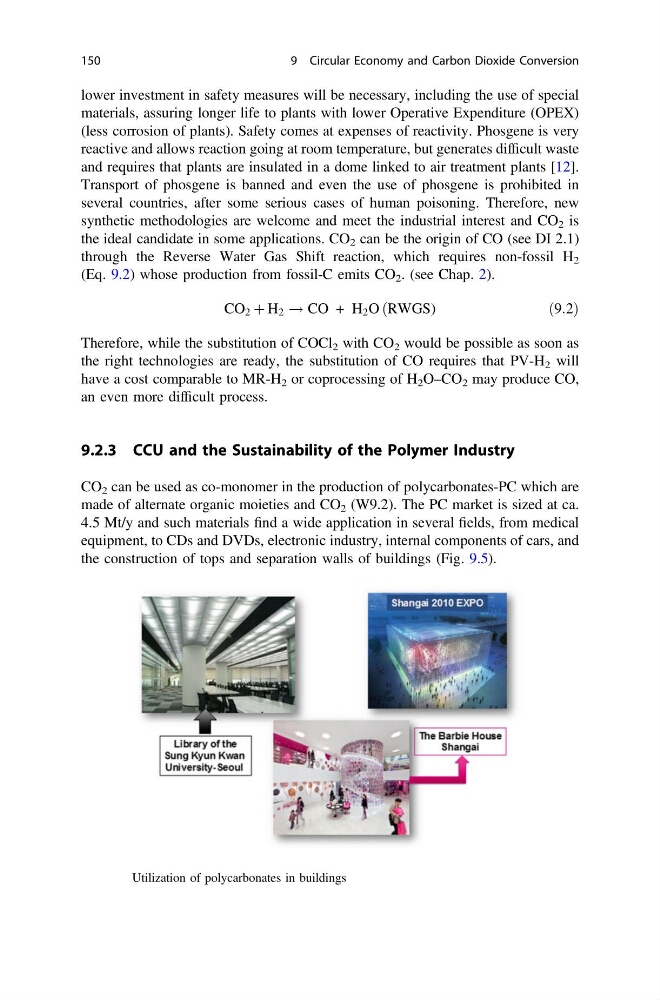
the construction of tops and separation walls of buildings (Fig. 9.5).
Fig. 9.5 Utilization of polycarbonates in buildings
150
9 Circular Economy and Carbon Dioxide Conversion
materials, assuring longer life to plants with lower Operative Expenditure (OPEX)
(less corrosion of plants). Safety comes at expenses of reactivity. Phosgene is very
reactive and allows reaction going at room temperature, but generates difficult waste
and requires that plants are insulated in a dome linked to air treatment plants [12].
Transport of phosgene is banned and even the use of phosgene is prohibited in
several countries, after some serious cases of human poisoning. Therefore, new
synthetic methodologies are welcome and meet the industrial interest and CO 2 is
the ideal candidate in some applications. CO 2 can be the origin of CO (see DI 2.1)
through the Reverse Water Gas Shift reaction, which requires non-fossil H 2
(Eq. 9.2) whose production from fossil-C emits CO 2 . (see Chap. 2).
CO 2 þ H 2 ! CO + H 2 O ðRWGS)
ð9:2Þ
Therefore, while the substitution of COCl 2 with CO 2 would be possible as soon as
the right technologies are ready, the substitution of CO requires that PV-H 2 will
have a cost comparable to MR-H 2 or coprocessing of H 2 O–CO 2 may produce CO,
an even more difficult process.
9.2.3 CCU and the Sustainability of the Polymer Industry
CO 2 can be used as co-monomer in the production of polycarbonates-PC which are
made of alternate organic moieties and CO 2 (W9.2). The PC market is sized at ca.
4.5 Mt/y and such materials find a wide application in several fields, from medical
equipment, to CDs and DVDs, electronic industry, internal components of cars, and
the construction of tops and separation walls of buildings (Fig. 9.5).
Fig. 9.5 Utilization of polycarbonates in buildings
150
9 Circular Economy and Carbon Dioxide Conversion