

not leave any residual liquid as it does not melt, but sublimates. Roughly 90–95%
of all produced dry ice is used in cooling products during transportation. Examples
are Airline catering, Food Packaging and Distribution, Home Delivery Services,
Medical (Biological) Samples and Pharmaceutical Distribution, Food Processing,
Winemaking (Cryomaceration), Baking, and Composite Material Manufacturing.
Another application is the blasting technique developed by Cold Jet in 1986,
originally developed to remove paint and coating from airplanes in the 1970s. Such
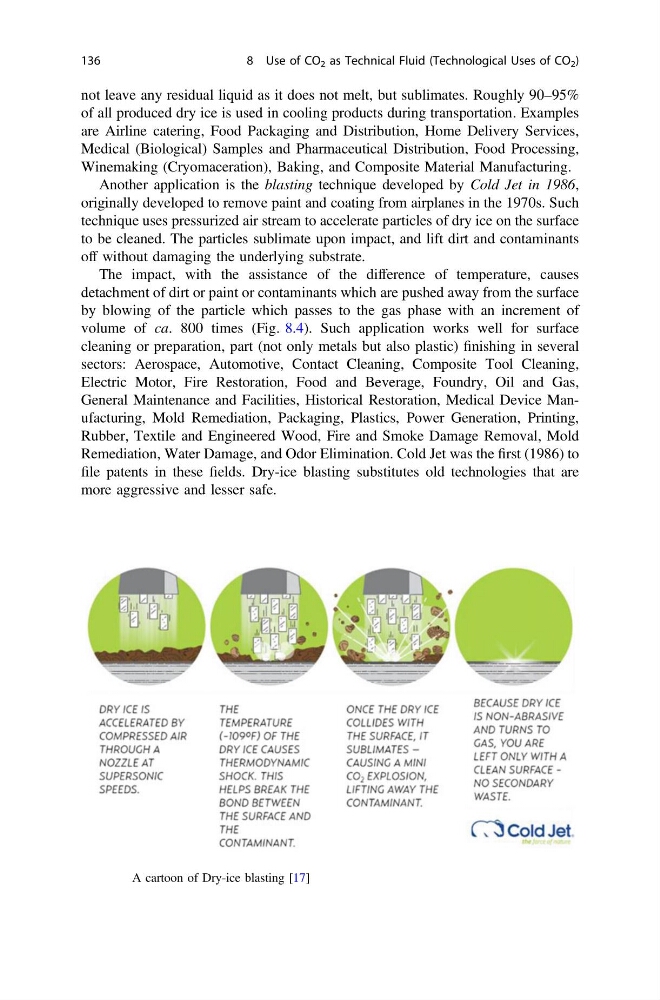
technique uses pressurized air stream to accelerate particles of dry ice on the surface
to be cleaned. The particles sublimate upon impact, and lift dirt and contaminants
off without damaging the underlying substrate.
The impact, with the assistance of the difference of temperature, causes
detachment of dirt or paint or contaminants which are pushed away from the surface
by blowing of the particle which passes to the gas phase with an increment of
volume of ca. 800 times (Fig. 8.4). Such application works well for surface
cleaning or preparation, part (not only metals but also plastic) finishing in several
sectors: Aerospace, Automotive, Contact Cleaning, Composite Tool Cleaning,
Electric Motor, Fire Restoration, Food and Beverage, Foundry, Oil and Gas,
General Maintenance and Facilities, Historical Restoration, Medical Device Manufacturing, Mold Remediation, Packaging, Plastics, Power Generation, Printing,
Rubber, Textile and Engineered Wood, Fire and Smoke Damage Removal, Mold
Remediation, Water Damage, and Odor Elimination. Cold Jet was the first (1986) to
file patents in these fields. Dry-ice blasting substitutes old technologies that are
more aggressive and lesser safe.
Fig. 8.4 A cartoon of Dry-ice blasting [17]
136
8 Use of CO 2 as Technical Fluid (Technological Uses of CO 2 )
of all produced dry ice is used in cooling products during transportation. Examples
are Airline catering, Food Packaging and Distribution, Home Delivery Services,
Medical (Biological) Samples and Pharmaceutical Distribution, Food Processing,
Winemaking (Cryomaceration), Baking, and Composite Material Manufacturing.
Another application is the blasting technique developed by Cold Jet in 1986,
originally developed to remove paint and coating from airplanes in the 1970s. Such
technique uses pressurized air stream to accelerate particles of dry ice on the surface
to be cleaned. The particles sublimate upon impact, and lift dirt and contaminants
off without damaging the underlying substrate.
The impact, with the assistance of the difference of temperature, causes
detachment of dirt or paint or contaminants which are pushed away from the surface
by blowing of the particle which passes to the gas phase with an increment of
volume of ca. 800 times (Fig. 8.4). Such application works well for surface
cleaning or preparation, part (not only metals but also plastic) finishing in several
sectors: Aerospace, Automotive, Contact Cleaning, Composite Tool Cleaning,
Electric Motor, Fire Restoration, Food and Beverage, Foundry, Oil and Gas,
General Maintenance and Facilities, Historical Restoration, Medical Device Manufacturing, Mold Remediation, Packaging, Plastics, Power Generation, Printing,
Rubber, Textile and Engineered Wood, Fire and Smoke Damage Removal, Mold
Remediation, Water Damage, and Odor Elimination. Cold Jet was the first (1986) to
file patents in these fields. Dry-ice blasting substitutes old technologies that are
more aggressive and lesser safe.
Fig. 8.4 A cartoon of Dry-ice blasting [17]
136
8 Use of CO 2 as Technical Fluid (Technological Uses of CO 2 )