

Algae appear to be a very promising source of fine chemicals and in some cases
pharmaceuticals. To size the amount of CO 2 used in such application is not an easy
task because a variety of gas streams are used, even flue gas from power plants.
Another interesting application of carbon dioxide is its addition to irrigation
water to enhance the absorption of nutrients by plants. Such beneficial effect is due
to the fact that, even CO 2 has itself weak nutrient properties, being it an acid may
mobilize some specific nutrient elements in soil that are adsorbed by roots of plants
and facilitate their growth.
8.3.11 Dry Ice
Dry ice is the common name for solid CO 2 . It is produced by injecting L-CO 2 into
pelletizers where it converts in almost equal amounts of gaseous CO 2 and CO 2 -
snow, which is compressed in a cylinder and extruded or pressed at high pressure,
resulting in the manufacture of various types of dry ice. Pellets and nuggets are
formed when the snow is extruded through die plates, which can be interchanged to
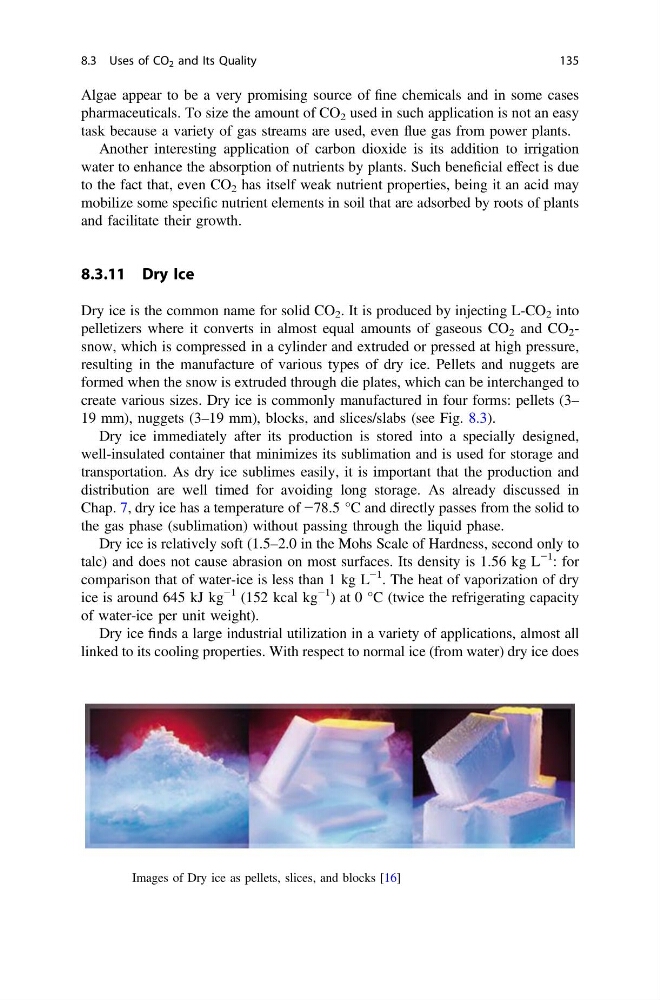
create various sizes. Dry ice is commonly manufactured in four forms: pellets (3–
19 mm), nuggets (3–19 mm), blocks, and slices/slabs (see Fig. 8.3).
Dry ice immediately after its production is stored into a specially designed,
well-insulated container that minimizes its sublimation and is used for storage and
transportation. As dry ice sublimes easily, it is important that the production and
distribution are well timed for avoiding long storage. As already discussed in
Chap. 7, dry ice has a temperature of −78.5 °C and directly passes from the solid to
the gas phase (sublimation) without passing through the liquid phase.
Dry ice is relatively soft (1.5–2.0 in the Mohs Scale of Hardness, second only to
talc) and does not cause abrasion on most surfaces. Its density is 1.56 kg L
−1 : for
comparison that of water-ice is less than 1 kg L
−1 . The heat of vaporization of dry
ice is around 645 kJ kg
−1 (152 kcal kg
−1 ) at 0 °C (twice the refrigerating capacity
of water-ice per unit weight).
Dry ice finds a large industrial utilization in a variety of applications, almost all
linked to its cooling properties. With respect to normal ice (from water) dry ice does
Fig. 8.3 Images of Dry ice as pellets, slices, and blocks [16]
8.3 Uses of CO 2 and Its Quality
135
pharmaceuticals. To size the amount of CO 2 used in such application is not an easy
task because a variety of gas streams are used, even flue gas from power plants.
Another interesting application of carbon dioxide is its addition to irrigation
water to enhance the absorption of nutrients by plants. Such beneficial effect is due
to the fact that, even CO 2 has itself weak nutrient properties, being it an acid may
mobilize some specific nutrient elements in soil that are adsorbed by roots of plants
and facilitate their growth.
8.3.11 Dry Ice
Dry ice is the common name for solid CO 2 . It is produced by injecting L-CO 2 into
pelletizers where it converts in almost equal amounts of gaseous CO 2 and CO 2 -
snow, which is compressed in a cylinder and extruded or pressed at high pressure,
resulting in the manufacture of various types of dry ice. Pellets and nuggets are
formed when the snow is extruded through die plates, which can be interchanged to
create various sizes. Dry ice is commonly manufactured in four forms: pellets (3–
19 mm), nuggets (3–19 mm), blocks, and slices/slabs (see Fig. 8.3).
Dry ice immediately after its production is stored into a specially designed,
well-insulated container that minimizes its sublimation and is used for storage and
transportation. As dry ice sublimes easily, it is important that the production and
distribution are well timed for avoiding long storage. As already discussed in
Chap. 7, dry ice has a temperature of −78.5 °C and directly passes from the solid to
the gas phase (sublimation) without passing through the liquid phase.
Dry ice is relatively soft (1.5–2.0 in the Mohs Scale of Hardness, second only to
talc) and does not cause abrasion on most surfaces. Its density is 1.56 kg L
−1 : for
comparison that of water-ice is less than 1 kg L
−1 . The heat of vaporization of dry
ice is around 645 kJ kg
−1 (152 kcal kg
−1 ) at 0 °C (twice the refrigerating capacity
of water-ice per unit weight).
Dry ice finds a large industrial utilization in a variety of applications, almost all
linked to its cooling properties. With respect to normal ice (from water) dry ice does
Fig. 8.3 Images of Dry ice as pellets, slices, and blocks [16]
8.3 Uses of CO 2 and Its Quality
135