

said “supercritical CO 2 , SC-CO 2 ” (above the critical parameters) that has interesting properties as solvent and, differently from the gaseous phase, can dissolve
liquids and solids affording a single-phase system (gases can dissolve only gases).
SC-CO 2 is a low-polarity fluid similar for certain aspects to hexane. It is worth to
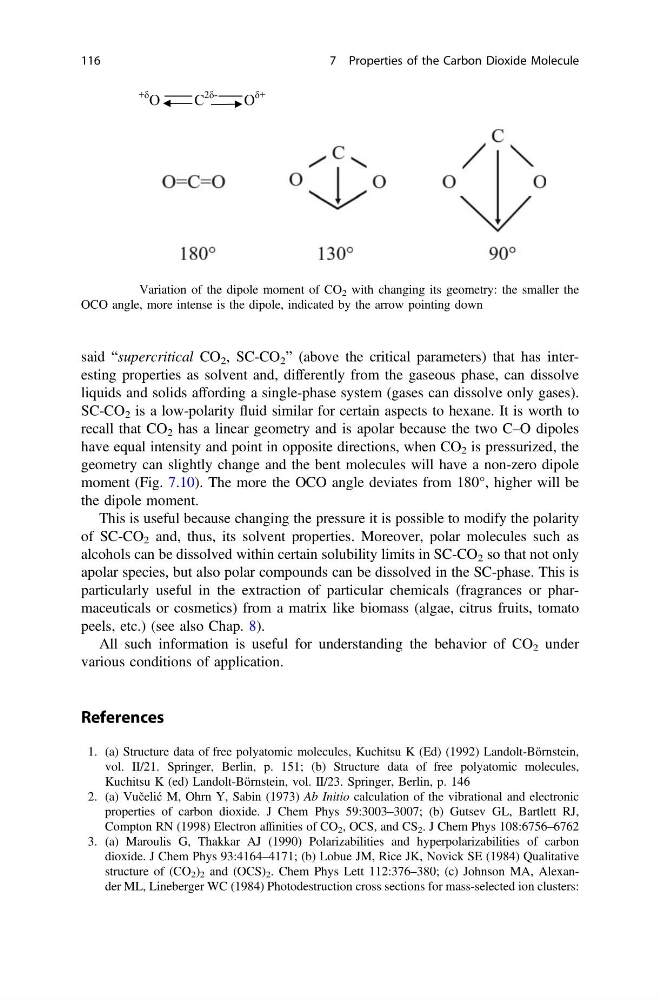
recall that CO 2 has a linear geometry and is apolar because the two C–O dipoles
have equal intensity and point in opposite directions, when CO 2 is pressurized, the
geometry can slightly change and the bent molecules will have a non-zero dipole
moment (Fig. 7.10). The more the OCO angle deviates from 180°, higher will be
the dipole moment.
This is useful because changing the pressure it is possible to modify the polarity
of SC-CO 2 and, thus, its solvent properties. Moreover, polar molecules such as
alcohols can be dissolved within certain solubility limits in SC-CO 2 so that not only
apolar species, but also polar compounds can be dissolved in the SC-phase. This is
particularly useful in the extraction of particular chemicals (fragrances or pharmaceuticals or cosmetics) from a matrix like biomass (algae, citrus fruits, tomato
peels, etc.) (see also Chap. 8).
All such information is useful for understanding the behavior of CO 2 under
various conditions of application.
References
1. (a) Structure data of free polyatomic molecules, Kuchitsu K (Ed) (1992) Landolt-Börnstein,
vol. II/21. Springer, Berlin, p. 151; (b) Structure data of free polyatomic molecules,
Kuchitsu K (ed) Landolt-Börnstein, vol. II/23. Springer, Berlin, p. 146
2. (a) Vučelić M, Ohrn Y, Sabin (1973) Ab Initio calculation of the vibrational and electronic
properties of carbon dioxide. J Chem Phys 59:3003–3007; (b) Gutsev GL, Bartlett RJ,
Compton RN (1998) Electron affinities of CO 2 , OCS, and CS 2 . J Chem Phys 108:6756–6762
3. (a) Maroulis G, Thakkar AJ (1990) Polarizabilities and hyperpolarizabilities of carbon
dioxide. J Chem Phys 93:4164–4171; (b) Lobue JM, Rice JK, Novick SE (1984) Qualitative
structure of (CO 2 ) 2 and (OCS) 2 . Chem Phys Lett 112:376–380; (c) Johnson MA, Alexander ML, Lineberger WC (1984) Photodestruction cross sections for mass-selected ion clusters:
+δ O
C
2δO
δ+
Fig. 7.10 Variation of the dipole moment of CO 2 with changing its geometry: the smaller the
OCO angle, more intense is the dipole, indicated by the arrow pointing down
116
7 Properties of the Carbon Dioxide Molecule
liquids and solids affording a single-phase system (gases can dissolve only gases).
SC-CO 2 is a low-polarity fluid similar for certain aspects to hexane. It is worth to
recall that CO 2 has a linear geometry and is apolar because the two C–O dipoles
have equal intensity and point in opposite directions, when CO 2 is pressurized, the
geometry can slightly change and the bent molecules will have a non-zero dipole
moment (Fig. 7.10). The more the OCO angle deviates from 180°, higher will be
the dipole moment.
This is useful because changing the pressure it is possible to modify the polarity
of SC-CO 2 and, thus, its solvent properties. Moreover, polar molecules such as
alcohols can be dissolved within certain solubility limits in SC-CO 2 so that not only
apolar species, but also polar compounds can be dissolved in the SC-phase. This is
particularly useful in the extraction of particular chemicals (fragrances or pharmaceuticals or cosmetics) from a matrix like biomass (algae, citrus fruits, tomato
peels, etc.) (see also Chap. 8).
All such information is useful for understanding the behavior of CO 2 under
various conditions of application.
References
1. (a) Structure data of free polyatomic molecules, Kuchitsu K (Ed) (1992) Landolt-Börnstein,
vol. II/21. Springer, Berlin, p. 151; (b) Structure data of free polyatomic molecules,
Kuchitsu K (ed) Landolt-Börnstein, vol. II/23. Springer, Berlin, p. 146
2. (a) Vučelić M, Ohrn Y, Sabin (1973) Ab Initio calculation of the vibrational and electronic
properties of carbon dioxide. J Chem Phys 59:3003–3007; (b) Gutsev GL, Bartlett RJ,
Compton RN (1998) Electron affinities of CO 2 , OCS, and CS 2 . J Chem Phys 108:6756–6762
3. (a) Maroulis G, Thakkar AJ (1990) Polarizabilities and hyperpolarizabilities of carbon
dioxide. J Chem Phys 93:4164–4171; (b) Lobue JM, Rice JK, Novick SE (1984) Qualitative
structure of (CO 2 ) 2 and (OCS) 2 . Chem Phys Lett 112:376–380; (c) Johnson MA, Alexander ML, Lineberger WC (1984) Photodestruction cross sections for mass-selected ion clusters:
+δ O
C
2δO
δ+
Fig. 7.10 Variation of the dipole moment of CO 2 with changing its geometry: the smaller the
OCO angle, more intense is the dipole, indicated by the arrow pointing down
116
7 Properties of the Carbon Dioxide Molecule