

2 CO
À
2 þ H 2 O ! HCO
À
3 þ HCO
À
2
ð7:3Þ
Under anhydrous conditions, it decays by a bimolecular process to afford CO
2À
3
and CO [20]. Interestingly, in a KCl matrix, oxalate dianion is observed as a minor
product.
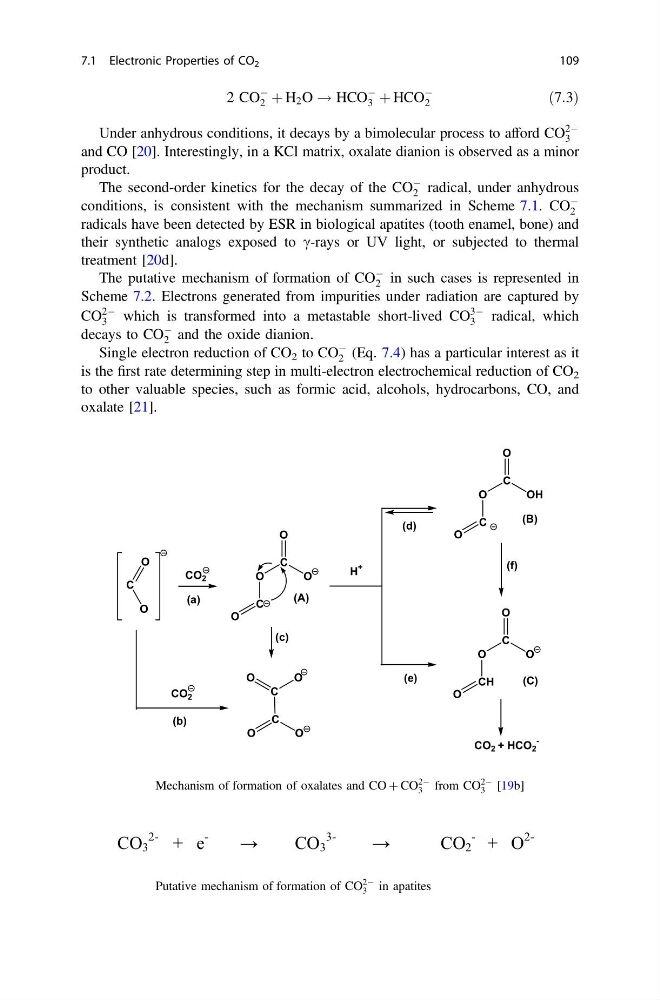
The second-order kinetics for the decay of the CO
À
2 radical, under anhydrous
conditions, is consistent with the mechanism summarized in Scheme 7.1. CO
À
2
radicals have been detected by ESR in biological apatites (tooth enamel, bone) and
their synthetic analogs exposed to c-rays or UV light, or subjected to thermal
treatment [20d].
The putative mechanism of formation of CO
À
2 in such cases is represented in
Scheme 7.2. Electrons generated from impurities under radiation are captured by
CO
2À
3
which is transformed into a metastable short-lived CO
3À
3
radical, which
decays to CO
À
2 and the oxide dianion.
Single electron reduction of CO 2 to CO
À
2 (Eq. 7.4) has a particular interest as it
is the first rate determining step in multi-electron electrochemical reduction of CO 2
to other valuable species, such as formic acid, alcohols, hydrocarbons, CO, and
oxalate [21].
C
O
O
CO 2
(a)
CO 2
(b)
C
O
O
O
C
O
C
O
O
C
O
O
(c)
(A)
H
+
(d)
(e)
C
O
O
O
CH
O
C
O
OH
O
C
O
CO 2 + HCO 2
-
(f)
(B)
(C)
Scheme 7.1 Mechanism of formation of oxalates and CO þ CO
2À
3 from CO
2À
3 [19b]
CO 3
2+ e
-
→
CO 3
3→
CO 2
-
+ O
2Scheme 7.2 Putative mechanism of formation of CO
2À
3 in apatites
7.1 Electronic Properties of CO 2
109
À
2 þ H 2 O ! HCO
À
3 þ HCO
À
2
ð7:3Þ
Under anhydrous conditions, it decays by a bimolecular process to afford CO
2À
3
and CO [20]. Interestingly, in a KCl matrix, oxalate dianion is observed as a minor
product.
The second-order kinetics for the decay of the CO
À
2 radical, under anhydrous
conditions, is consistent with the mechanism summarized in Scheme 7.1. CO
À
2
radicals have been detected by ESR in biological apatites (tooth enamel, bone) and
their synthetic analogs exposed to c-rays or UV light, or subjected to thermal
treatment [20d].
The putative mechanism of formation of CO
À
2 in such cases is represented in
Scheme 7.2. Electrons generated from impurities under radiation are captured by
CO
2À
3
which is transformed into a metastable short-lived CO
3À
3
radical, which
decays to CO
À
2 and the oxide dianion.
Single electron reduction of CO 2 to CO
À
2 (Eq. 7.4) has a particular interest as it
is the first rate determining step in multi-electron electrochemical reduction of CO 2
to other valuable species, such as formic acid, alcohols, hydrocarbons, CO, and
oxalate [21].
C
O
O
CO 2
(a)
CO 2
(b)
C
O
O
O
C
O
C
O
O
C
O
O
(c)
(A)
H
+
(d)
(e)
C
O
O
O
CH
O
C
O
OH
O
C
O
CO 2 + HCO 2
-
(f)
(B)
(C)
Scheme 7.1 Mechanism of formation of oxalates and CO þ CO
2À
3 from CO
2À
3 [19b]
CO 3
2+ e
-
→
CO 3
3→
CO 2
-
+ O
2Scheme 7.2 Putative mechanism of formation of CO
2À
3 in apatites
7.1 Electronic Properties of CO 2
109