

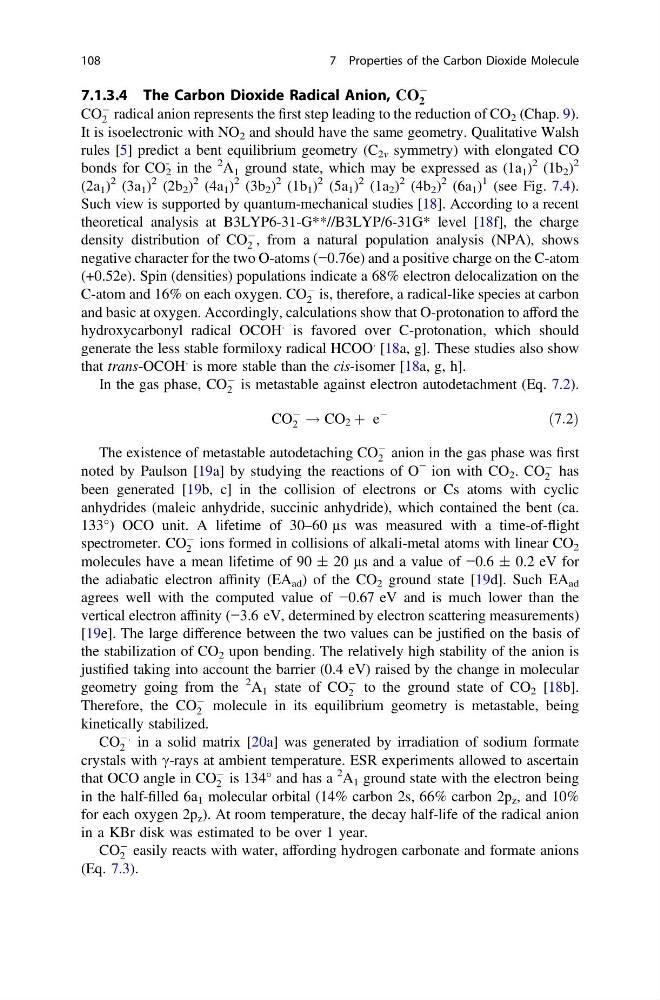
7.1.3.4 The Carbon Dioxide Radical Anion, CO
À
2
CO
À
2 radical anion represents the first step leading to the reduction of CO 2 (Chap. 9).
It is isoelectronic with NO 2 and should have the same geometry. Qualitative Walsh
rules [5] predict a bent equilibrium geometry (C 2v symmetry) with elongated CO
bonds for CO 2
- in the
2 A 1 ground state, which may be expressed as (1a 1 )
2 (1b 2 )
2
(2a 1 )
2 (3a 1 )
2 (2b 2 )
2 (4a 1 )
2 (3b 2 )
2 (1b 1 )
2 (5a 1 )
2 (1a 2 )
2 (4b 2 )
2 (6a 1 )
1 (see Fig. 7.4).
Such view is supported by quantum-mechanical studies [18]. According to a recent
theoretical analysis at B3LYP6-31-G**//B3LYP/6-31G* level [18f], the charge
density distribution of CO
À
2 , from a natural population analysis (NPA), shows
negative character for the two O-atoms (−0.76e) and a positive charge on the C-atom
(+0.52e). Spin (densities) populations indicate a 68% electron delocalization on the
C-atom and 16% on each oxygen. CO
À
2 is, therefore, a radical-like species at carbon
and basic at oxygen. Accordingly, calculations show that O-protonation to afford the
hydroxycarbonyl radical OCOH
. is favored over C-protonation, which should
generate the less stable formiloxy radical HCOO
. [18a, g]. These studies also show
that trans-OCOH
. is more stable than the cis-isomer [18a, g, h].
In the gas phase, CO
À
2 is metastable against electron autodetachment (Eq. 7.2).
CO
À
2 ! CO 2 þ e
À
ð7:2Þ
The existence of metastable autodetaching CO
À
2 anion in the gas phase was first
noted by Paulson [19a] by studying the reactions of O
− ion with CO 2 . CO
À
2 has
been generated [19b, c] in the collision of electrons or Cs atoms with cyclic
anhydrides (maleic anhydride, succinic anhydride), which contained the bent (ca.
133°) OCO unit. A lifetime of 30–60 µs was measured with a time-of-flight
spectrometer. CO
À
2 ions formed in collisions of alkali-metal atoms with linear CO 2
molecules have a mean lifetime of 90 ± 20 ls and a value of −0.6 ± 0.2 eV for
the adiabatic electron affinity (EA ad ) of the CO 2 ground state [19d]. Such EA ad
agrees well with the computed value of −0.67 eV and is much lower than the
vertical electron affinity (−3.6 eV, determined by electron scattering measurements)
[19e]. The large difference between the two values can be justified on the basis of
the stabilization of CO 2 upon bending. The relatively high stability of the anion is
justified taking into account the barrier (0.4 eV) raised by the change in molecular
geometry going from the
2 A 1 state of CO
À
2 to the ground state of CO 2 [18b].
Therefore, the CO
À
2 molecule in its equilibrium geometry is metastable, being
kinetically stabilized.
CO
À:
2 in a solid matrix [20a] was generated by irradiation of sodium formate
crystals with c-rays at ambient temperature. ESR experiments allowed to ascertain
that OCO angle in CO
À
2 is 134° and has a
2 A 1 ground state with the electron being
in the half-filled 6a 1 molecular orbital (14% carbon 2s, 66% carbon 2p z , and 10%
for each oxygen 2p z ). At room temperature, the decay half-life of the radical anion
in a KBr disk was estimated to be over 1 year.
CO
À
2 easily reacts with water, affording hydrogen carbonate and formate anions
(Eq. 7.3).
108
7 Properties of the Carbon Dioxide Molecule
À
2
CO
À
2 radical anion represents the first step leading to the reduction of CO 2 (Chap. 9).
It is isoelectronic with NO 2 and should have the same geometry. Qualitative Walsh
rules [5] predict a bent equilibrium geometry (C 2v symmetry) with elongated CO
bonds for CO 2
- in the
2 A 1 ground state, which may be expressed as (1a 1 )
2 (1b 2 )
2
(2a 1 )
2 (3a 1 )
2 (2b 2 )
2 (4a 1 )
2 (3b 2 )
2 (1b 1 )
2 (5a 1 )
2 (1a 2 )
2 (4b 2 )
2 (6a 1 )
1 (see Fig. 7.4).
Such view is supported by quantum-mechanical studies [18]. According to a recent
theoretical analysis at B3LYP6-31-G**//B3LYP/6-31G* level [18f], the charge
density distribution of CO
À
2 , from a natural population analysis (NPA), shows
negative character for the two O-atoms (−0.76e) and a positive charge on the C-atom
(+0.52e). Spin (densities) populations indicate a 68% electron delocalization on the
C-atom and 16% on each oxygen. CO
À
2 is, therefore, a radical-like species at carbon
and basic at oxygen. Accordingly, calculations show that O-protonation to afford the
hydroxycarbonyl radical OCOH
. is favored over C-protonation, which should
generate the less stable formiloxy radical HCOO
. [18a, g]. These studies also show
that trans-OCOH
. is more stable than the cis-isomer [18a, g, h].
In the gas phase, CO
À
2 is metastable against electron autodetachment (Eq. 7.2).
CO
À
2 ! CO 2 þ e
À
ð7:2Þ
The existence of metastable autodetaching CO
À
2 anion in the gas phase was first
noted by Paulson [19a] by studying the reactions of O
− ion with CO 2 . CO
À
2 has
been generated [19b, c] in the collision of electrons or Cs atoms with cyclic
anhydrides (maleic anhydride, succinic anhydride), which contained the bent (ca.
133°) OCO unit. A lifetime of 30–60 µs was measured with a time-of-flight
spectrometer. CO
À
2 ions formed in collisions of alkali-metal atoms with linear CO 2
molecules have a mean lifetime of 90 ± 20 ls and a value of −0.6 ± 0.2 eV for
the adiabatic electron affinity (EA ad ) of the CO 2 ground state [19d]. Such EA ad
agrees well with the computed value of −0.67 eV and is much lower than the
vertical electron affinity (−3.6 eV, determined by electron scattering measurements)
[19e]. The large difference between the two values can be justified on the basis of
the stabilization of CO 2 upon bending. The relatively high stability of the anion is
justified taking into account the barrier (0.4 eV) raised by the change in molecular
geometry going from the
2 A 1 state of CO
À
2 to the ground state of CO 2 [18b].
Therefore, the CO
À
2 molecule in its equilibrium geometry is metastable, being
kinetically stabilized.
CO
À:
2 in a solid matrix [20a] was generated by irradiation of sodium formate
crystals with c-rays at ambient temperature. ESR experiments allowed to ascertain
that OCO angle in CO
À
2 is 134° and has a
2 A 1 ground state with the electron being
in the half-filled 6a 1 molecular orbital (14% carbon 2s, 66% carbon 2p z , and 10%
for each oxygen 2p z ). At room temperature, the decay half-life of the radical anion
in a KBr disk was estimated to be over 1 year.
CO
À
2 easily reacts with water, affording hydrogen carbonate and formate anions
(Eq. 7.3).
108
7 Properties of the Carbon Dioxide Molecule