

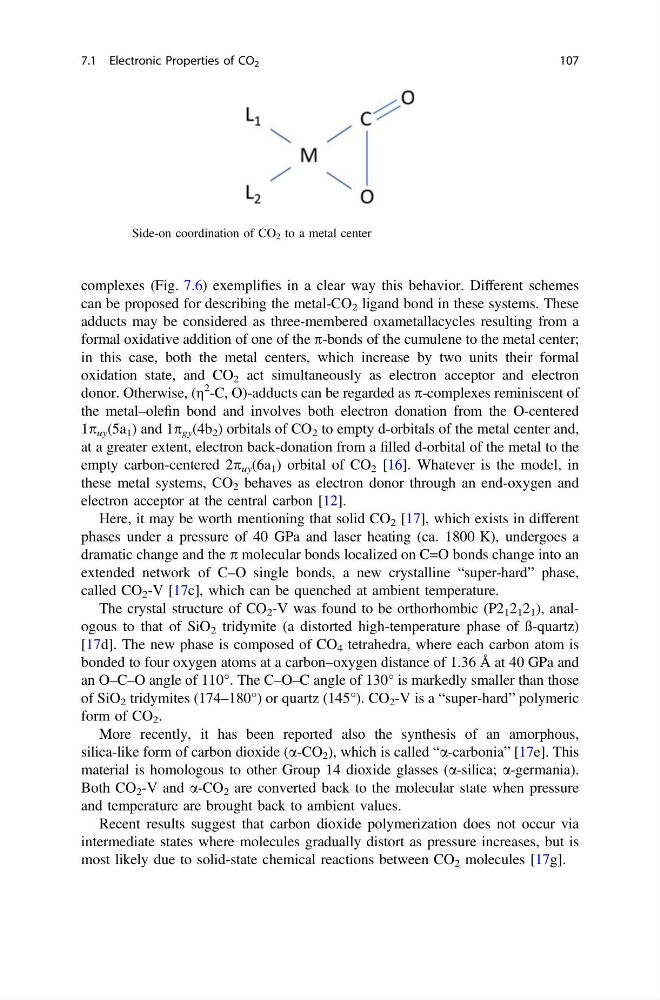
complexes (Fig. 7.6) exemplifies in a clear way this behavior. Different schemes
can be proposed for describing the metal-CO 2 ligand bond in these systems. These
adducts may be considered as three-membered oxametallacycles resulting from a
formal oxidative addition of one of the p-bonds of the cumulene to the metal center;
in this case, both the metal centers, which increase by two units their formal
oxidation state, and CO 2 act simultaneously as electron acceptor and electron
donor. Otherwise, (η
2 -C, O)-adducts can be regarded as p-complexes reminiscent of
the metal–olefin bond and involves both electron donation from the O-centered
1p uy (5a 1 ) and 1p gy (4b 2 ) orbitals of CO 2 to empty d-orbitals of the metal center and,
at a greater extent, electron back-donation from a filled d-orbital of the metal to the
empty carbon-centered 2p uy (6a 1 ) orbital of CO 2 [16]. Whatever is the model, in
these metal systems, CO 2 behaves as electron donor through an end-oxygen and
electron acceptor at the central carbon [12].
Here, it may be worth mentioning that solid CO 2 [17], which exists in different
phases under a pressure of 40 GPa and laser heating (ca. 1800 K), undergoes a
dramatic change and the p molecular bonds localized on C=O bonds change into an
extended network of C–O single bonds, a new crystalline “super-hard” phase,
called CO 2 -V [17c], which can be quenched at ambient temperature.
The crystal structure of CO 2 -V was found to be orthorhombic (P2 1 2 1 2 1 ), analogous to that of SiO 2 tridymite (a distorted high-temperature phase of ß-quartz)
[17d]. The new phase is composed of CO 4 tetrahedra, where each carbon atom is
bonded to four oxygen atoms at a carbon–oxygen distance of 1.36 Å at 40 GPa and
an O–C–O angle of 110°. The C–O–C angle of 130° is markedly smaller than those
of SiO 2 tridymites (174–180°) or quartz (145°). CO 2 -V is a “super-hard” polymeric
form of CO 2 .
More recently, it has been reported also the synthesis of an amorphous,
silica-like form of carbon dioxide (a-CO 2 ), which is called “a-carbonia” [17e]. This
material is homologous to other Group 14 dioxide glasses (a-silica; a-germania).
Both CO 2 -V and a-CO 2 are converted back to the molecular state when pressure
and temperature are brought back to ambient values.
Recent results suggest that carbon dioxide polymerization does not occur via
intermediate states where molecules gradually distort as pressure increases, but is
most likely due to solid-state chemical reactions between CO 2 molecules [17g].
Fig. 7.6 Side-on coordination of CO 2 to a metal center
7.1 Electronic Properties of CO 2
107
can be proposed for describing the metal-CO 2 ligand bond in these systems. These
adducts may be considered as three-membered oxametallacycles resulting from a
formal oxidative addition of one of the p-bonds of the cumulene to the metal center;
in this case, both the metal centers, which increase by two units their formal
oxidation state, and CO 2 act simultaneously as electron acceptor and electron
donor. Otherwise, (η
2 -C, O)-adducts can be regarded as p-complexes reminiscent of
the metal–olefin bond and involves both electron donation from the O-centered
1p uy (5a 1 ) and 1p gy (4b 2 ) orbitals of CO 2 to empty d-orbitals of the metal center and,
at a greater extent, electron back-donation from a filled d-orbital of the metal to the
empty carbon-centered 2p uy (6a 1 ) orbital of CO 2 [16]. Whatever is the model, in
these metal systems, CO 2 behaves as electron donor through an end-oxygen and
electron acceptor at the central carbon [12].
Here, it may be worth mentioning that solid CO 2 [17], which exists in different
phases under a pressure of 40 GPa and laser heating (ca. 1800 K), undergoes a
dramatic change and the p molecular bonds localized on C=O bonds change into an
extended network of C–O single bonds, a new crystalline “super-hard” phase,
called CO 2 -V [17c], which can be quenched at ambient temperature.
The crystal structure of CO 2 -V was found to be orthorhombic (P2 1 2 1 2 1 ), analogous to that of SiO 2 tridymite (a distorted high-temperature phase of ß-quartz)
[17d]. The new phase is composed of CO 4 tetrahedra, where each carbon atom is
bonded to four oxygen atoms at a carbon–oxygen distance of 1.36 Å at 40 GPa and
an O–C–O angle of 110°. The C–O–C angle of 130° is markedly smaller than those
of SiO 2 tridymites (174–180°) or quartz (145°). CO 2 -V is a “super-hard” polymeric
form of CO 2 .
More recently, it has been reported also the synthesis of an amorphous,
silica-like form of carbon dioxide (a-CO 2 ), which is called “a-carbonia” [17e]. This
material is homologous to other Group 14 dioxide glasses (a-silica; a-germania).
Both CO 2 -V and a-CO 2 are converted back to the molecular state when pressure
and temperature are brought back to ambient values.
Recent results suggest that carbon dioxide polymerization does not occur via
intermediate states where molecules gradually distort as pressure increases, but is
most likely due to solid-state chemical reactions between CO 2 molecules [17g].
Fig. 7.6 Side-on coordination of CO 2 to a metal center
7.1 Electronic Properties of CO 2
107