

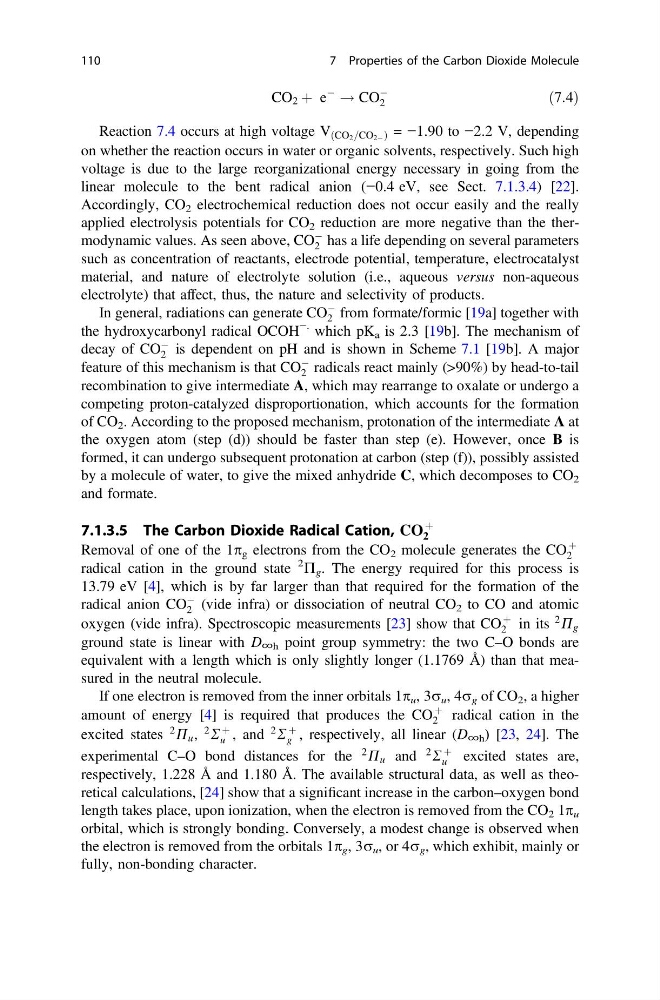
CO 2 þ e
À
! CO
À
2
ð7:4Þ
Reaction 7.4 occurs at high voltage V ðCO 2 =CO 2À Þ = −1.90 to −2.2 V, depending
on whether the reaction occurs in water or organic solvents, respectively. Such high
voltage is due to the large reorganizational energy necessary in going from the
linear molecule to the bent radical anion (−0.4 eV, see Sect. 7.1.3.4) [22].
Accordingly, CO 2 electrochemical reduction does not occur easily and the really
applied electrolysis potentials for CO 2 reduction are more negative than the thermodynamic values. As seen above, CO
À
2 has a life depending on several parameters
such as concentration of reactants, electrode potential, temperature, electrocatalyst
material, and nature of electrolyte solution (i.e., aqueous versus non-aqueous
electrolyte) that affect, thus, the nature and selectivity of products.
In general, radiations can generate CO
À
2 from formate/formic [19a] together with
the hydroxycarbonyl radical OCOH
−. which pK a is 2.3 [19b]. The mechanism of
decay of CO
À
2 is dependent on pH and is shown in Scheme 7.1 [19b]. A major
feature of this mechanism is that CO
À
2 radicals react mainly (>90%) by head-to-tail
recombination to give intermediate A, which may rearrange to oxalate or undergo a
competing proton-catalyzed disproportionation, which accounts for the formation
of CO 2 . According to the proposed mechanism, protonation of the intermediate A at
the oxygen atom (step (d)) should be faster than step (e). However, once B is
formed, it can undergo subsequent protonation at carbon (step (f)), possibly assisted
by a molecule of water, to give the mixed anhydride C, which decomposes to CO 2
and formate.
7.1.3.5 The Carbon Dioxide Radical Cation, CO
þ
2
Removal of one of the 1p g electrons from the CO 2 molecule generates the CO
þ
2
radical cation in the ground state
2
P g . The energy required for this process is
13.79 eV [4], which is by far larger than that required for the formation of the
radical anion CO
À
2 (vide infra) or dissociation of neutral CO 2 to CO and atomic
oxygen (vide infra). Spectroscopic measurements [23] show that CO
þ
2 in its
2
P g
ground state is linear with D ∞h point group symmetry: the two C–O bonds are
equivalent with a length which is only slightly longer (1.1769 Å) than that measured in the neutral molecule.
If one electron is removed from the inner orbitals 1p u , 3r u , 4r g of CO 2 , a higher
amount of energy [4] is required that produces the CO
þ
2 radical cation in the
excited states
2
P u ,
2
R
þ
u , and
2
R
þ
g , respectively, all linear (D ∞h ) [23, 24]. The
experimental C–O bond distances for the
2
P u and
2
R
þ
u
excited states are,
respectively, 1.228 Å and 1.180 Å. The available structural data, as well as theoretical calculations, [24] show that a significant increase in the carbon–oxygen bond
length takes place, upon ionization, when the electron is removed from the CO 2 1p u
orbital, which is strongly bonding. Conversely, a modest change is observed when
the electron is removed from the orbitals 1p g , 3r u , or 4r g , which exhibit, mainly or
fully, non-bonding character.
110
7 Properties of the Carbon Dioxide Molecule
À
! CO
À
2
ð7:4Þ
Reaction 7.4 occurs at high voltage V ðCO 2 =CO 2À Þ = −1.90 to −2.2 V, depending
on whether the reaction occurs in water or organic solvents, respectively. Such high
voltage is due to the large reorganizational energy necessary in going from the
linear molecule to the bent radical anion (−0.4 eV, see Sect. 7.1.3.4) [22].
Accordingly, CO 2 electrochemical reduction does not occur easily and the really
applied electrolysis potentials for CO 2 reduction are more negative than the thermodynamic values. As seen above, CO
À
2 has a life depending on several parameters
such as concentration of reactants, electrode potential, temperature, electrocatalyst
material, and nature of electrolyte solution (i.e., aqueous versus non-aqueous
electrolyte) that affect, thus, the nature and selectivity of products.
In general, radiations can generate CO
À
2 from formate/formic [19a] together with
the hydroxycarbonyl radical OCOH
−. which pK a is 2.3 [19b]. The mechanism of
decay of CO
À
2 is dependent on pH and is shown in Scheme 7.1 [19b]. A major
feature of this mechanism is that CO
À
2 radicals react mainly (>90%) by head-to-tail
recombination to give intermediate A, which may rearrange to oxalate or undergo a
competing proton-catalyzed disproportionation, which accounts for the formation
of CO 2 . According to the proposed mechanism, protonation of the intermediate A at
the oxygen atom (step (d)) should be faster than step (e). However, once B is
formed, it can undergo subsequent protonation at carbon (step (f)), possibly assisted
by a molecule of water, to give the mixed anhydride C, which decomposes to CO 2
and formate.
7.1.3.5 The Carbon Dioxide Radical Cation, CO
þ
2
Removal of one of the 1p g electrons from the CO 2 molecule generates the CO
þ
2
radical cation in the ground state
2
P g . The energy required for this process is
13.79 eV [4], which is by far larger than that required for the formation of the
radical anion CO
À
2 (vide infra) or dissociation of neutral CO 2 to CO and atomic
oxygen (vide infra). Spectroscopic measurements [23] show that CO
þ
2 in its
2
P g
ground state is linear with D ∞h point group symmetry: the two C–O bonds are
equivalent with a length which is only slightly longer (1.1769 Å) than that measured in the neutral molecule.
If one electron is removed from the inner orbitals 1p u , 3r u , 4r g of CO 2 , a higher
amount of energy [4] is required that produces the CO
þ
2 radical cation in the
excited states
2
P u ,
2
R
þ
u , and
2
R
þ
g , respectively, all linear (D ∞h ) [23, 24]. The
experimental C–O bond distances for the
2
P u and
2
R
þ
u
excited states are,
respectively, 1.228 Å and 1.180 Å. The available structural data, as well as theoretical calculations, [24] show that a significant increase in the carbon–oxygen bond
length takes place, upon ionization, when the electron is removed from the CO 2 1p u
orbital, which is strongly bonding. Conversely, a modest change is observed when
the electron is removed from the orbitals 1p g , 3r u , or 4r g , which exhibit, mainly or
fully, non-bonding character.
110
7 Properties of the Carbon Dioxide Molecule