

the molecular axis. They do not involve the C-atom (nodal plane) and behave more
as “lone pairs” located on the O-atoms.
7.1.2 The Lowest Excited States of Carbon Dioxide
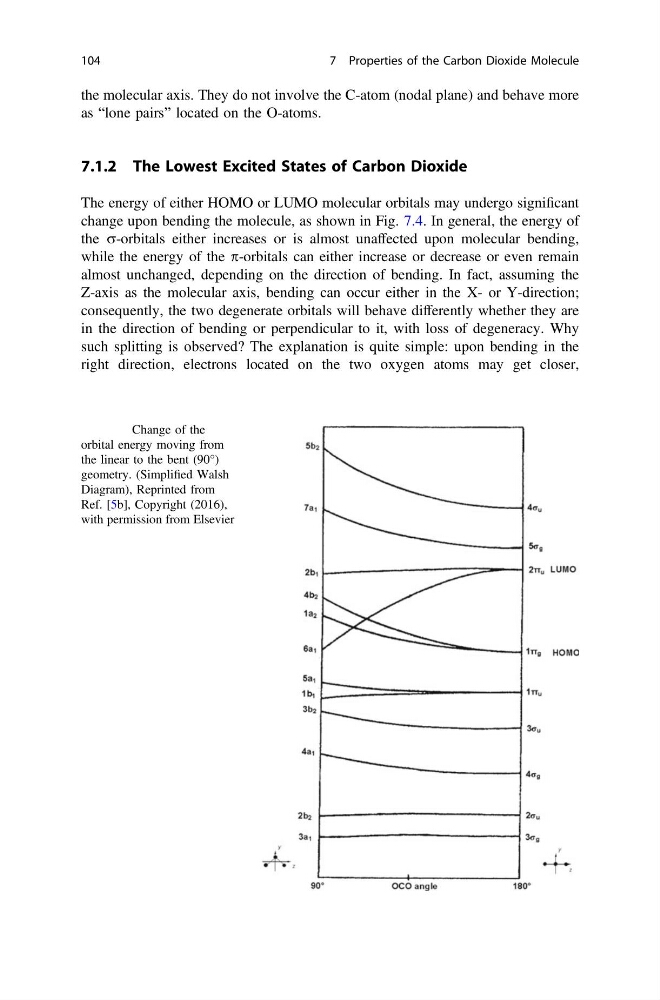
The energy of either HOMO or LUMO molecular orbitals may undergo significant
change upon bending the molecule, as shown in Fig. 7.4. In general, the energy of
the r-orbitals either increases or is almost unaffected upon molecular bending,
while the energy of the p-orbitals can either increase or decrease or even remain
almost unchanged, depending on the direction of bending. In fact, assuming the
Z-axis as the molecular axis, bending can occur either in the X- or Y-direction;
consequently, the two degenerate orbitals will behave differently whether they are
in the direction of bending or perpendicular to it, with loss of degeneracy. Why
such splitting is observed? The explanation is quite simple: upon bending in the
right direction, electrons located on the two oxygen atoms may get closer,
Fig. 7.4 Change of the
orbital energy moving from
the linear to the bent (90°)
geometry. (Simplified Walsh
Diagram), Reprinted from
Ref. [5b], Copyright (2016),
with permission from Elsevier
104
7 Properties of the Carbon Dioxide Molecule
as “lone pairs” located on the O-atoms.
7.1.2 The Lowest Excited States of Carbon Dioxide
The energy of either HOMO or LUMO molecular orbitals may undergo significant
change upon bending the molecule, as shown in Fig. 7.4. In general, the energy of
the r-orbitals either increases or is almost unaffected upon molecular bending,
while the energy of the p-orbitals can either increase or decrease or even remain
almost unchanged, depending on the direction of bending. In fact, assuming the
Z-axis as the molecular axis, bending can occur either in the X- or Y-direction;
consequently, the two degenerate orbitals will behave differently whether they are
in the direction of bending or perpendicular to it, with loss of degeneracy. Why
such splitting is observed? The explanation is quite simple: upon bending in the
right direction, electrons located on the two oxygen atoms may get closer,
Fig. 7.4 Change of the
orbital energy moving from
the linear to the bent (90°)
geometry. (Simplified Walsh
Diagram), Reprinted from
Ref. [5b], Copyright (2016),
with permission from Elsevier
104
7 Properties of the Carbon Dioxide Molecule