

increasing their repulsion and the energy of the orbitals. The linear geometry is the
one that minimizes electron repulsion and thus has the lower energy.
Figure 7.4 makes evident the peculiar character of the empty 2p u (6a 1 ) MO.
Upon bending its energy largely decreases. However, any electron transfer to such
orbital, whatever is the origin of the electron, will reduce the energy upon bending
of CO 2 . This is true when CO 2 is excited (internal e
− -transfer), when a single
electron is transferred to CO 2 to form the radical anion CO
À
2 , or when two electrons
are used in bonding CO 2 at the C-atom. The internal electron transfer corresponds
to the “excitation of CO 2 ”; in addition to bending, an elongation of the C–O bond
from original 116 pm to 124–126 pm is observed, while the angle moves from
original 180° to 122°–148°, according to the state.
7.1.3 Main Features of Carbon Dioxide Reactivity
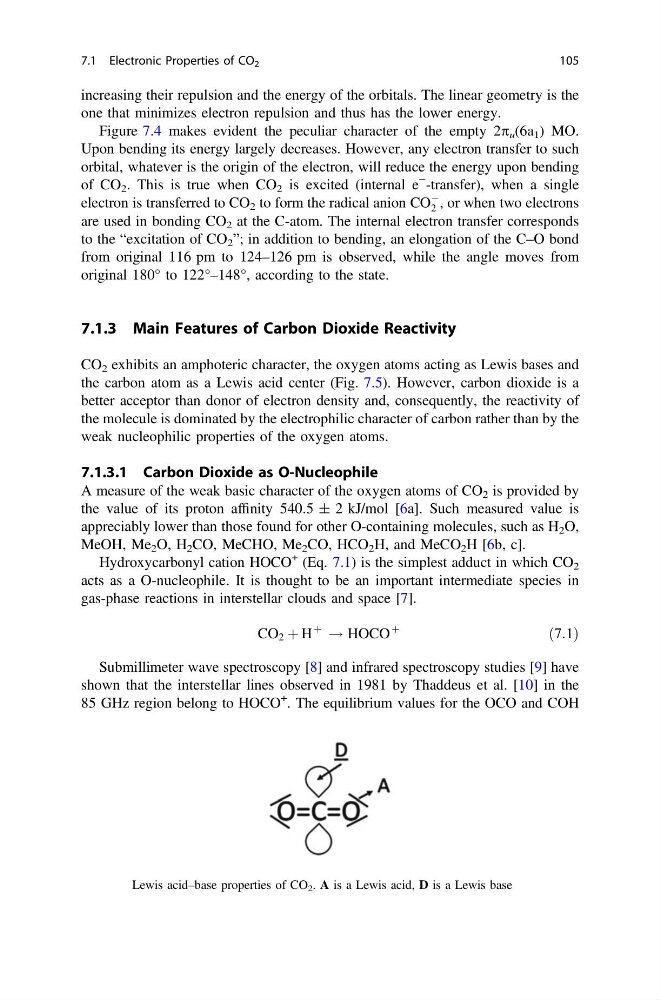
CO 2 exhibits an amphoteric character, the oxygen atoms acting as Lewis bases and
the carbon atom as a Lewis acid center (Fig. 7.5). However, carbon dioxide is a
better acceptor than donor of electron density and, consequently, the reactivity of
the molecule is dominated by the electrophilic character of carbon rather than by the
weak nucleophilic properties of the oxygen atoms.
7.1.3.1 Carbon Dioxide as O-Nucleophile
A measure of the weak basic character of the oxygen atoms of CO 2 is provided by
the value of its proton affinity 540.5 ± 2 kJ/mol [6a]. Such measured value is
appreciably lower than those found for other O-containing molecules, such as H 2 O,
MeOH, Me 2 O, H 2 CO, MeCHO, Me 2 CO, HCO 2 H, and MeCO 2 H [6b, c].
Hydroxycarbonyl cation HOCO
+ (Eq. 7.1) is the simplest adduct in which CO 2
acts as a O-nucleophile. It is thought to be an important intermediate species in
gas-phase reactions in interstellar clouds and space [7].
CO 2 þ H
þ
! HOCO
þ
ð7:1Þ
Submillimeter wave spectroscopy [8] and infrared spectroscopy studies [9] have
shown that the interstellar lines observed in 1981 by Thaddeus et al. [10] in the
85 GHz region belong to HOCO
+
. The equilibrium values for the OCO and COH
Fig. 7.5 Lewis acid–base properties of CO 2 . A is a Lewis acid, D is a Lewis base
7.1 Electronic Properties of CO 2
105
one that minimizes electron repulsion and thus has the lower energy.
Figure 7.4 makes evident the peculiar character of the empty 2p u (6a 1 ) MO.
Upon bending its energy largely decreases. However, any electron transfer to such
orbital, whatever is the origin of the electron, will reduce the energy upon bending
of CO 2 . This is true when CO 2 is excited (internal e
− -transfer), when a single
electron is transferred to CO 2 to form the radical anion CO
À
2 , or when two electrons
are used in bonding CO 2 at the C-atom. The internal electron transfer corresponds
to the “excitation of CO 2 ”; in addition to bending, an elongation of the C–O bond
from original 116 pm to 124–126 pm is observed, while the angle moves from
original 180° to 122°–148°, according to the state.
7.1.3 Main Features of Carbon Dioxide Reactivity
CO 2 exhibits an amphoteric character, the oxygen atoms acting as Lewis bases and
the carbon atom as a Lewis acid center (Fig. 7.5). However, carbon dioxide is a
better acceptor than donor of electron density and, consequently, the reactivity of
the molecule is dominated by the electrophilic character of carbon rather than by the
weak nucleophilic properties of the oxygen atoms.
7.1.3.1 Carbon Dioxide as O-Nucleophile
A measure of the weak basic character of the oxygen atoms of CO 2 is provided by
the value of its proton affinity 540.5 ± 2 kJ/mol [6a]. Such measured value is
appreciably lower than those found for other O-containing molecules, such as H 2 O,
MeOH, Me 2 O, H 2 CO, MeCHO, Me 2 CO, HCO 2 H, and MeCO 2 H [6b, c].
Hydroxycarbonyl cation HOCO
+ (Eq. 7.1) is the simplest adduct in which CO 2
acts as a O-nucleophile. It is thought to be an important intermediate species in
gas-phase reactions in interstellar clouds and space [7].
CO 2 þ H
þ
! HOCO
þ
ð7:1Þ
Submillimeter wave spectroscopy [8] and infrared spectroscopy studies [9] have
shown that the interstellar lines observed in 1981 by Thaddeus et al. [10] in the
85 GHz region belong to HOCO
+
. The equilibrium values for the OCO and COH
Fig. 7.5 Lewis acid–base properties of CO 2 . A is a Lewis acid, D is a Lewis base
7.1 Electronic Properties of CO 2
105