

three doubly degenerate (having the same energy) p-orbitals denoted as 1p u , 1p g ,
and 2p u .
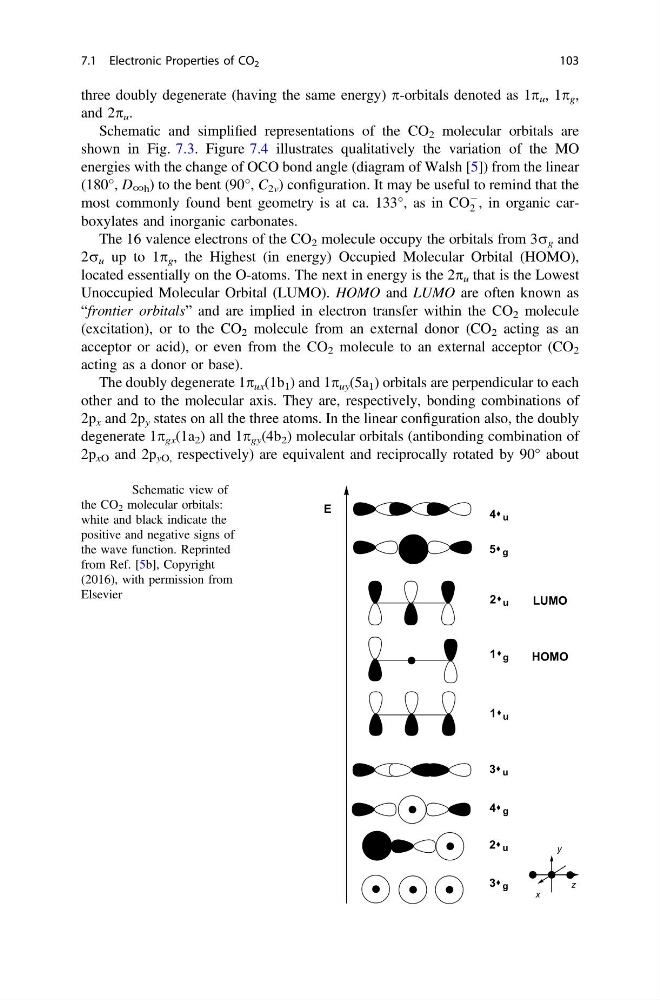
Schematic and simplified representations of the CO 2 molecular orbitals are
shown in Fig. 7.3. Figure 7.4 illustrates qualitatively the variation of the MO
energies with the change of OCO bond angle (diagram of Walsh [5]) from the linear
(180°, D ∞h ) to the bent (90°, C 2v ) configuration. It may be useful to remind that the
most commonly found bent geometry is at ca. 133°, as in CO
À
2 , in organic carboxylates and inorganic carbonates.
The 16 valence electrons of the CO 2 molecule occupy the orbitals from 3r g and
2r u up to 1p g , the Highest (in energy) Occupied Molecular Orbital (HOMO),
located essentially on the O-atoms. The next in energy is the 2p u that is the Lowest
Unoccupied Molecular Orbital (LUMO). HOMO and LUMO are often known as
“frontier orbitals” and are implied in electron transfer within the CO 2 molecule
(excitation), or to the CO 2 molecule from an external donor (CO 2 acting as an
acceptor or acid), or even from the CO 2 molecule to an external acceptor (CO 2
acting as a donor or base).
The doubly degenerate 1p ux (1b 1 ) and 1p uy (5a 1 ) orbitals are perpendicular to each
other and to the molecular axis. They are, respectively, bonding combinations of
2p x and 2p y states on all the three atoms. In the linear configuration also, the doubly
degenerate 1p gx (1a 2 ) and 1p gy (4b 2 ) molecular orbitals (antibonding combination of
2p xO and 2p yO, respectively) are equivalent and reciprocally rotated by 90° about
HOMO
E
1 g
1 u
2 u
z
y
x
LUMO
Fig. 7.3 Schematic view of
the CO 2 molecular orbitals:
white and black indicate the
positive and negative signs of
the wave function. Reprinted
from Ref. [5b], Copyright
(2016), with permission from
Elsevier
7.1 Electronic Properties of CO 2
103
and 2p u .
Schematic and simplified representations of the CO 2 molecular orbitals are
shown in Fig. 7.3. Figure 7.4 illustrates qualitatively the variation of the MO
energies with the change of OCO bond angle (diagram of Walsh [5]) from the linear
(180°, D ∞h ) to the bent (90°, C 2v ) configuration. It may be useful to remind that the
most commonly found bent geometry is at ca. 133°, as in CO
À
2 , in organic carboxylates and inorganic carbonates.
The 16 valence electrons of the CO 2 molecule occupy the orbitals from 3r g and
2r u up to 1p g , the Highest (in energy) Occupied Molecular Orbital (HOMO),
located essentially on the O-atoms. The next in energy is the 2p u that is the Lowest
Unoccupied Molecular Orbital (LUMO). HOMO and LUMO are often known as
“frontier orbitals” and are implied in electron transfer within the CO 2 molecule
(excitation), or to the CO 2 molecule from an external donor (CO 2 acting as an
acceptor or acid), or even from the CO 2 molecule to an external acceptor (CO 2
acting as a donor or base).
The doubly degenerate 1p ux (1b 1 ) and 1p uy (5a 1 ) orbitals are perpendicular to each
other and to the molecular axis. They are, respectively, bonding combinations of
2p x and 2p y states on all the three atoms. In the linear configuration also, the doubly
degenerate 1p gx (1a 2 ) and 1p gy (4b 2 ) molecular orbitals (antibonding combination of
2p xO and 2p yO, respectively) are equivalent and reciprocally rotated by 90° about
HOMO
E
1 g
1 u
2 u
z
y
x
LUMO
Fig. 7.3 Schematic view of
the CO 2 molecular orbitals:
white and black indicate the
positive and negative signs of
the wave function. Reprinted
from Ref. [5b], Copyright
(2016), with permission from
Elsevier
7.1 Electronic Properties of CO 2
103