

Mg 3 Si 2 O 5 OH
ð Þ 4 þ 6HCl ! 3MgCl 2 þ 2SiO 2 þ 5H 2 O
ð6:20Þ
CO 2 þ 2NaOH ! Na 2 CO 3 þ H 2 O
ð6:21Þ
MgCl 2 þ Na 2 CO 3 ! MgCO 3 þ 2 NaCl
ð6:22Þ
As shown in Eqs. 6.20–6.22, the added chemicals HCl and NaOH are converted
into NaCl that cannot be recycled. SiO 2 formed in Eq. 6.20 can easily be filtered
off, and so MgCO 3 formed in Eq. 6.22. For keeping low the cost of the process and
the environmental impact, NaCl should be converted back into HCl and NaOH: this
is the energy demanding part of the process.
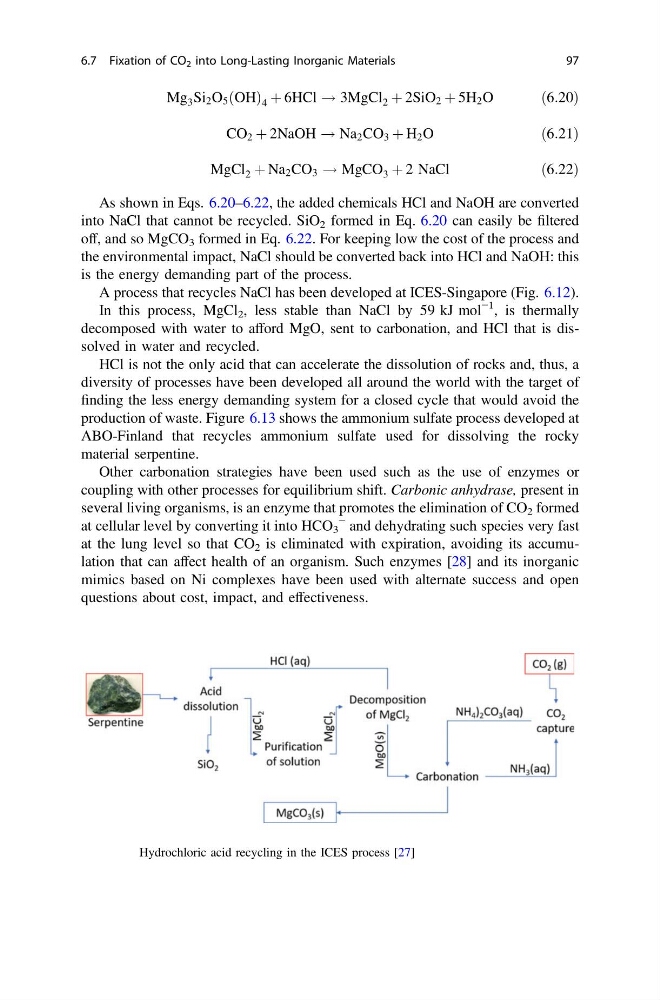
A process that recycles NaCl has been developed at ICES-Singapore (Fig. 6.12).
In this process, MgCl 2 , less stable than NaCl by 59 kJ mol
−1 , is thermally
decomposed with water to afford MgO, sent to carbonation, and HCl that is dissolved in water and recycled.
HCl is not the only acid that can accelerate the dissolution of rocks and, thus, a
diversity of processes have been developed all around the world with the target of
finding the less energy demanding system for a closed cycle that would avoid the
production of waste. Figure 6.13 shows the ammonium sulfate process developed at
ABO-Finland that recycles ammonium sulfate used for dissolving the rocky
material serpentine.
Other carbonation strategies have been used such as the use of enzymes or
coupling with other processes for equilibrium shift. Carbonic anhydrase, present in
several living organisms, is an enzyme that promotes the elimination of CO 2 formed
at cellular level by converting it into HCO 3
− and dehydrating such species very fast
at the lung level so that CO 2 is eliminated with expiration, avoiding its accumulation that can affect health of an organism. Such enzymes [28] and its inorganic
mimics based on Ni complexes have been used with alternate success and open
questions about cost, impact, and effectiveness.
Fig. 6.12 Hydrochloric acid recycling in the ICES process [27]
6.7 Fixation of CO 2 into Long-Lasting Inorganic Materials
97
ð Þ 4 þ 6HCl ! 3MgCl 2 þ 2SiO 2 þ 5H 2 O
ð6:20Þ
CO 2 þ 2NaOH ! Na 2 CO 3 þ H 2 O
ð6:21Þ
MgCl 2 þ Na 2 CO 3 ! MgCO 3 þ 2 NaCl
ð6:22Þ
As shown in Eqs. 6.20–6.22, the added chemicals HCl and NaOH are converted
into NaCl that cannot be recycled. SiO 2 formed in Eq. 6.20 can easily be filtered
off, and so MgCO 3 formed in Eq. 6.22. For keeping low the cost of the process and
the environmental impact, NaCl should be converted back into HCl and NaOH: this
is the energy demanding part of the process.
A process that recycles NaCl has been developed at ICES-Singapore (Fig. 6.12).
In this process, MgCl 2 , less stable than NaCl by 59 kJ mol
−1 , is thermally
decomposed with water to afford MgO, sent to carbonation, and HCl that is dissolved in water and recycled.
HCl is not the only acid that can accelerate the dissolution of rocks and, thus, a
diversity of processes have been developed all around the world with the target of
finding the less energy demanding system for a closed cycle that would avoid the
production of waste. Figure 6.13 shows the ammonium sulfate process developed at
ABO-Finland that recycles ammonium sulfate used for dissolving the rocky
material serpentine.
Other carbonation strategies have been used such as the use of enzymes or
coupling with other processes for equilibrium shift. Carbonic anhydrase, present in
several living organisms, is an enzyme that promotes the elimination of CO 2 formed
at cellular level by converting it into HCO 3
− and dehydrating such species very fast
at the lung level so that CO 2 is eliminated with expiration, avoiding its accumulation that can affect health of an organism. Such enzymes [28] and its inorganic
mimics based on Ni complexes have been used with alternate success and open
questions about cost, impact, and effectiveness.
Fig. 6.12 Hydrochloric acid recycling in the ICES process [27]
6.7 Fixation of CO 2 into Long-Lasting Inorganic Materials
97