

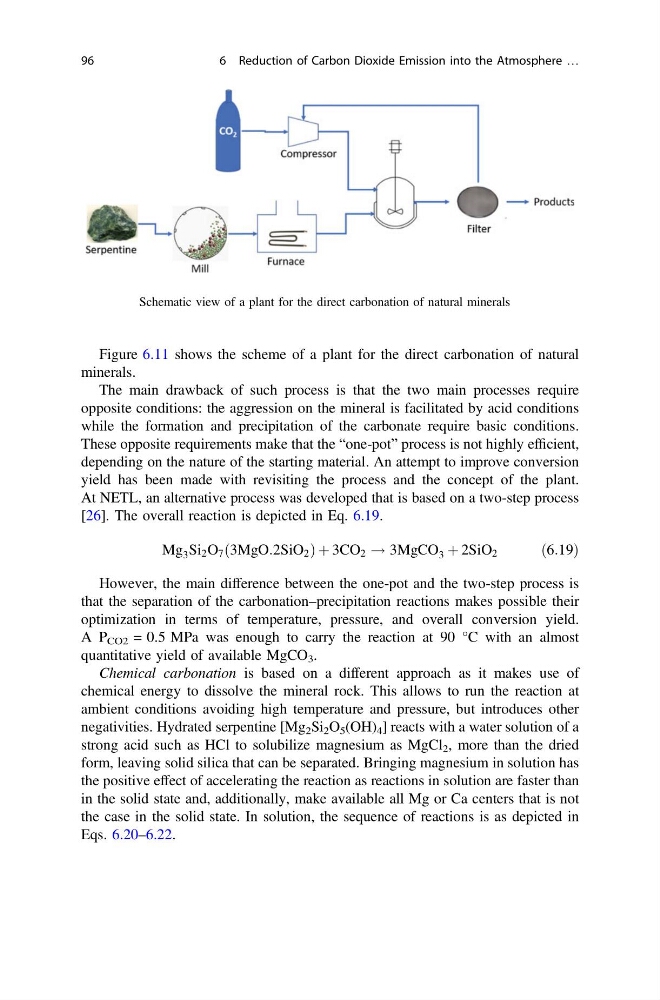
Figure 6.11 shows the scheme of a plant for the direct carbonation of natural
minerals.
The main drawback of such process is that the two main processes require
opposite conditions: the aggression on the mineral is facilitated by acid conditions
while the formation and precipitation of the carbonate require basic conditions.
These opposite requirements make that the “one-pot” process is not highly efficient,
depending on the nature of the starting material. An attempt to improve conversion
yield has been made with revisiting the process and the concept of the plant.
At NETL, an alternative process was developed that is based on a two-step process
[26]. The overall reaction is depicted in Eq. 6.19.
Mg 3 Si 2 O 7 3MgO:2SiO 2
ð
Þ þ 3CO 2 ! 3MgCO 3 þ 2SiO 2
ð6:19Þ
However, the main difference between the one-pot and the two-step process is
that the separation of the carbonation–precipitation reactions makes possible their
optimization in terms of temperature, pressure, and overall conversion yield.
A P CO2 = 0.5 MPa was enough to carry the reaction at 90 °C with an almost
quantitative yield of available MgCO 3 .
Chemical carbonation is based on a different approach as it makes use of
chemical energy to dissolve the mineral rock. This allows to run the reaction at
ambient conditions avoiding high temperature and pressure, but introduces other
negativities. Hydrated serpentine [Mg 2 Si 2 O 5 (OH) 4 ] reacts with a water solution of a
strong acid such as HCl to solubilize magnesium as MgCl 2 , more than the dried
form, leaving solid silica that can be separated. Bringing magnesium in solution has
the positive effect of accelerating the reaction as reactions in solution are faster than
in the solid state and, additionally, make available all Mg or Ca centers that is not
the case in the solid state. In solution, the sequence of reactions is as depicted in
Eqs. 6.20–6.22.
Fig. 6.11 Schematic view of a plant for the direct carbonation of natural minerals
96
6 Reduction of Carbon Dioxide Emission into the Atmosphere …
minerals.
The main drawback of such process is that the two main processes require
opposite conditions: the aggression on the mineral is facilitated by acid conditions
while the formation and precipitation of the carbonate require basic conditions.
These opposite requirements make that the “one-pot” process is not highly efficient,
depending on the nature of the starting material. An attempt to improve conversion
yield has been made with revisiting the process and the concept of the plant.
At NETL, an alternative process was developed that is based on a two-step process
[26]. The overall reaction is depicted in Eq. 6.19.
Mg 3 Si 2 O 7 3MgO:2SiO 2
ð
Þ þ 3CO 2 ! 3MgCO 3 þ 2SiO 2
ð6:19Þ
However, the main difference between the one-pot and the two-step process is
that the separation of the carbonation–precipitation reactions makes possible their
optimization in terms of temperature, pressure, and overall conversion yield.
A P CO2 = 0.5 MPa was enough to carry the reaction at 90 °C with an almost
quantitative yield of available MgCO 3 .
Chemical carbonation is based on a different approach as it makes use of
chemical energy to dissolve the mineral rock. This allows to run the reaction at
ambient conditions avoiding high temperature and pressure, but introduces other
negativities. Hydrated serpentine [Mg 2 Si 2 O 5 (OH) 4 ] reacts with a water solution of a
strong acid such as HCl to solubilize magnesium as MgCl 2 , more than the dried
form, leaving solid silica that can be separated. Bringing magnesium in solution has
the positive effect of accelerating the reaction as reactions in solution are faster than
in the solid state and, additionally, make available all Mg or Ca centers that is not
the case in the solid state. In solution, the sequence of reactions is as depicted in
Eqs. 6.20–6.22.
Fig. 6.11 Schematic view of a plant for the direct carbonation of natural minerals
96
6 Reduction of Carbon Dioxide Emission into the Atmosphere …