

19.7 Sheltering and Evacuation
243
• Medical needs
• Food and water
• Operational and logistical considerations
• Indoor radiation dose rate
• Likely radiation dose during evacuation
• Number of people to be evacuated
• Evacuation method, route, and starting location
• Specific response strategy.
In these various papers, the optimal sheltering time varied from a few hours to
several days with most recommending a sheltering time of about one day.
The radiation exposure received by those being evacuated depends on:
• External radiation dose rate
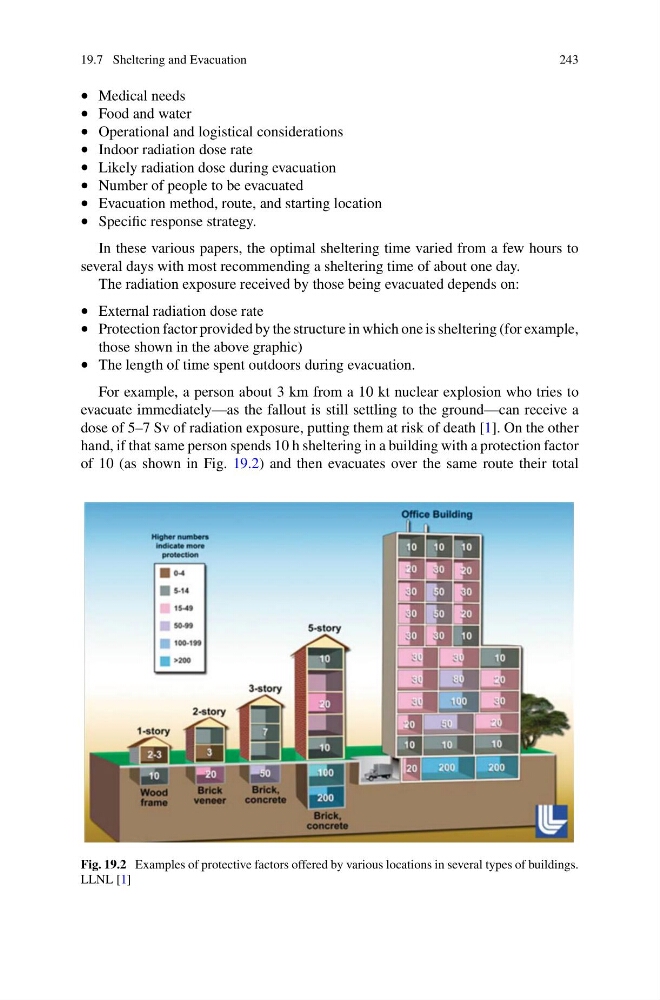
• Protection factor provided by the structure in which one is sheltering (for example,
those shown in the above graphic)
• The length of time spent outdoors during evacuation.
For example, a person about 3 km from a 10 kt nuclear explosion who tries to
evacuate immediately—as the fallout is still settling to the ground—can receive a
dose of 5–7 Sv of radiation exposure, putting them at risk of death [1]. On the other
hand, if that same person spends 10 h sheltering in a building with a protection factor
of 10 (as shown in Fig. 19.2) and then evacuates over the same route their total
Fig. 19.2 Examples of protective factors offered by various locations in several types of buildings.
LLNL [1]
243
• Medical needs
• Food and water
• Operational and logistical considerations
• Indoor radiation dose rate
• Likely radiation dose during evacuation
• Number of people to be evacuated
• Evacuation method, route, and starting location
• Specific response strategy.
In these various papers, the optimal sheltering time varied from a few hours to
several days with most recommending a sheltering time of about one day.
The radiation exposure received by those being evacuated depends on:
• External radiation dose rate
• Protection factor provided by the structure in which one is sheltering (for example,
those shown in the above graphic)
• The length of time spent outdoors during evacuation.
For example, a person about 3 km from a 10 kt nuclear explosion who tries to
evacuate immediately—as the fallout is still settling to the ground—can receive a
dose of 5–7 Sv of radiation exposure, putting them at risk of death [1]. On the other
hand, if that same person spends 10 h sheltering in a building with a protection factor
of 10 (as shown in Fig. 19.2) and then evacuates over the same route their total
Fig. 19.2 Examples of protective factors offered by various locations in several types of buildings.
LLNL [1]