

78
5 Quantum Key Distribution with Imperfect Devices
events are inconclusive and the corresponding bits get discarded. The parties also
discard the bits for which they used different bases. Bob flips all his remaining bits,
except for those generated in rounds where he selected the diagonal basis and the
pulses were projected on |ψ 01 .
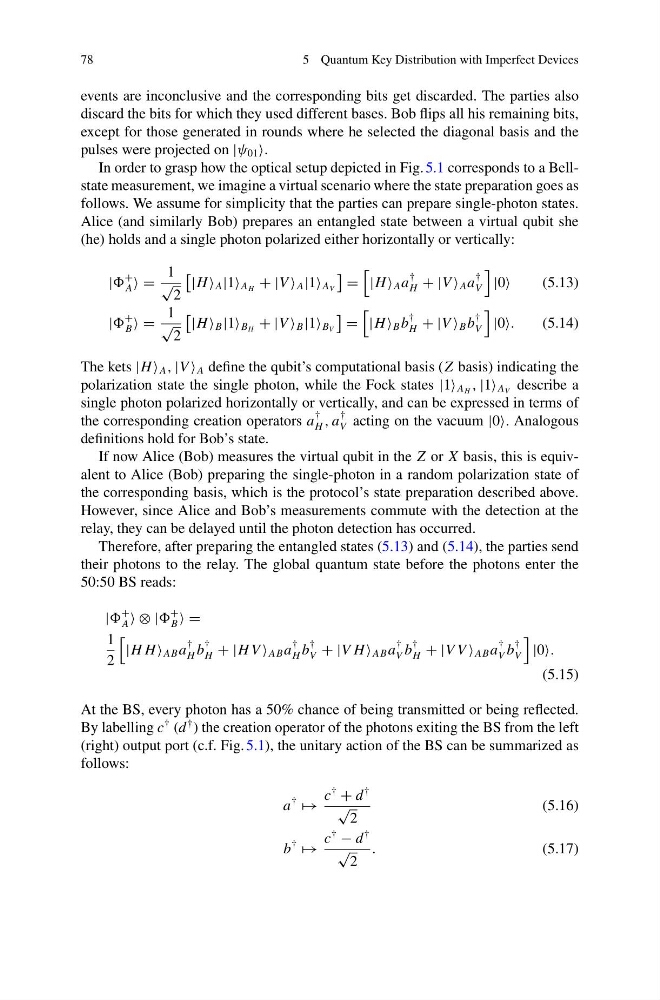
In order to grasp how the optical setup depicted in Fig. 5.1 corresponds to a Bellstate measurement, we imagine a virtual scenario where the state preparation goes as
follows. We assume for simplicity that the parties can prepare single-photon states.
Alice (and similarly Bob) prepares an entangled state between a virtual qubit she
(he) holds and a single photon polarized either horizontally or vertically:
|
+
A =
1
√
2
|H A |1 A H + |V A |1 A V
=
|H A a
†
H + |V A a
†
V
|0
(5.13)
|
+
B =
1
√
2
|H B |1 B H + |V B |1 B V
=
|H B b
†
H + |V B b
†
V
|0.
(5.14)
The kets |H A , |V A define the qubit’s computational basis (Z basis) indicating the
polarization state the single photon, while the Fock states |1 A H , |1 A V describe a
single photon polarized horizontally or vertically, and can be expressed in terms of
the corresponding creation operators a
†
H , a
†
V acting on the vacuum |0. Analogous
definitions hold for Bob’s state.
If now Alice (Bob) measures the virtual qubit in the Z or X basis, this is equivalent to Alice (Bob) preparing the single-photon in a random polarization state of
the corresponding basis, which is the protocol’s state preparation described above.
However, since Alice and Bob’s measurements commute with the detection at the
relay, they can be delayed until the photon detection has occurred.
Therefore, after preparing the entangled states (5.13) and (5.14), the parties send
their photons to the relay. The global quantum state before the photons enter the
50:50 BS reads:
|
+
A ⊗ |
+
B =
1
2
|H H AB a
†
H b
†
H + |H V AB a
†
H b
†
V + |V H AB a
†
V b
†
H + |V V AB a
†
V b
†
V
|0.
(5.15)
At the BS, every photon has a 50% chance of being transmitted or being reflected.
By labelling c
† (d
† ) the creation operator of the photons exiting the BS from the left
(right) output port (c.f. Fig. 5.1), the unitary action of the BS can be summarized as
follows:
a
†
→
c
†
+ d
†
√
2
(5.16)
b
†
→
c
†
− d
†
√
2
.
(5.17)
5 Quantum Key Distribution with Imperfect Devices
events are inconclusive and the corresponding bits get discarded. The parties also
discard the bits for which they used different bases. Bob flips all his remaining bits,
except for those generated in rounds where he selected the diagonal basis and the
pulses were projected on |ψ 01 .
In order to grasp how the optical setup depicted in Fig. 5.1 corresponds to a Bellstate measurement, we imagine a virtual scenario where the state preparation goes as
follows. We assume for simplicity that the parties can prepare single-photon states.
Alice (and similarly Bob) prepares an entangled state between a virtual qubit she
(he) holds and a single photon polarized either horizontally or vertically:
|
+
A =
1
√
2
|H A |1 A H + |V A |1 A V
=
|H A a
†
H + |V A a
†
V
|0
(5.13)
|
+
B =
1
√
2
|H B |1 B H + |V B |1 B V
=
|H B b
†
H + |V B b
†
V
|0.
(5.14)
The kets |H A , |V A define the qubit’s computational basis (Z basis) indicating the
polarization state the single photon, while the Fock states |1 A H , |1 A V describe a
single photon polarized horizontally or vertically, and can be expressed in terms of
the corresponding creation operators a
†
H , a
†
V acting on the vacuum |0. Analogous
definitions hold for Bob’s state.
If now Alice (Bob) measures the virtual qubit in the Z or X basis, this is equivalent to Alice (Bob) preparing the single-photon in a random polarization state of
the corresponding basis, which is the protocol’s state preparation described above.
However, since Alice and Bob’s measurements commute with the detection at the
relay, they can be delayed until the photon detection has occurred.
Therefore, after preparing the entangled states (5.13) and (5.14), the parties send
their photons to the relay. The global quantum state before the photons enter the
50:50 BS reads:
|
+
A ⊗ |
+
B =
1
2
|H H AB a
†
H b
†
H + |H V AB a
†
H b
†
V + |V H AB a
†
V b
†
H + |V V AB a
†
V b
†
V
|0.
(5.15)
At the BS, every photon has a 50% chance of being transmitted or being reflected.
By labelling c
† (d
† ) the creation operator of the photons exiting the BS from the left
(right) output port (c.f. Fig. 5.1), the unitary action of the BS can be summarized as
follows:
a
†
→
c
†
+ d
†
√
2
(5.16)
b
†
→
c
†
− d
†
√
2
.
(5.17)