

5.4 Practical Measurement-Device-Independent QKD
77
5.4 Practical Measurement-Device-Independent QKD
The first practical version of an MDI-QKD protocol was introduced by Lo and coworkers in [13] with a fully optical setup. The single-photon pulses are replaced by
phase-randomized WCPs in combination with the decoy-state method to guarantee
security, while the Bell-state measurement is implemented using linear optics. Unfortunately, with linear optics only two out of four Bell-state projectors can be realized.
This, however, does not undermine security as it only introduces some inconclusive
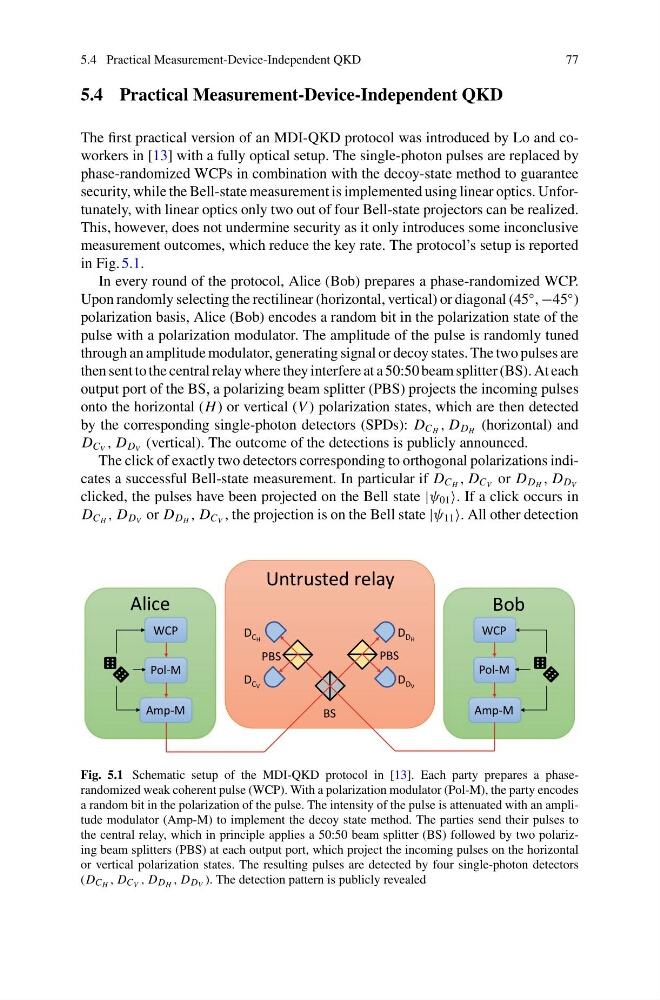
measurement outcomes, which reduce the key rate. The protocol’s setup is reported
in Fig. 5.1.
In every round of the protocol, Alice (Bob) prepares a phase-randomized WCP.
Upon randomly selecting the rectilinear (horizontal, vertical) or diagonal (45
◦ , −45
◦ )
polarization basis, Alice (Bob) encodes a random bit in the polarization state of the
pulse with a polarization modulator. The amplitude of the pulse is randomly tuned
through an amplitude modulator, generating signal or decoy states. The two pulses are
then sent to the central relay where they interfere at a 50:50 beam splitter (BS). At each
output port of the BS, a polarizing beam splitter (PBS) projects the incoming pulses
onto the horizontal (H ) or vertical (V ) polarization states, which are then detected
by the corresponding single-photon detectors (SPDs): D C H , D D H (horizontal) and
D C V , D D V (vertical). The outcome of the detections is publicly announced.
The click of exactly two detectors corresponding to orthogonal polarizations indicates a successful Bell-state measurement. In particular if D C H , D C V or D D H , D D V
clicked, the pulses have been projected on the Bell state |ψ 01 . If a click occurs in
D C H , D D V or D D H , D C V , the projection is on the Bell state |ψ 11 . All other detection
Alice
Untrusted relay
WCP
Pol-M
Amp-M
Bob
WCP
Pol-M
Amp-M
BS
PBS
D C H
D C V
D D H
D D V
PBS
Fig. 5.1 Schematic setup of the MDI-QKD protocol in [13]. Each party prepares a phaserandomized weak coherent pulse (WCP). With a polarization modulator (Pol-M), the party encodes
a random bit in the polarization of the pulse. The intensity of the pulse is attenuated with an amplitude modulator (Amp-M) to implement the decoy state method. The parties send their pulses to
the central relay, which in principle applies a 50:50 beam splitter (BS) followed by two polarizing beam splitters (PBS) at each output port, which project the incoming pulses on the horizontal
or vertical polarization states. The resulting pulses are detected by four single-photon detectors
(D C H , D C V , D D H , D D V ). The detection pattern is publicly revealed
77
5.4 Practical Measurement-Device-Independent QKD
The first practical version of an MDI-QKD protocol was introduced by Lo and coworkers in [13] with a fully optical setup. The single-photon pulses are replaced by
phase-randomized WCPs in combination with the decoy-state method to guarantee
security, while the Bell-state measurement is implemented using linear optics. Unfortunately, with linear optics only two out of four Bell-state projectors can be realized.
This, however, does not undermine security as it only introduces some inconclusive
measurement outcomes, which reduce the key rate. The protocol’s setup is reported
in Fig. 5.1.
In every round of the protocol, Alice (Bob) prepares a phase-randomized WCP.
Upon randomly selecting the rectilinear (horizontal, vertical) or diagonal (45
◦ , −45
◦ )
polarization basis, Alice (Bob) encodes a random bit in the polarization state of the
pulse with a polarization modulator. The amplitude of the pulse is randomly tuned
through an amplitude modulator, generating signal or decoy states. The two pulses are
then sent to the central relay where they interfere at a 50:50 beam splitter (BS). At each
output port of the BS, a polarizing beam splitter (PBS) projects the incoming pulses
onto the horizontal (H ) or vertical (V ) polarization states, which are then detected
by the corresponding single-photon detectors (SPDs): D C H , D D H (horizontal) and
D C V , D D V (vertical). The outcome of the detections is publicly announced.
The click of exactly two detectors corresponding to orthogonal polarizations indicates a successful Bell-state measurement. In particular if D C H , D C V or D D H , D D V
clicked, the pulses have been projected on the Bell state |ψ 01 . If a click occurs in
D C H , D D V or D D H , D C V , the projection is on the Bell state |ψ 11 . All other detection
Alice
Untrusted relay
WCP
Pol-M
Amp-M
Bob
WCP
Pol-M
Amp-M
BS
PBS
D C H
D C V
D D H
D D V
PBS
Fig. 5.1 Schematic setup of the MDI-QKD protocol in [13]. Each party prepares a phaserandomized weak coherent pulse (WCP). With a polarization modulator (Pol-M), the party encodes
a random bit in the polarization of the pulse. The intensity of the pulse is attenuated with an amplitude modulator (Amp-M) to implement the decoy state method. The parties send their pulses to
the central relay, which in principle applies a 50:50 beam splitter (BS) followed by two polarizing beam splitters (PBS) at each output port, which project the incoming pulses on the horizontal
or vertical polarization states. The resulting pulses are detected by four single-photon detectors
(D C H , D C V , D D H , D D V ). The detection pattern is publicly revealed