

5.4 Practical Measurement-Device-Independent QKD
79
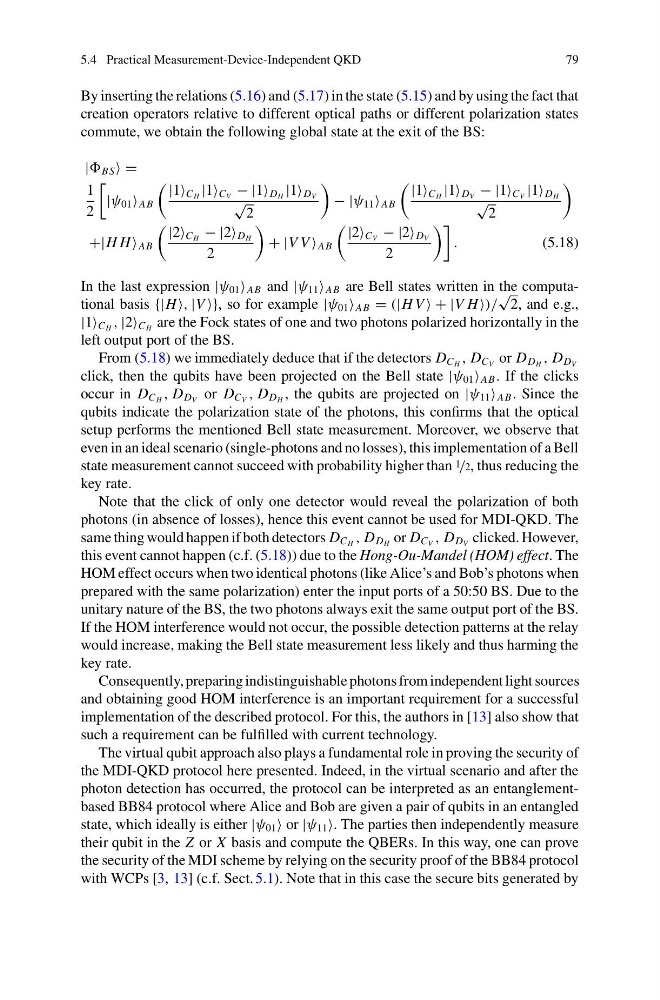
By inserting the relations (5.16) and (5.17) in the state (5.15) and by using the fact that
creation operators relative to different optical paths or different polarization states
commute, we obtain the following global state at the exit of the BS:
| BS =
1
2
|ψ 01 AB
|1 C H |1 C V − |1 D H |1 D V
√
2
− |ψ 11 AB
|1 C H |1 D V − |1 C V |1 D H
√
2
+|H H AB
|2 C H − |2 D H
2
+ |V V AB
|2 C V − |2 D V
2
.
(5.18)
In the last expression |ψ 01 AB and |ψ 11 AB are Bell states written in the computational basis {|H , |V }, so for example |ψ 01 AB = (|H V + |V H)/
√
2, and e.g.,
|1 C H , |2 C H are the Fock states of one and two photons polarized horizontally in the
left output port of the BS.
From (5.18) we immediately deduce that if the detectors D C H , D C V or D D H , D D V
click, then the qubits have been projected on the Bell state |ψ 01 AB . If the clicks
occur in D C H , D D V or D C V , D D H , the qubits are projected on |ψ 11 AB . Since the
qubits indicate the polarization state of the photons, this confirms that the optical
setup performs the mentioned Bell state measurement. Moreover, we observe that
even in an ideal scenario (single-photons and no losses), this implementation of a Bell
state measurement cannot succeed with probability higher than 1 /2, thus reducing the
key rate.
Note that the click of only one detector would reveal the polarization of both
photons (in absence of losses), hence this event cannot be used for MDI-QKD. The
same thing would happen if both detectors D C H , D D H or D C V , D D V clicked. However,
this event cannot happen (c.f. (5.18)) due to the Hong-Ou-Mandel (HOM) effect. The
HOM effect occurs when two identical photons (like Alice’s and Bob’s photons when
prepared with the same polarization) enter the input ports of a 50:50 BS. Due to the
unitary nature of the BS, the two photons always exit the same output port of the BS.
If the HOM interference would not occur, the possible detection patterns at the relay
would increase, making the Bell state measurement less likely and thus harming the
key rate.
Consequently, preparing indistinguishable photons from independent light sources
and obtaining good HOM interference is an important requirement for a successful
implementation of the described protocol. For this, the authors in [13] also show that
such a requirement can be fulfilled with current technology.
The virtual qubit approach also plays a fundamental role in proving the security of
the MDI-QKD protocol here presented. Indeed, in the virtual scenario and after the
photon detection has occurred, the protocol can be interpreted as an entanglementbased BB84 protocol where Alice and Bob are given a pair of qubits in an entangled
state, which ideally is either |ψ 01 or |ψ 11 . The parties then independently measure
their qubit in the Z or X basis and compute the QBERs. In this way, one can prove
the security of the MDI scheme by relying on the security proof of the BB84 protocol
with WCPs [3, 13] (c.f. Sect. 5.1). Note that in this case the secure bits generated by
79
By inserting the relations (5.16) and (5.17) in the state (5.15) and by using the fact that
creation operators relative to different optical paths or different polarization states
commute, we obtain the following global state at the exit of the BS:
| BS =
1
2
|ψ 01 AB
|1 C H |1 C V − |1 D H |1 D V
√
2
− |ψ 11 AB
|1 C H |1 D V − |1 C V |1 D H
√
2
+|H H AB
|2 C H − |2 D H
2
+ |V V AB
|2 C V − |2 D V
2
.
(5.18)
In the last expression |ψ 01 AB and |ψ 11 AB are Bell states written in the computational basis {|H , |V }, so for example |ψ 01 AB = (|H V + |V H)/
√
2, and e.g.,
|1 C H , |2 C H are the Fock states of one and two photons polarized horizontally in the
left output port of the BS.
From (5.18) we immediately deduce that if the detectors D C H , D C V or D D H , D D V
click, then the qubits have been projected on the Bell state |ψ 01 AB . If the clicks
occur in D C H , D D V or D C V , D D H , the qubits are projected on |ψ 11 AB . Since the
qubits indicate the polarization state of the photons, this confirms that the optical
setup performs the mentioned Bell state measurement. Moreover, we observe that
even in an ideal scenario (single-photons and no losses), this implementation of a Bell
state measurement cannot succeed with probability higher than 1 /2, thus reducing the
key rate.
Note that the click of only one detector would reveal the polarization of both
photons (in absence of losses), hence this event cannot be used for MDI-QKD. The
same thing would happen if both detectors D C H , D D H or D C V , D D V clicked. However,
this event cannot happen (c.f. (5.18)) due to the Hong-Ou-Mandel (HOM) effect. The
HOM effect occurs when two identical photons (like Alice’s and Bob’s photons when
prepared with the same polarization) enter the input ports of a 50:50 BS. Due to the
unitary nature of the BS, the two photons always exit the same output port of the BS.
If the HOM interference would not occur, the possible detection patterns at the relay
would increase, making the Bell state measurement less likely and thus harming the
key rate.
Consequently, preparing indistinguishable photons from independent light sources
and obtaining good HOM interference is an important requirement for a successful
implementation of the described protocol. For this, the authors in [13] also show that
such a requirement can be fulfilled with current technology.
The virtual qubit approach also plays a fundamental role in proving the security of
the MDI-QKD protocol here presented. Indeed, in the virtual scenario and after the
photon detection has occurred, the protocol can be interpreted as an entanglementbased BB84 protocol where Alice and Bob are given a pair of qubits in an entangled
state, which ideally is either |ψ 01 or |ψ 11 . The parties then independently measure
their qubit in the Z or X basis and compute the QBERs. In this way, one can prove
the security of the MDI scheme by relying on the security proof of the BB84 protocol
with WCPs [3, 13] (c.f. Sect. 5.1). Note that in this case the secure bits generated by