

92
6 Beyond Point-to-Point Quantum Key Distribution
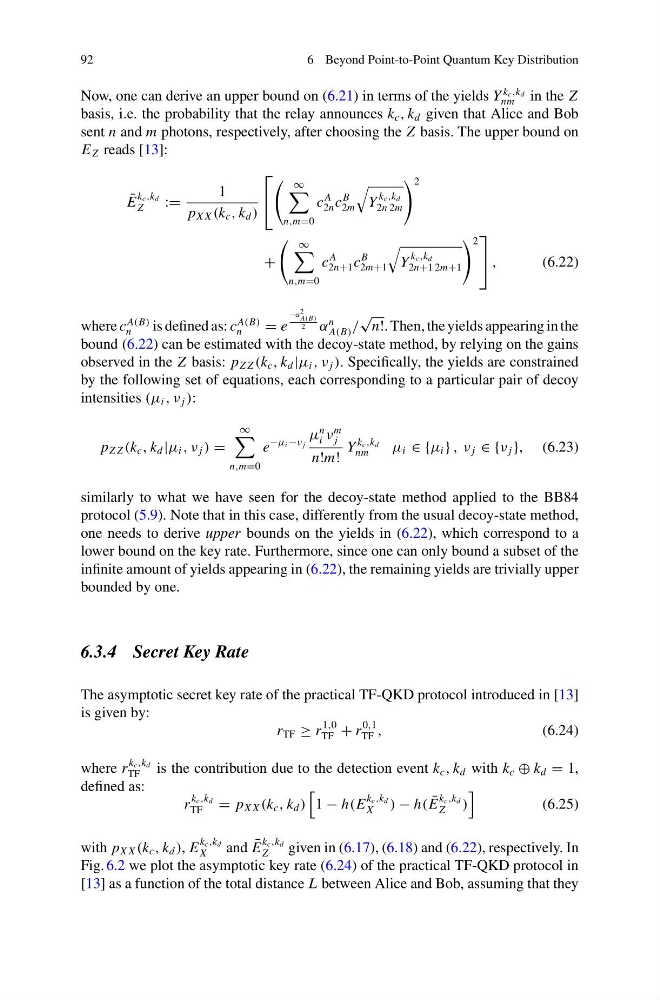
Now, one can derive an upper bound on (6.21) in terms of the yields Y
k c ,k d
nm
in the Z
basis, i.e. the probability that the relay announces k c , k d given that Alice and Bob
sent n and m photons, respectively, after choosing the Z basis. The upper bound on
E Z reads [13]:
¯
E
k c ,k d
Z
:=
1
p X X (k c , k d )
⎡
⎣
∞
n,m=0
c
A
2n c
B
2m
Y
k c ,k d
2n 2m
2
+
∞
n,m=0
c
A
2n+1 c
B
2m+1
Y
k c ,k d
2n+1 2m+1
2
⎤
⎦ ,
(6.22)
where c
A(B)
n
is defined as: c
A(B)
n
= e
−α 2
A(B)
2
α
n
A(B) /
√
n!. Then, the yields appearing in the
bound (6.22) can be estimated with the decoy-state method, by relying on the gains
observed in the Z basis: p Z Z (k c , k d |μ i , ν j ). Specifically, the yields are constrained
by the following set of equations, each corresponding to a particular pair of decoy
intensities (μ i , ν j ):
p Z Z (k c , k d |μ i , ν j ) =
∞
n,m=0
e
−μ i −ν j
μ
n
i ν
m
j
n!m!
Y
k c ,k d
nm
μ i ∈ {μ i } , ν j ∈ {ν j }, (6.23)
similarly to what we have seen for the decoy-state method applied to the BB84
protocol (5.9). Note that in this case, differently from the usual decoy-state method,
one needs to derive upper bounds on the yields in (6.22), which correspond to a
lower bound on the key rate. Furthermore, since one can only bound a subset of the
infinite amount of yields appearing in (6.22), the remaining yields are trivially upper
bounded by one.
6.3.4 Secret Key Rate
The asymptotic secret key rate of the practical TF-QKD protocol introduced in [13]
is given by:
r TF ≥ r
1,0
TF + r
0,1
TF ,
(6.24)
where r
k c ,k d
TF
is the contribution due to the detection event k c , k d with k c ⊕ k d = 1,
defined as:
r
k c ,k d
TF
= p X X (k c , k d )
1 − h(E
k c ,k d
X
) − h( ¯
E
k c ,k d
Z
)
(6.25)
with p X X (k c , k d ), E
k c ,k d
X
and ¯
E
k c ,k d
Z
given in (6.17), (6.18) and (6.22), respectively. In
Fig. 6.2 we plot the asymptotic key rate (6.24) of the practical TF-QKD protocol in
[13] as a function of the total distance L between Alice and Bob, assuming that they
6 Beyond Point-to-Point Quantum Key Distribution
Now, one can derive an upper bound on (6.21) in terms of the yields Y
k c ,k d
nm
in the Z
basis, i.e. the probability that the relay announces k c , k d given that Alice and Bob
sent n and m photons, respectively, after choosing the Z basis. The upper bound on
E Z reads [13]:
¯
E
k c ,k d
Z
:=
1
p X X (k c , k d )
⎡
⎣
∞
n,m=0
c
A
2n c
B
2m
Y
k c ,k d
2n 2m
2
+
∞
n,m=0
c
A
2n+1 c
B
2m+1
Y
k c ,k d
2n+1 2m+1
2
⎤
⎦ ,
(6.22)
where c
A(B)
n
is defined as: c
A(B)
n
= e
−α 2
A(B)
2
α
n
A(B) /
√
n!. Then, the yields appearing in the
bound (6.22) can be estimated with the decoy-state method, by relying on the gains
observed in the Z basis: p Z Z (k c , k d |μ i , ν j ). Specifically, the yields are constrained
by the following set of equations, each corresponding to a particular pair of decoy
intensities (μ i , ν j ):
p Z Z (k c , k d |μ i , ν j ) =
∞
n,m=0
e
−μ i −ν j
μ
n
i ν
m
j
n!m!
Y
k c ,k d
nm
μ i ∈ {μ i } , ν j ∈ {ν j }, (6.23)
similarly to what we have seen for the decoy-state method applied to the BB84
protocol (5.9). Note that in this case, differently from the usual decoy-state method,
one needs to derive upper bounds on the yields in (6.22), which correspond to a
lower bound on the key rate. Furthermore, since one can only bound a subset of the
infinite amount of yields appearing in (6.22), the remaining yields are trivially upper
bounded by one.
6.3.4 Secret Key Rate
The asymptotic secret key rate of the practical TF-QKD protocol introduced in [13]
is given by:
r TF ≥ r
1,0
TF + r
0,1
TF ,
(6.24)
where r
k c ,k d
TF
is the contribution due to the detection event k c , k d with k c ⊕ k d = 1,
defined as:
r
k c ,k d
TF
= p X X (k c , k d )
1 − h(E
k c ,k d
X
) − h( ¯
E
k c ,k d
Z
)
(6.25)
with p X X (k c , k d ), E
k c ,k d
X
and ¯
E
k c ,k d
Z
given in (6.17), (6.18) and (6.22), respectively. In
Fig. 6.2 we plot the asymptotic key rate (6.24) of the practical TF-QKD protocol in
[13] as a function of the total distance L between Alice and Bob, assuming that they