

6.3 Twin-Field QKD Without Phase Post-selection
91
From the observed gains, the parties can estimate the error rates E X and E Z as
follows. In the following, we assume that the detection pattern k c , k d is such that
k c ⊕ k d = 1.
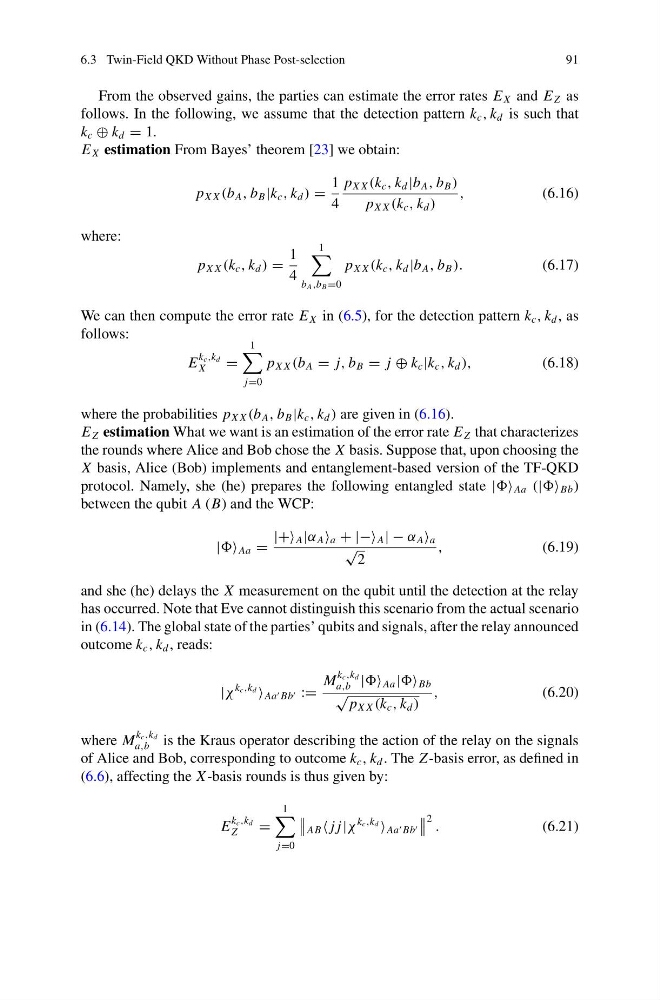
E X estimation From Bayes’ theorem [23] we obtain:
p X X (b A , b B |k c , k d ) =
1
4
p X X (k c , k d |b A , b B )
p X X (k c , k d )
,
(6.16)
where:
p X X (k c , k d ) =
1
4
1
b A ,b B =0
p X X (k c , k d |b A , b B ).
(6.17)
We can then compute the error rate E X in (6.5), for the detection pattern k c , k d , as
follows:
E
k c ,k d
X
=
1
j=0
p X X (b A = j, b B = j ⊕ k c |k c , k d ),
(6.18)
where the probabilities p X X (b A , b B |k c , k d ) are given in (6.16).
E Z estimation What we want is an estimation of the error rate E Z that characterizes
the rounds where Alice and Bob chose the X basis. Suppose that, upon choosing the
X basis, Alice (Bob) implements and entanglement-based version of the TF-QKD
protocol. Namely, she (he) prepares the following entangled state | Aa (| Bb )
between the qubit A (B) and the WCP:
| Aa =
|++ A |α A a + |−− A | − α A a
√
2
,
(6.19)
and she (he) delays the X measurement on the qubit until the detection at the relay
has occurred. Note that Eve cannot distinguish this scenario from the actual scenario
in (6.14). The global state of the parties’ qubits and signals, after the relay announced
outcome k c , k d , reads:
|χ
k c ,k d Aa Bb :=
M
k c ,k d
a,b | Aa | Bb
√
p X X (k c , k d )
,
(6.20)
where M
k c ,k d
a,b is the Kraus operator describing the action of the relay on the signals
of Alice and Bob, corresponding to outcome k c , k d . The Z -basis error, as defined in
(6.6), affecting the X -basis rounds is thus given by:
E
k c ,k d
Z
=
1
j=0
AB j j|χ
k c ,k d Aa Bb
2 .
(6.21)
91
From the observed gains, the parties can estimate the error rates E X and E Z as
follows. In the following, we assume that the detection pattern k c , k d is such that
k c ⊕ k d = 1.
E X estimation From Bayes’ theorem [23] we obtain:
p X X (b A , b B |k c , k d ) =
1
4
p X X (k c , k d |b A , b B )
p X X (k c , k d )
,
(6.16)
where:
p X X (k c , k d ) =
1
4
1
b A ,b B =0
p X X (k c , k d |b A , b B ).
(6.17)
We can then compute the error rate E X in (6.5), for the detection pattern k c , k d , as
follows:
E
k c ,k d
X
=
1
j=0
p X X (b A = j, b B = j ⊕ k c |k c , k d ),
(6.18)
where the probabilities p X X (b A , b B |k c , k d ) are given in (6.16).
E Z estimation What we want is an estimation of the error rate E Z that characterizes
the rounds where Alice and Bob chose the X basis. Suppose that, upon choosing the
X basis, Alice (Bob) implements and entanglement-based version of the TF-QKD
protocol. Namely, she (he) prepares the following entangled state | Aa (| Bb )
between the qubit A (B) and the WCP:
| Aa =
|++ A |α A a + |−− A | − α A a
√
2
,
(6.19)
and she (he) delays the X measurement on the qubit until the detection at the relay
has occurred. Note that Eve cannot distinguish this scenario from the actual scenario
in (6.14). The global state of the parties’ qubits and signals, after the relay announced
outcome k c , k d , reads:
|χ
k c ,k d Aa Bb :=
M
k c ,k d
a,b | Aa | Bb
√
p X X (k c , k d )
,
(6.20)
where M
k c ,k d
a,b is the Kraus operator describing the action of the relay on the signals
of Alice and Bob, corresponding to outcome k c , k d . The Z -basis error, as defined in
(6.6), affecting the X -basis rounds is thus given by:
E
k c ,k d
Z
=
1
j=0
AB j j|χ
k c ,k d Aa Bb
2 .
(6.21)