

6.3 Twin-Field QKD Without Phase Post-selection
93
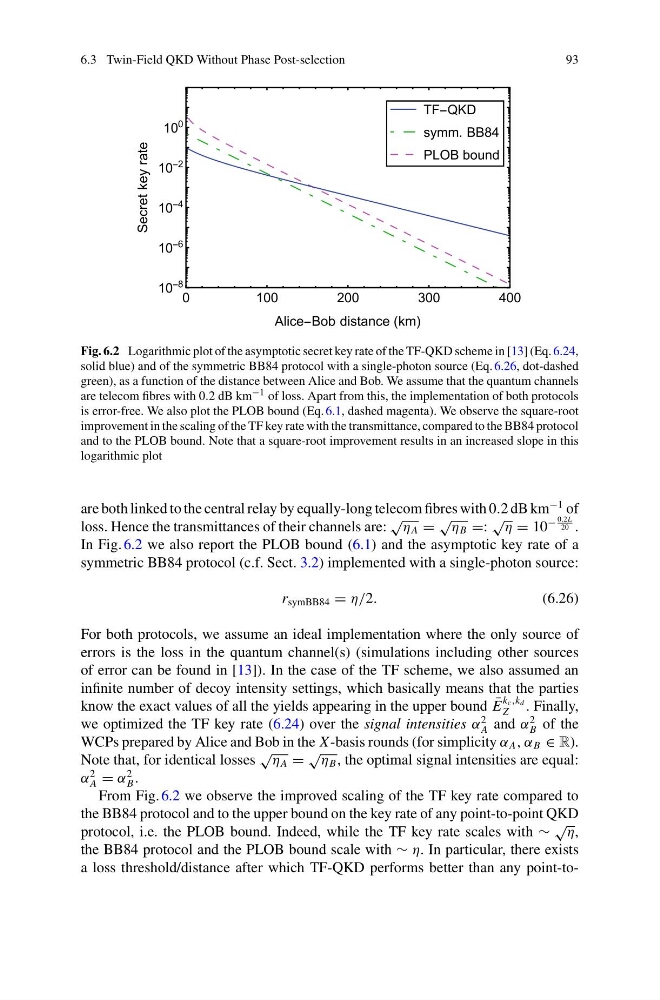
Fig. 6.2 Logarithmic plot of the asymptotic secret key rate of the TF-QKD scheme in [13] (Eq. 6.24,
solid blue) and of the symmetric BB84 protocol with a single-photon source (Eq. 6.26, dot-dashed
green), as a function of the distance between Alice and Bob. We assume that the quantum channels
are telecom fibres with 0.2 dB km −1 of loss. Apart from this, the implementation of both protocols
is error-free. We also plot the PLOB bound (Eq. 6.1, dashed magenta). We observe the square-root
improvement in the scaling of the TF key rate with the transmittance, compared to the BB84 protocol
and to the PLOB bound. Note that a square-root improvement results in an increased slope in this
logarithmic plot
are both linked to the central relay by equally-long telecom fibres with 0.2 dB km
−1 of
loss. Hence the transmittances of their channels are:
√ η A =
√
η B =:
√ η = 10
−
0.2L
20 .
In Fig. 6.2 we also report the PLOB bound (6.1) and the asymptotic key rate of a
symmetric BB84 protocol (c.f. Sect. 3.2) implemented with a single-photon source:
r symBB84 = η/2.
(6.26)
For both protocols, we assume an ideal implementation where the only source of
errors is the loss in the quantum channel(s) (simulations including other sources
of error can be found in [13]). In the case of the TF scheme, we also assumed an
infinite number of decoy intensity settings, which basically means that the parties
know the exact values of all the yields appearing in the upper bound ¯
E
k c ,k d
Z
. Finally,
we optimized the TF key rate (6.24) over the signal intensities α
2
A and α
2
B of the
WCPs prepared by Alice and Bob in the X -basis rounds (for simplicity α A , α B ∈ R).
Note that, for identical losses
√
η A =
√ η B , the optimal signal intensities are equal:
α
2
A = α
2
B .
From Fig. 6.2 we observe the improved scaling of the TF key rate compared to
the BB84 protocol and to the upper bound on the key rate of any point-to-point QKD
protocol, i.e. the PLOB bound. Indeed, while the TF key rate scales with ∼
√ η,
the BB84 protocol and the PLOB bound scale with ∼ η. In particular, there exists
a loss threshold/distance after which TF-QKD performs better than any point-to-
93
Fig. 6.2 Logarithmic plot of the asymptotic secret key rate of the TF-QKD scheme in [13] (Eq. 6.24,
solid blue) and of the symmetric BB84 protocol with a single-photon source (Eq. 6.26, dot-dashed
green), as a function of the distance between Alice and Bob. We assume that the quantum channels
are telecom fibres with 0.2 dB km −1 of loss. Apart from this, the implementation of both protocols
is error-free. We also plot the PLOB bound (Eq. 6.1, dashed magenta). We observe the square-root
improvement in the scaling of the TF key rate with the transmittance, compared to the BB84 protocol
and to the PLOB bound. Note that a square-root improvement results in an increased slope in this
logarithmic plot
are both linked to the central relay by equally-long telecom fibres with 0.2 dB km
−1 of
loss. Hence the transmittances of their channels are:
√ η A =
√
η B =:
√ η = 10
−
0.2L
20 .
In Fig. 6.2 we also report the PLOB bound (6.1) and the asymptotic key rate of a
symmetric BB84 protocol (c.f. Sect. 3.2) implemented with a single-photon source:
r symBB84 = η/2.
(6.26)
For both protocols, we assume an ideal implementation where the only source of
errors is the loss in the quantum channel(s) (simulations including other sources
of error can be found in [13]). In the case of the TF scheme, we also assumed an
infinite number of decoy intensity settings, which basically means that the parties
know the exact values of all the yields appearing in the upper bound ¯
E
k c ,k d
Z
. Finally,
we optimized the TF key rate (6.24) over the signal intensities α
2
A and α
2
B of the
WCPs prepared by Alice and Bob in the X -basis rounds (for simplicity α A , α B ∈ R).
Note that, for identical losses
√
η A =
√ η B , the optimal signal intensities are equal:
α
2
A = α
2
B .
From Fig. 6.2 we observe the improved scaling of the TF key rate compared to
the BB84 protocol and to the upper bound on the key rate of any point-to-point QKD
protocol, i.e. the PLOB bound. Indeed, while the TF key rate scales with ∼
√ η,
the BB84 protocol and the PLOB bound scale with ∼ η. In particular, there exists
a loss threshold/distance after which TF-QKD performs better than any point-to-