

14
2 A New View on Mechanism of Functional Expression …
and 1 atm) and d L /d S = 20, for example, −1.5k B Tη S (d L /d S ) reaches an unexpectedly large value, −11.5k B T. In a biological system where large biomolecules such
as proteins or protein complexes are immersed in water, the entropic EV effect is
remarkably large.
2.5.2 Simple Examples of Entropic Force and Potential
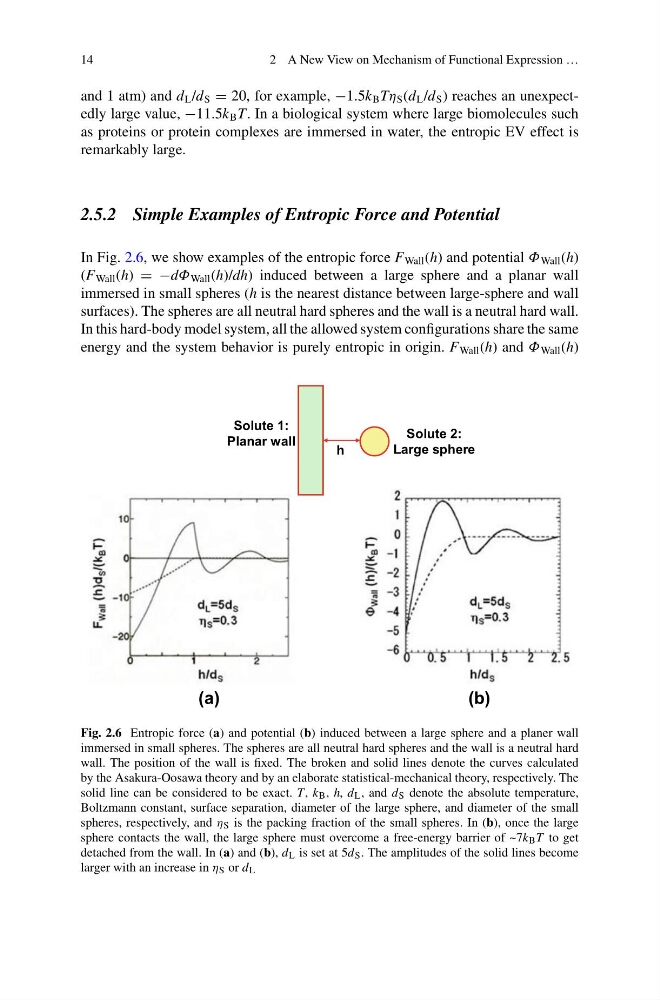
In Fig. 2.6, we show examples of the entropic force F Wall (h) and potential Φ Wall (h)
(F Wall (h) = −dΦ Wall (h)/dh) induced between a large sphere and a planar wall
immersed in small spheres (h is the nearest distance between large-sphere and wall
surfaces). The spheres are all neutral hard spheres and the wall is a neutral hard wall.
In this hard-body model system, all the allowed system configurations share the same
energy and the system behavior is purely entropic in origin. F Wall (h) and Φ Wall (h)
Solute 1:
Planar wall
Solute 2:
Large sphere
h
(a)
(b)
Fig. 2.6 Entropic force (a) and potential (b) induced between a large sphere and a planer wall
immersed in small spheres. The spheres are all neutral hard spheres and the wall is a neutral hard
wall. The position of the wall is fixed. The broken and solid lines denote the curves calculated
by the Asakura-Oosawa theory and by an elaborate statistical-mechanical theory, respectively. The
solid line can be considered to be exact. T, k B , h, d L , and d S denote the absolute temperature,
Boltzmann constant, surface separation, diameter of the large sphere, and diameter of the small
spheres, respectively, and η S is the packing fraction of the small spheres. In (b), once the large
sphere contacts the wall, the large sphere must overcome a free-energy barrier of ~7k B T to get
detached from the wall. In (a) and (b), d L is set at 5d S . The amplitudes of the solid lines become
larger with an increase in η S or d L
2 A New View on Mechanism of Functional Expression …
and 1 atm) and d L /d S = 20, for example, −1.5k B Tη S (d L /d S ) reaches an unexpectedly large value, −11.5k B T. In a biological system where large biomolecules such
as proteins or protein complexes are immersed in water, the entropic EV effect is
remarkably large.
2.5.2 Simple Examples of Entropic Force and Potential
In Fig. 2.6, we show examples of the entropic force F Wall (h) and potential Φ Wall (h)
(F Wall (h) = −dΦ Wall (h)/dh) induced between a large sphere and a planar wall
immersed in small spheres (h is the nearest distance between large-sphere and wall
surfaces). The spheres are all neutral hard spheres and the wall is a neutral hard wall.
In this hard-body model system, all the allowed system configurations share the same
energy and the system behavior is purely entropic in origin. F Wall (h) and Φ Wall (h)
Solute 1:
Planar wall
Solute 2:
Large sphere
h
(a)
(b)
Fig. 2.6 Entropic force (a) and potential (b) induced between a large sphere and a planer wall
immersed in small spheres. The spheres are all neutral hard spheres and the wall is a neutral hard
wall. The position of the wall is fixed. The broken and solid lines denote the curves calculated
by the Asakura-Oosawa theory and by an elaborate statistical-mechanical theory, respectively. The
solid line can be considered to be exact. T, k B , h, d L , and d S denote the absolute temperature,
Boltzmann constant, surface separation, diameter of the large sphere, and diameter of the small
spheres, respectively, and η S is the packing fraction of the small spheres. In (b), once the large
sphere contacts the wall, the large sphere must overcome a free-energy barrier of ~7k B T to get
detached from the wall. In (a) and (b), d L is set at 5d S . The amplitudes of the solid lines become
larger with an increase in η S or d L