

2.5 Entropic Excluded-Volume Effect and Entropic Force …
13
Manner 1
Manner 2
Manner 3
Manner 4
Solute:
Cylinder or Disc
Overlap of
Excluded Spaces
Water Molecules
Excluded
Space
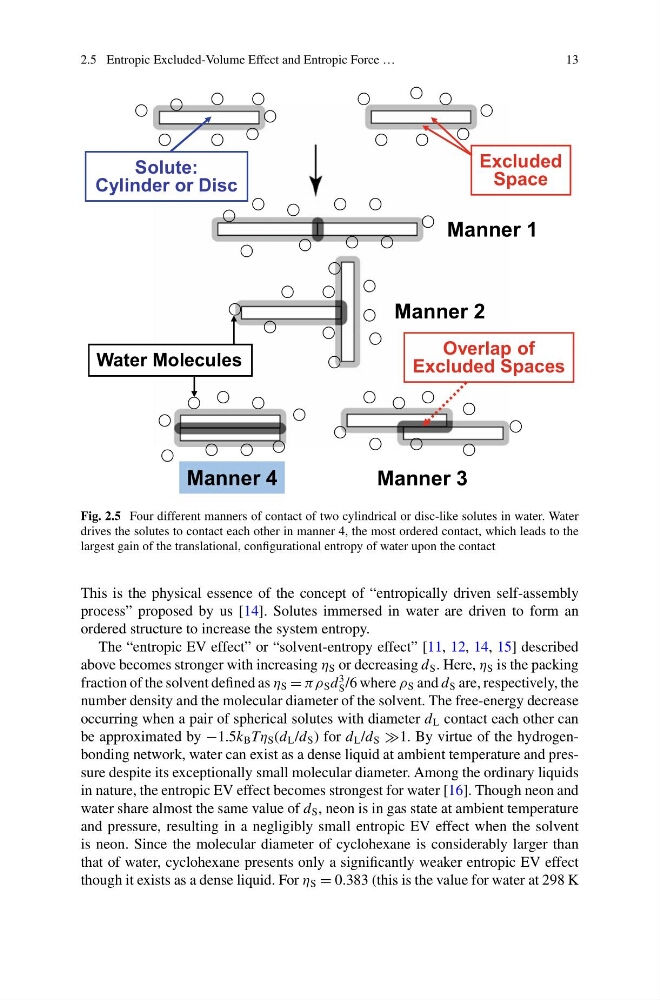
Fig. 2.5 Four different manners of contact of two cylindrical or disc-like solutes in water. Water
drives the solutes to contact each other in manner 4, the most ordered contact, which leads to the
largest gain of the translational, configurational entropy of water upon the contact
This is the physical essence of the concept of “entropically driven self-assembly
process” proposed by us [14]. Solutes immersed in water are driven to form an
ordered structure to increase the system entropy.
The “entropic EV effect” or “solvent-entropy effect” [11, 12, 14, 15] described
above becomes stronger with increasing η S or decreasing d S . Here, η S is the packing
fraction of the solvent defined as η S = πρ S d
3
S /6 where ρ S and d S are, respectively, the
number density and the molecular diameter of the solvent. The free-energy decrease
occurring when a pair of spherical solutes with diameter d L contact each other can
be approximated by −1.5k B Tη S (d L /d S ) for d L /d S 1. By virtue of the hydrogenbonding network, water can exist as a dense liquid at ambient temperature and pressure despite its exceptionally small molecular diameter. Among the ordinary liquids
in nature, the entropic EV effect becomes strongest for water [16]. Though neon and
water share almost the same value of d S , neon is in gas state at ambient temperature
and pressure, resulting in a negligibly small entropic EV effect when the solvent
is neon. Since the molecular diameter of cyclohexane is considerably larger than
that of water, cyclohexane presents only a significantly weaker entropic EV effect
though it exists as a dense liquid. For η S = 0.383 (this is the value for water at 298 K
13
Manner 1
Manner 2
Manner 3
Manner 4
Solute:
Cylinder or Disc
Overlap of
Excluded Spaces
Water Molecules
Excluded
Space
Fig. 2.5 Four different manners of contact of two cylindrical or disc-like solutes in water. Water
drives the solutes to contact each other in manner 4, the most ordered contact, which leads to the
largest gain of the translational, configurational entropy of water upon the contact
This is the physical essence of the concept of “entropically driven self-assembly
process” proposed by us [14]. Solutes immersed in water are driven to form an
ordered structure to increase the system entropy.
The “entropic EV effect” or “solvent-entropy effect” [11, 12, 14, 15] described
above becomes stronger with increasing η S or decreasing d S . Here, η S is the packing
fraction of the solvent defined as η S = πρ S d
3
S /6 where ρ S and d S are, respectively, the
number density and the molecular diameter of the solvent. The free-energy decrease
occurring when a pair of spherical solutes with diameter d L contact each other can
be approximated by −1.5k B Tη S (d L /d S ) for d L /d S 1. By virtue of the hydrogenbonding network, water can exist as a dense liquid at ambient temperature and pressure despite its exceptionally small molecular diameter. Among the ordinary liquids
in nature, the entropic EV effect becomes strongest for water [16]. Though neon and
water share almost the same value of d S , neon is in gas state at ambient temperature
and pressure, resulting in a negligibly small entropic EV effect when the solvent
is neon. Since the molecular diameter of cyclohexane is considerably larger than
that of water, cyclohexane presents only a significantly weaker entropic EV effect
though it exists as a dense liquid. For η S = 0.383 (this is the value for water at 298 K