

12
2 A New View on Mechanism of Functional Expression …
(a)
(b)
Water Molecules
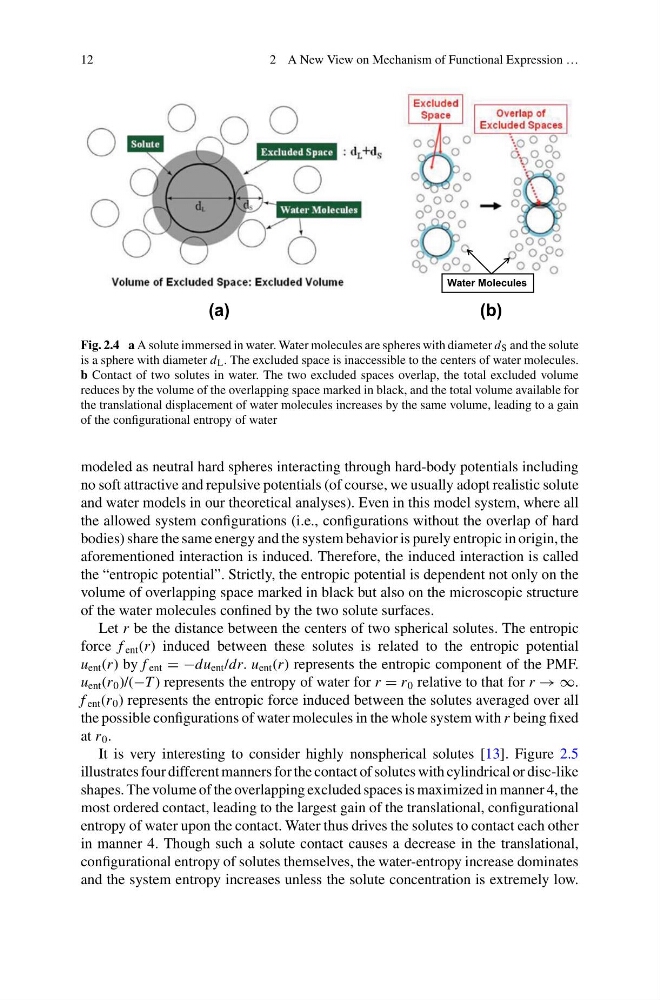
Fig. 2.4 a A solute immersed in water. Water molecules are spheres with diameter d S and the solute
is a sphere with diameter d L . The excluded space is inaccessible to the centers of water molecules.
b Contact of two solutes in water. The two excluded spaces overlap, the total excluded volume
reduces by the volume of the overlapping space marked in black, and the total volume available for
the translational displacement of water molecules increases by the same volume, leading to a gain
of the configurational entropy of water
modeled as neutral hard spheres interacting through hard-body potentials including
no soft attractive and repulsive potentials (of course, we usually adopt realistic solute
and water models in our theoretical analyses). Even in this model system, where all
the allowed system configurations (i.e., configurations without the overlap of hard
bodies) share the same energy and the system behavior is purely entropic in origin, the
aforementioned interaction is induced. Therefore, the induced interaction is called
the “entropic potential”. Strictly, the entropic potential is dependent not only on the
volume of overlapping space marked in black but also on the microscopic structure
of the water molecules confined by the two solute surfaces.
Let r be the distance between the centers of two spherical solutes. The entropic
force f ent (r) induced between these solutes is related to the entropic potential
u ent (r) by f ent = −du ent /dr. u ent (r) represents the entropic component of the PMF.
u ent (r 0 )/(−T ) represents the entropy of water for r = r 0 relative to that for r → ∞.
f ent (r 0 ) represents the entropic force induced between the solutes averaged over all
the possible configurations of water molecules in the whole system with r being fixed
at r 0 .
It is very interesting to consider highly nonspherical solutes [13]. Figure 2.5
illustrates four different manners for the contact of solutes with cylindrical or disc-like
shapes. The volume of the overlapping excluded spaces is maximized in manner 4, the
most ordered contact, leading to the largest gain of the translational, configurational
entropy of water upon the contact. Water thus drives the solutes to contact each other
in manner 4. Though such a solute contact causes a decrease in the translational,
configurational entropy of solutes themselves, the water-entropy increase dominates
and the system entropy increases unless the solute concentration is extremely low.
2 A New View on Mechanism of Functional Expression …
(a)
(b)
Water Molecules
Fig. 2.4 a A solute immersed in water. Water molecules are spheres with diameter d S and the solute
is a sphere with diameter d L . The excluded space is inaccessible to the centers of water molecules.
b Contact of two solutes in water. The two excluded spaces overlap, the total excluded volume
reduces by the volume of the overlapping space marked in black, and the total volume available for
the translational displacement of water molecules increases by the same volume, leading to a gain
of the configurational entropy of water
modeled as neutral hard spheres interacting through hard-body potentials including
no soft attractive and repulsive potentials (of course, we usually adopt realistic solute
and water models in our theoretical analyses). Even in this model system, where all
the allowed system configurations (i.e., configurations without the overlap of hard
bodies) share the same energy and the system behavior is purely entropic in origin, the
aforementioned interaction is induced. Therefore, the induced interaction is called
the “entropic potential”. Strictly, the entropic potential is dependent not only on the
volume of overlapping space marked in black but also on the microscopic structure
of the water molecules confined by the two solute surfaces.
Let r be the distance between the centers of two spherical solutes. The entropic
force f ent (r) induced between these solutes is related to the entropic potential
u ent (r) by f ent = −du ent /dr. u ent (r) represents the entropic component of the PMF.
u ent (r 0 )/(−T ) represents the entropy of water for r = r 0 relative to that for r → ∞.
f ent (r 0 ) represents the entropic force induced between the solutes averaged over all
the possible configurations of water molecules in the whole system with r being fixed
at r 0 .
It is very interesting to consider highly nonspherical solutes [13]. Figure 2.5
illustrates four different manners for the contact of solutes with cylindrical or disc-like
shapes. The volume of the overlapping excluded spaces is maximized in manner 4, the
most ordered contact, leading to the largest gain of the translational, configurational
entropy of water upon the contact. Water thus drives the solutes to contact each other
in manner 4. Though such a solute contact causes a decrease in the translational,
configurational entropy of solutes themselves, the water-entropy increase dominates
and the system entropy increases unless the solute concentration is extremely low.