

2.5 Entropic Excluded-Volume Effect and Entropic Force …
15
are, respectively, the mean force and the PMF possessing no energetic components.
Φ Wall (h 0 ) represents the free energy of small spheres for h = h 0 relative to that for h
→ ∞.
The curves of F Wall (h) and Φ Wall (h) calculated using the Asakura-Oosawa (AO)
theory [17, 18] and an elaborate statistical-mechanical theory (e.g., the integral equation theory [19]) are compared in Fig. 2.6. In the AO theory, the force and potential
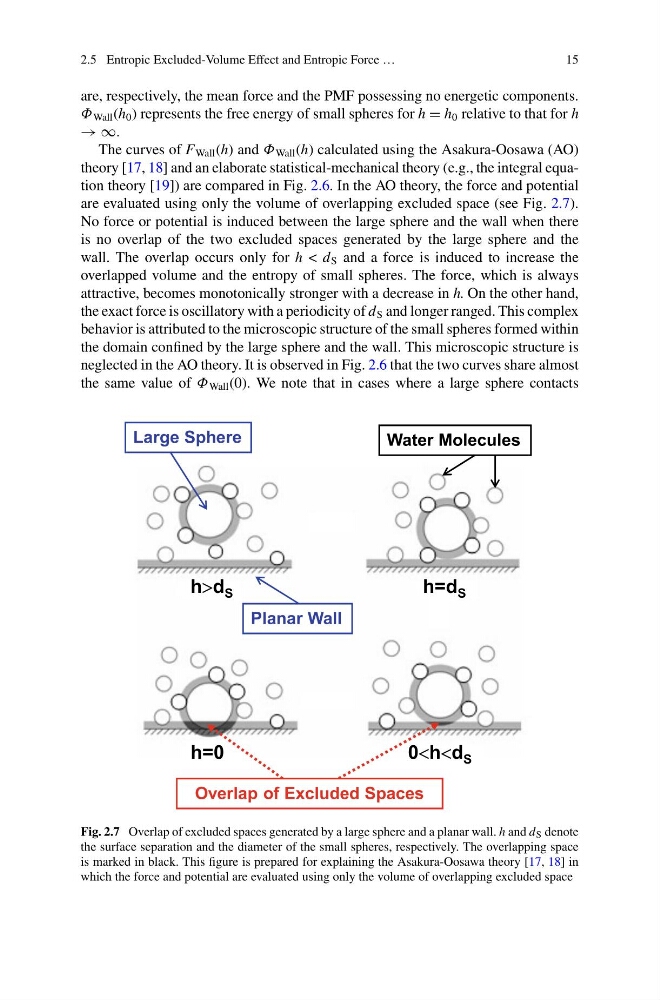
are evaluated using only the volume of overlapping excluded space (see Fig. 2.7).
No force or potential is induced between the large sphere and the wall when there
is no overlap of the two excluded spaces generated by the large sphere and the
wall. The overlap occurs only for h < d S and a force is induced to increase the
overlapped volume and the entropy of small spheres. The force, which is always
attractive, becomes monotonically stronger with a decrease in h. On the other hand,
the exact force is oscillatory with a periodicity of d S and longer ranged. This complex
behavior is attributed to the microscopic structure of the small spheres formed within
the domain confined by the large sphere and the wall. This microscopic structure is
neglected in the AO theory. It is observed in Fig. 2.6 that the two curves share almost
the same value of Φ Wall (0). We note that in cases where a large sphere contacts
Fig. 2.7 Overlap of excluded spaces generated by a large sphere and a planar wall. h and d S denote
the surface separation and the diameter of the small spheres, respectively. The overlapping space
is marked in black. This figure is prepared for explaining the Asakura-Oosawa theory [17, 18] in
which the force and potential are evaluated using only the volume of overlapping excluded space
15
are, respectively, the mean force and the PMF possessing no energetic components.
Φ Wall (h 0 ) represents the free energy of small spheres for h = h 0 relative to that for h
→ ∞.
The curves of F Wall (h) and Φ Wall (h) calculated using the Asakura-Oosawa (AO)
theory [17, 18] and an elaborate statistical-mechanical theory (e.g., the integral equation theory [19]) are compared in Fig. 2.6. In the AO theory, the force and potential
are evaluated using only the volume of overlapping excluded space (see Fig. 2.7).
No force or potential is induced between the large sphere and the wall when there
is no overlap of the two excluded spaces generated by the large sphere and the
wall. The overlap occurs only for h < d S and a force is induced to increase the
overlapped volume and the entropy of small spheres. The force, which is always
attractive, becomes monotonically stronger with a decrease in h. On the other hand,
the exact force is oscillatory with a periodicity of d S and longer ranged. This complex
behavior is attributed to the microscopic structure of the small spheres formed within
the domain confined by the large sphere and the wall. This microscopic structure is
neglected in the AO theory. It is observed in Fig. 2.6 that the two curves share almost
the same value of Φ Wall (0). We note that in cases where a large sphere contacts
Fig. 2.7 Overlap of excluded spaces generated by a large sphere and a planar wall. h and d S denote
the surface separation and the diameter of the small spheres, respectively. The overlapping space
is marked in black. This figure is prepared for explaining the Asakura-Oosawa theory [17, 18] in
which the force and potential are evaluated using only the volume of overlapping excluded space