

8
2 A New View on Mechanism of Functional Expression …
ATP
ADP, Pi
Binding
of ATP
Dissociation
of ADP and Pi
Hydrolysis
of ATP
(1)
(2)
(3)
Structural Changes of a Protein or Protein Complex
Catalyzing ATP Hydrolysis Reaction
Structure I
Structure II
Structure III
Structure I
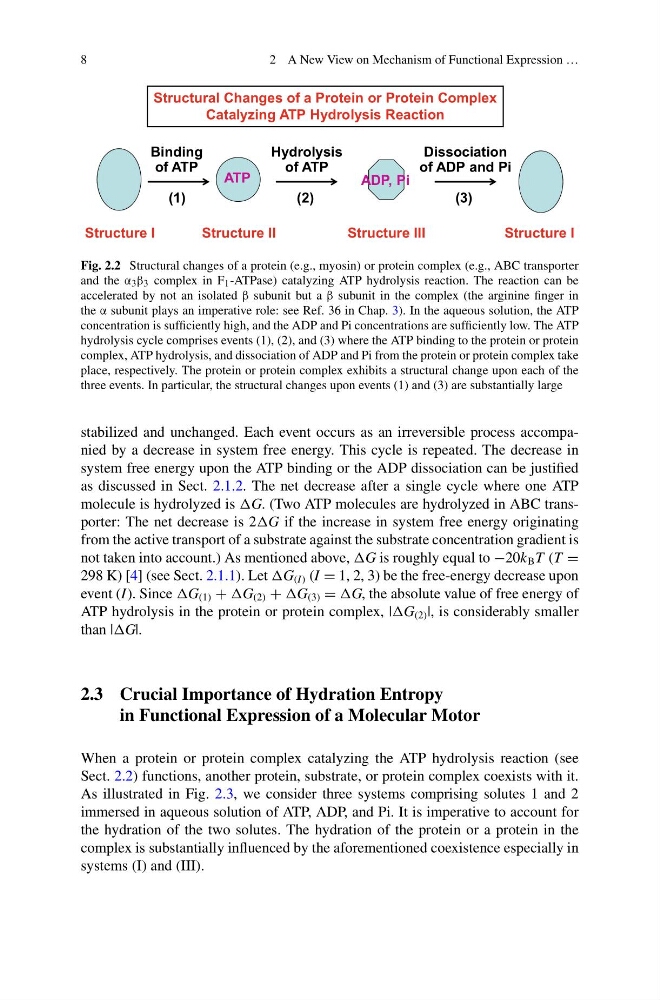
Fig. 2.2 Structural changes of a protein (e.g., myosin) or protein complex (e.g., ABC transporter
and the α 3 β 3 complex in F 1 -ATPase) catalyzing ATP hydrolysis reaction. The reaction can be
accelerated by not an isolated β subunit but a β subunit in the complex (the arginine finger in
the α subunit plays an imperative role: see Ref. 36 in Chap. 3). In the aqueous solution, the ATP
concentration is sufficiently high, and the ADP and Pi concentrations are sufficiently low. The ATP
hydrolysis cycle comprises events (1), (2), and (3) where the ATP binding to the protein or protein
complex, ATP hydrolysis, and dissociation of ADP and Pi from the protein or protein complex take
place, respectively. The protein or protein complex exhibits a structural change upon each of the
three events. In particular, the structural changes upon events (1) and (3) are substantially large
stabilized and unchanged. Each event occurs as an irreversible process accompanied by a decrease in system free energy. This cycle is repeated. The decrease in
system free energy upon the ATP binding or the ADP dissociation can be justified
as discussed in Sect. 2.1.2. The net decrease after a single cycle where one ATP
molecule is hydrolyzed is (Two ATP molecules are hydrolyzed in ABC transporter: The net decrease is 2 if the increase in system free energy originating
from the active transport of a substrate against the substrate concentration gradient is
not taken into account.) As mentioned above, is roughly equal to −20k B T (T =
298 K) [4] (see Sect. 2.1.1). Let (I) (I = 1, 2, 3) be the free-energy decrease upon
event (I). Since (1) + (2) + (3) = the absolute value of free energy of
ATP hydrolysis in the protein or protein complex, | (2) |, is considerably smaller
than |
2.3 Crucial Importance of Hydration Entropy
in Functional Expression of a Molecular Motor
When a protein or protein complex catalyzing the ATP hydrolysis reaction (see
Sect. 2.2) functions, another protein, substrate, or protein complex coexists with it.
As illustrated in Fig. 2.3, we consider three systems comprising solutes 1 and 2
immersed in aqueous solution of ATP, ADP, and Pi. It is imperative to account for
the hydration of the two solutes. The hydration of the protein or a protein in the
complex is substantially influenced by the aforementioned coexistence especially in
systems (I) and (III).
2 A New View on Mechanism of Functional Expression …
ATP
ADP, Pi
Binding
of ATP
Dissociation
of ADP and Pi
Hydrolysis
of ATP
(1)
(2)
(3)
Structural Changes of a Protein or Protein Complex
Catalyzing ATP Hydrolysis Reaction
Structure I
Structure II
Structure III
Structure I
Fig. 2.2 Structural changes of a protein (e.g., myosin) or protein complex (e.g., ABC transporter
and the α 3 β 3 complex in F 1 -ATPase) catalyzing ATP hydrolysis reaction. The reaction can be
accelerated by not an isolated β subunit but a β subunit in the complex (the arginine finger in
the α subunit plays an imperative role: see Ref. 36 in Chap. 3). In the aqueous solution, the ATP
concentration is sufficiently high, and the ADP and Pi concentrations are sufficiently low. The ATP
hydrolysis cycle comprises events (1), (2), and (3) where the ATP binding to the protein or protein
complex, ATP hydrolysis, and dissociation of ADP and Pi from the protein or protein complex take
place, respectively. The protein or protein complex exhibits a structural change upon each of the
three events. In particular, the structural changes upon events (1) and (3) are substantially large
stabilized and unchanged. Each event occurs as an irreversible process accompanied by a decrease in system free energy. This cycle is repeated. The decrease in
system free energy upon the ATP binding or the ADP dissociation can be justified
as discussed in Sect. 2.1.2. The net decrease after a single cycle where one ATP
molecule is hydrolyzed is (Two ATP molecules are hydrolyzed in ABC transporter: The net decrease is 2 if the increase in system free energy originating
from the active transport of a substrate against the substrate concentration gradient is
not taken into account.) As mentioned above, is roughly equal to −20k B T (T =
298 K) [4] (see Sect. 2.1.1). Let (I) (I = 1, 2, 3) be the free-energy decrease upon
event (I). Since (1) + (2) + (3) = the absolute value of free energy of
ATP hydrolysis in the protein or protein complex, | (2) |, is considerably smaller
than |
2.3 Crucial Importance of Hydration Entropy
in Functional Expression of a Molecular Motor
When a protein or protein complex catalyzing the ATP hydrolysis reaction (see
Sect. 2.2) functions, another protein, substrate, or protein complex coexists with it.
As illustrated in Fig. 2.3, we consider three systems comprising solutes 1 and 2
immersed in aqueous solution of ATP, ADP, and Pi. It is imperative to account for
the hydration of the two solutes. The hydration of the protein or a protein in the
complex is substantially influenced by the aforementioned coexistence especially in
systems (I) and (III).