

2.1 Coupling of a Molecular Motor and ATP Hydrolysis Reaction
7
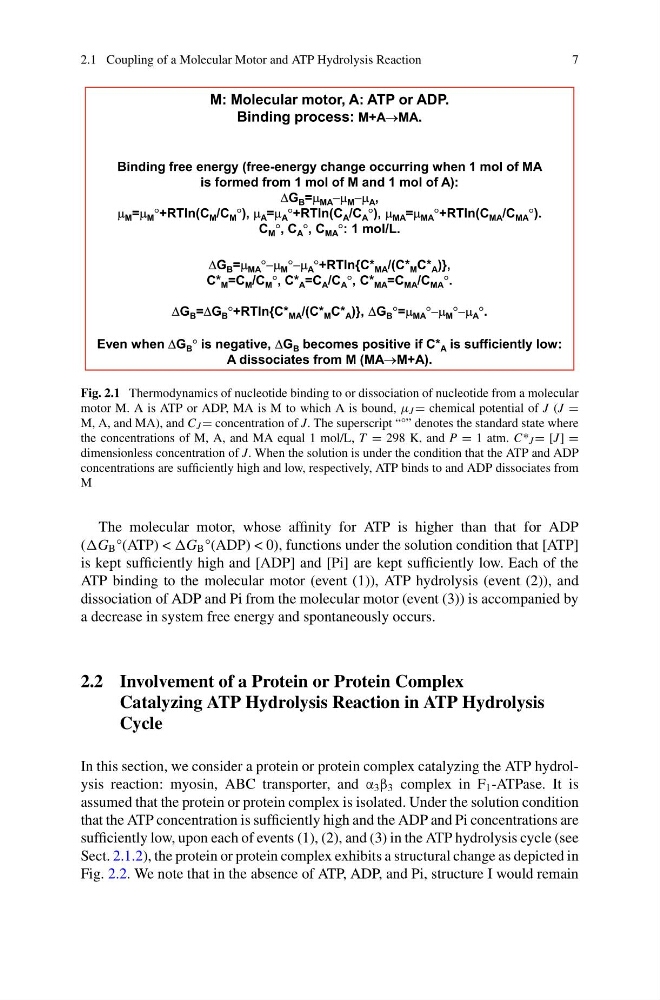
Fig. 2.1 Thermodynamics of nucleotide binding to or dissociation of nucleotide from a molecular
motor M. A is ATP or ADP, MA is M to which A is bound, μ J = chemical potential of J (J =
M, A, and MA), and C J = concentration of J. The superscript “°” denotes the standard state where
the concentrations of M, A, and MA equal 1 mol/L, T = 298 K, and P = 1 atm. C* J = [J] =
dimensionless concentration of J. When the solution is under the condition that the ATP and ADP
concentrations are sufficiently high and low, respectively, ATP binds to and ADP dissociates from
M
The molecular motor, whose affinity for ATP is higher than that for ADP
( B °(ATP) < B °(ADP) < 0), functions under the solution condition that [ATP]
is kept sufficiently high and [ADP] and [Pi] are kept sufficiently low. Each of the
ATP binding to the molecular motor (event (1)), ATP hydrolysis (event (2)), and
dissociation of ADP and Pi from the molecular motor (event (3)) is accompanied by
a decrease in system free energy and spontaneously occurs.
2.2 Involvement of a Protein or Protein Complex
Catalyzing ATP Hydrolysis Reaction in ATP Hydrolysis
Cycle
In this section, we consider a protein or protein complex catalyzing the ATP hydrolysis reaction: myosin, ABC transporter, and α 3 β 3 complex in F 1 -ATPase. It is
assumed that the protein or protein complex is isolated. Under the solution condition
that the ATP concentration is sufficiently high and the ADP and Pi concentrations are
sufficiently low, upon each of events (1), (2), and (3) in the ATP hydrolysis cycle (see
Sect. 2.1.2), the protein or protein complex exhibits a structural change as depicted in
Fig. 2.2. We note that in the absence of ATP, ADP, and Pi, structure I would remain
7
Fig. 2.1 Thermodynamics of nucleotide binding to or dissociation of nucleotide from a molecular
motor M. A is ATP or ADP, MA is M to which A is bound, μ J = chemical potential of J (J =
M, A, and MA), and C J = concentration of J. The superscript “°” denotes the standard state where
the concentrations of M, A, and MA equal 1 mol/L, T = 298 K, and P = 1 atm. C* J = [J] =
dimensionless concentration of J. When the solution is under the condition that the ATP and ADP
concentrations are sufficiently high and low, respectively, ATP binds to and ADP dissociates from
M
The molecular motor, whose affinity for ATP is higher than that for ADP
( B °(ATP) < B °(ADP) < 0), functions under the solution condition that [ATP]
is kept sufficiently high and [ADP] and [Pi] are kept sufficiently low. Each of the
ATP binding to the molecular motor (event (1)), ATP hydrolysis (event (2)), and
dissociation of ADP and Pi from the molecular motor (event (3)) is accompanied by
a decrease in system free energy and spontaneously occurs.
2.2 Involvement of a Protein or Protein Complex
Catalyzing ATP Hydrolysis Reaction in ATP Hydrolysis
Cycle
In this section, we consider a protein or protein complex catalyzing the ATP hydrolysis reaction: myosin, ABC transporter, and α 3 β 3 complex in F 1 -ATPase. It is
assumed that the protein or protein complex is isolated. Under the solution condition
that the ATP concentration is sufficiently high and the ADP and Pi concentrations are
sufficiently low, upon each of events (1), (2), and (3) in the ATP hydrolysis cycle (see
Sect. 2.1.2), the protein or protein complex exhibits a structural change as depicted in
Fig. 2.2. We note that in the absence of ATP, ADP, and Pi, structure I would remain