

520
A. del Val et al.
relatively slow flow conditions, the thermo-chemical state adjusts rapidly to the
flow state and is close to thermal and chemical equilibrium. However, in many
applications, the chemical kinetics and relaxation time scales are similar to the flow
motion scales, defining a state of non-equilibrium. In this state, equations for the
different chemical species must be additionally solved adding complexity to the
system. Boundary conditions are also complicated because of their dependence on
the surface material and flow conditions, injecting ablation species into the boundary
layer.
The coupling of the different mechanisms in the flow together with the difference
in time scales of the processes involved makes this system an ideal place to develop
and improve numerical methods that can provide accurate and fast predictions.
A particular example of a computational model for atmospheric entry flows is
described in Sect. 16.3.1.1.
Hereafter follows a review of the most important theoretical aspects and models
used to describe the system.
16.3.1 Governing Equations for Atmospheric Flows
Fluid dynamics allows to describe macroscopically a plasma flow. To that aim,
the Navier–Stokes equations deal with the conservation of mass, momentum, and
energy in a small element of volume of plasma. Transport phenomena occur at
the volume surface. First, diffusion of chemical species and heat fluxes arise
through the interface. Second, shear stresses applied on the surface participate to
the equilibrium of the forces acting on the volume. The transport fluxes can be
interpreted at a microscopic scale by studying binary collisions among particles
of the plasma. The Boltzmann transport equation is the fundamental governing
equation for non-equilibrium flow systems. The link between both macro and
microscales is established by means of the kinetic theory.
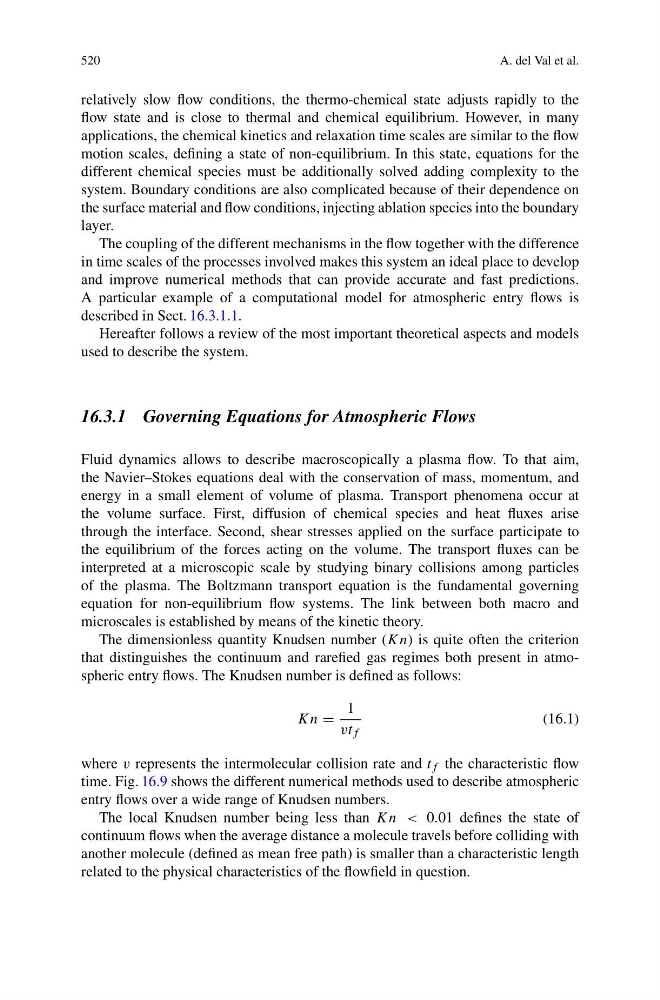
The dimensionless quantity Knudsen number (Kn) is quite often the criterion
that distinguishes the continuum and rarefied gas regimes both present in atmospheric entry flows. The Knudsen number is defined as follows:
Kn =
1
vt f
(16.1)
where v represents the intermolecular collision rate and t f the characteristic flow
time. Fig. 16.9 shows the different numerical methods used to describe atmospheric
entry flows over a wide range of Knudsen numbers.
The local Knudsen number being less than Kn < 0.01 defines the state of
continuum flows when the average distance a molecule travels before colliding with
another molecule (defined as mean free path) is smaller than a characteristic length
related to the physical characteristics of the flowfield in question.