

16 Uncertainty Treatment Applications: High-Enthalpy Flow Ground Testing
521
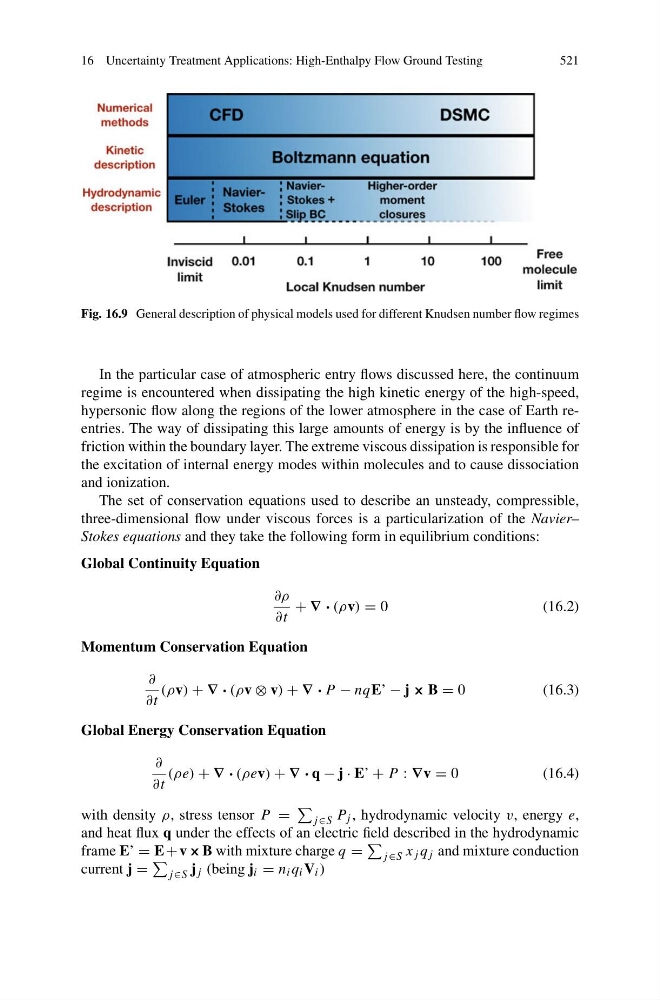
Fig. 16.9 General description of physical models used for different Knudsen number flow regimes
In the particular case of atmospheric entry flows discussed here, the continuum
regime is encountered when dissipating the high kinetic energy of the high-speed,
hypersonic flow along the regions of the lower atmosphere in the case of Earth reentries. The way of dissipating this large amounts of energy is by the influence of
friction within the boundary layer. The extreme viscous dissipation is responsible for
the excitation of internal energy modes within molecules and to cause dissociation
and ionization.
The set of conservation equations used to describe an unsteady, compressible,
three-dimensional flow under viscous forces is a particularization of the Navier–
Stokes equations and they take the following form in equilibrium conditions:
Global Continuity Equation
∂ρ
∂t
+ ∇ · (ρv) = 0
(16.2)
Momentum Conservation Equation
∂
∂t
(ρv) + ∇ · (ρv ⊗ v) + ∇ · P − nqE’ − j × B = 0
(16.3)
Global Energy Conservation Equation
∂
∂t
(ρe) + ∇ · (ρev) + ∇ · q − j · E’ + P : ∇v = 0
(16.4)
with density ρ, stress tensor P =
j ∈S P j , hydrodynamic velocity v, energy e,
and heat flux q under the effects of an electric field described in the hydrodynamic
frame E’ = E + v × B with mixture charge q =
j ∈S x j q j and mixture conduction
current j =
j ∈S j j (being j i = n i q i V i )