

518
A. del Val et al.
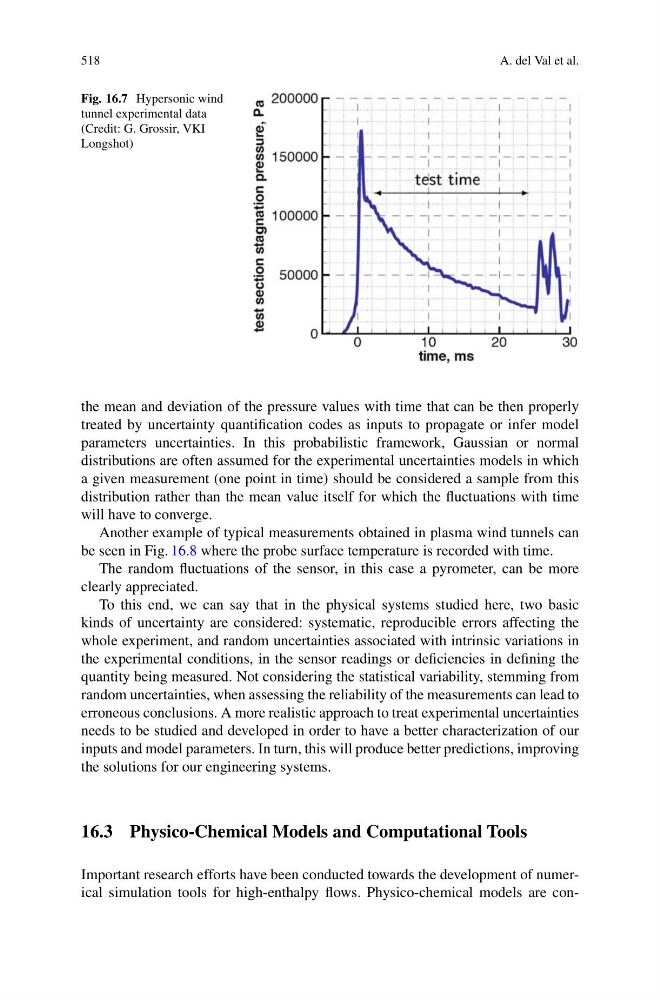
Fig. 16.7 Hypersonic wind
tunnel experimental data
(Credit: G. Grossir, VKI
Longshot)
the mean and deviation of the pressure values with time that can be then properly
treated by uncertainty quantification codes as inputs to propagate or infer model
parameters uncertainties. In this probabilistic framework, Gaussian or normal
distributions are often assumed for the experimental uncertainties models in which
a given measurement (one point in time) should be considered a sample from this
distribution rather than the mean value itself for which the fluctuations with time
will have to converge.
Another example of typical measurements obtained in plasma wind tunnels can
be seen in Fig. 16.8 where the probe surface temperature is recorded with time.
The random fluctuations of the sensor, in this case a pyrometer, can be more
clearly appreciated.
To this end, we can say that in the physical systems studied here, two basic
kinds of uncertainty are considered: systematic, reproducible errors affecting the
whole experiment, and random uncertainties associated with intrinsic variations in
the experimental conditions, in the sensor readings or deficiencies in defining the
quantity being measured. Not considering the statistical variability, stemming from
random uncertainties, when assessing the reliability of the measurements can lead to
erroneous conclusions. A more realistic approach to treat experimental uncertainties
needs to be studied and developed in order to have a better characterization of our
inputs and model parameters. In turn, this will produce better predictions, improving
the solutions for our engineering systems.
16.3 Physico-Chemical Models and Computational Tools
Important research efforts have been conducted towards the development of numerical simulation tools for high-enthalpy flows. Physico-chemical models are con-