

16 Uncertainty Treatment Applications: High-Enthalpy Flow Ground Testing
511
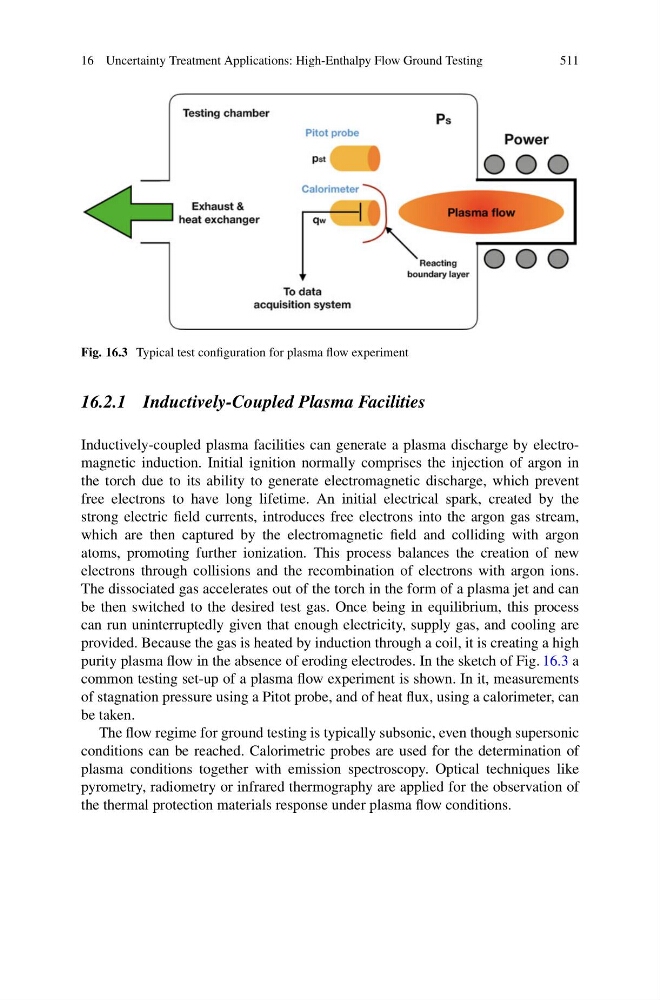
Fig. 16.3 Typical test configuration for plasma flow experiment
16.2.1 Inductively-Coupled Plasma Facilities
Inductively-coupled plasma facilities can generate a plasma discharge by electromagnetic induction. Initial ignition normally comprises the injection of argon in
the torch due to its ability to generate electromagnetic discharge, which prevent
free electrons to have long lifetime. An initial electrical spark, created by the
strong electric field currents, introduces free electrons into the argon gas stream,
which are then captured by the electromagnetic field and colliding with argon
atoms, promoting further ionization. This process balances the creation of new
electrons through collisions and the recombination of electrons with argon ions.
The dissociated gas accelerates out of the torch in the form of a plasma jet and can
be then switched to the desired test gas. Once being in equilibrium, this process
can run uninterruptedly given that enough electricity, supply gas, and cooling are
provided. Because the gas is heated by induction through a coil, it is creating a high
purity plasma flow in the absence of eroding electrodes. In the sketch of Fig. 16.3 a
common testing set-up of a plasma flow experiment is shown. In it, measurements
of stagnation pressure using a Pitot probe, and of heat flux, using a calorimeter, can
be taken.
The flow regime for ground testing is typically subsonic, even though supersonic
conditions can be reached. Calorimetric probes are used for the determination of
plasma conditions together with emission spectroscopy. Optical techniques like
pyrometry, radiometry or infrared thermography are applied for the observation of
the thermal protection materials response under plasma flow conditions.