

510
A. del Val et al.
16.2 Ground Testing in High-Enthalpy Facilities
In order to provide relevant data, the severe environment encountered by a spacecraft
during re-entry has to be reproduced in ground based facilities. High-speed flows
and high thermal loads must be provided simultaneously which represents a
limitation for our current technical capabilities as briefly explained in the previous
section [2]. Facilities able to provide high Mach number flows are characterized
by limited test time, insufficient to reproduce the characteristic heat loads for
thermal protection material performance testing. Plasma wind tunnels instead allow
long duration heating tests, but flow Mach numbers are limited. To overcome this
limitation, testing methodologies have been elaborated to simulate high temperature
effects in hypersonic flows in high-enthalpy wind tunnels, like binary scaling [3–5]
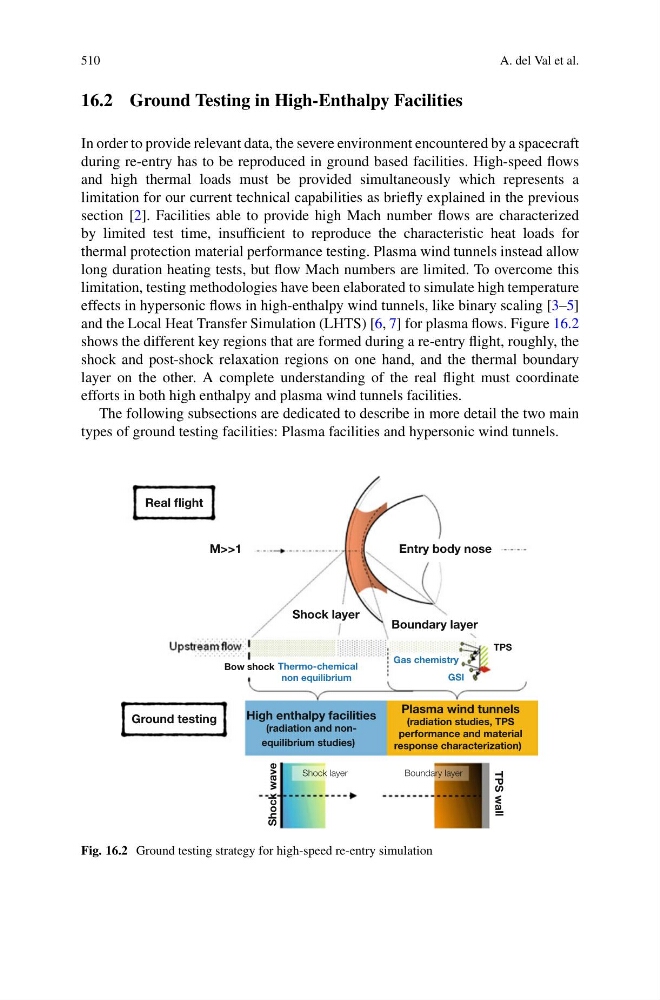
and the Local Heat Transfer Simulation (LHTS) [6, 7] for plasma flows. Figure 16.2
shows the different key regions that are formed during a re-entry flight, roughly, the
shock and post-shock relaxation regions on one hand, and the thermal boundary
layer on the other. A complete understanding of the real flight must coordinate
efforts in both high enthalpy and plasma wind tunnels facilities.
The following subsections are dedicated to describe in more detail the two main
types of ground testing facilities: Plasma facilities and hypersonic wind tunnels.
Ground testing
M>>1
Entry body nose
Bow shock
Shock layer
Thermo-chemical
non equilibrium
Gas chemistry
GSI
TPS
Boundary layer
High enthalpy facilities
(radiation and nonequilibrium studies)
Plasma wind tunnels
(radiation studies, TPS
performance and material
response characterization)
Shock layer
Shock wave
Boundary layer
TPS
wall
Fig. 16.2 Ground testing strategy for high-speed re-entry simulation