

15 In-flight Icing: Modeling, Prediction, and Uncertainty
493
with ice protection systems. Nowadays most of the aircraft include ice protection
systems (IPS) to minimize the impact caused by the encounter of icing conditions
in-flight.
Ice protection systems are deployed into aircraft to delay or to remove any
ice accumulation on its surface and its components and therefore to maintain
the performance and safety. The IPS can be classified into anti-icing or de-icing
depending on whether they allow the ice to build on the aircraft. Anti-icing systems
prevent the formation of ice, whereas de-icing technologies remove the already
formed ice. They are implemented in several critical parts of the aircraft which are
susceptible to build ice, such as the wings leading edge, the leading edge slats,
the stabilizers, the engine nacelle, the wind screens, and the sensors [92]. Different
technologies can be combined within the same aircraft for accomplishing the most
convenient holistic protection. In this section, first the most mature IPS technologies,
which are widely implemented [93–95], will be presented. Those can be classified
into pneumatic thermal, de-icing boot, chemical, and electrical. Then, new IPS
technologies will be briefly described and finally the regulations for certification
to flight on icing conditions will be introduced.
15.4.1 Mature Protection Technologies
15.4.1.1 Pneumatic-Thermal Protection
This technology is widely used and it has been deployed in numerous commercial,
defense, and business aircraft from different manufacturers such as Airbus A320
[93], Bombardier Challenger 300 [96], or Piaggio p.180 Avanti II [97]. Aircraft
engines contain bleed air ports where pressurized hot air can be conveniently
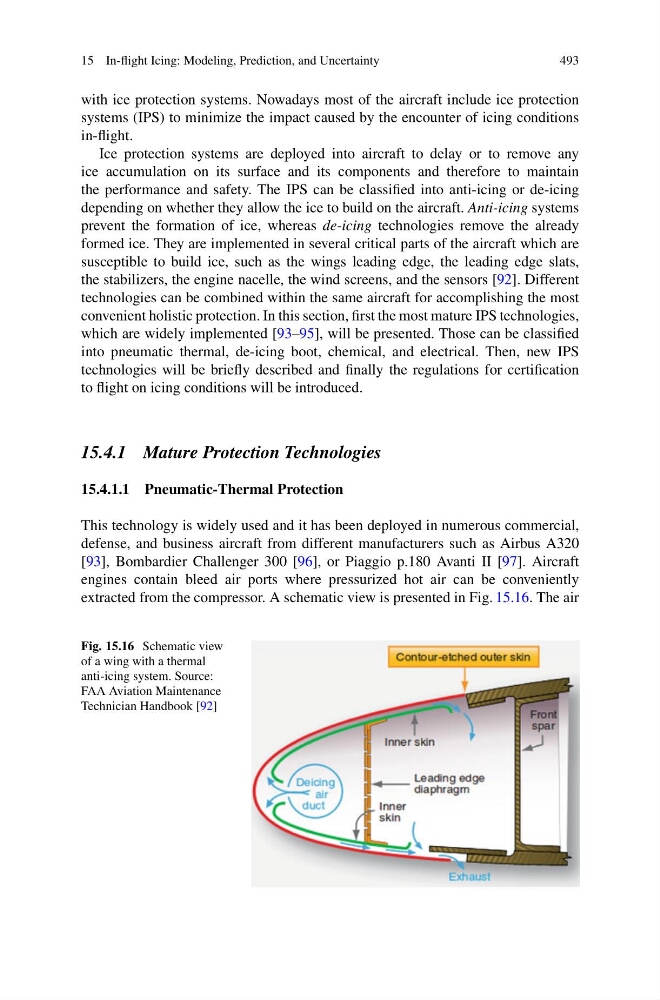
extracted from the compressor. A schematic view is presented in Fig. 15.16. The air
Fig. 15.16 Schematic view
of a wing with a thermal
anti-icing system. Source:
FAA Aviation Maintenance
Technician Handbook [92]
493
with ice protection systems. Nowadays most of the aircraft include ice protection
systems (IPS) to minimize the impact caused by the encounter of icing conditions
in-flight.
Ice protection systems are deployed into aircraft to delay or to remove any
ice accumulation on its surface and its components and therefore to maintain
the performance and safety. The IPS can be classified into anti-icing or de-icing
depending on whether they allow the ice to build on the aircraft. Anti-icing systems
prevent the formation of ice, whereas de-icing technologies remove the already
formed ice. They are implemented in several critical parts of the aircraft which are
susceptible to build ice, such as the wings leading edge, the leading edge slats,
the stabilizers, the engine nacelle, the wind screens, and the sensors [92]. Different
technologies can be combined within the same aircraft for accomplishing the most
convenient holistic protection. In this section, first the most mature IPS technologies,
which are widely implemented [93–95], will be presented. Those can be classified
into pneumatic thermal, de-icing boot, chemical, and electrical. Then, new IPS
technologies will be briefly described and finally the regulations for certification
to flight on icing conditions will be introduced.
15.4.1 Mature Protection Technologies
15.4.1.1 Pneumatic-Thermal Protection
This technology is widely used and it has been deployed in numerous commercial,
defense, and business aircraft from different manufacturers such as Airbus A320
[93], Bombardier Challenger 300 [96], or Piaggio p.180 Avanti II [97]. Aircraft
engines contain bleed air ports where pressurized hot air can be conveniently
extracted from the compressor. A schematic view is presented in Fig. 15.16. The air
Fig. 15.16 Schematic view
of a wing with a thermal
anti-icing system. Source:
FAA Aviation Maintenance
Technician Handbook [92]