

492
B. Arizmendi et al.
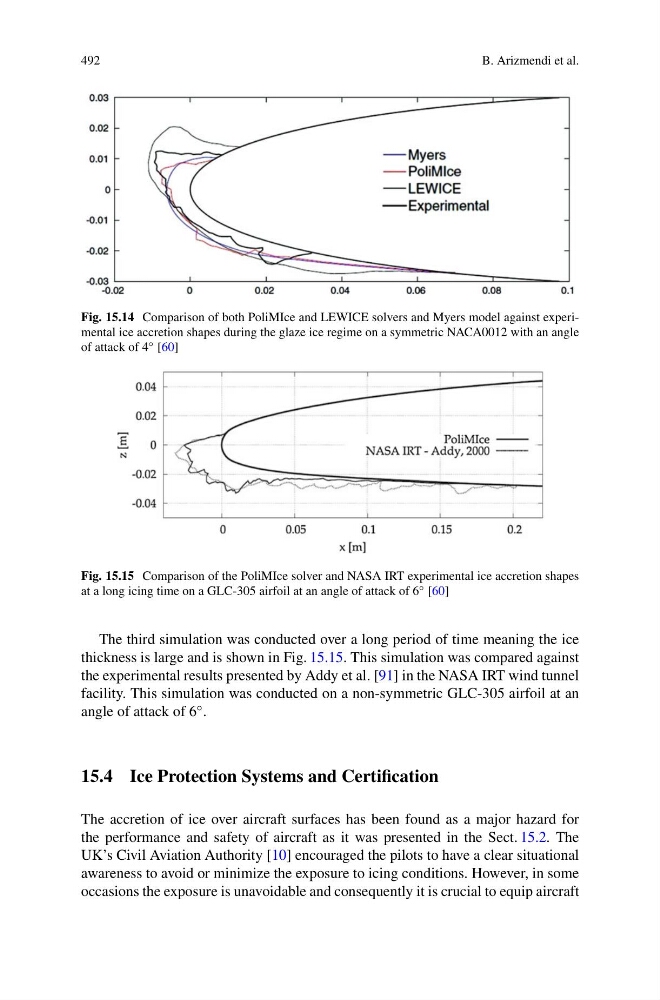
Fig. 15.14 Comparison of both PoliMIce and LEWICE solvers and Myers model against experimental ice accretion shapes during the glaze ice regime on a symmetric NACA0012 with an angle
of attack of 4 ◦ [60]
Fig. 15.15 Comparison of the PoliMIce solver and NASA IRT experimental ice accretion shapes
at a long icing time on a GLC-305 airfoil at an angle of attack of 6 ◦ [60]
The third simulation was conducted over a long period of time meaning the ice
thickness is large and is shown in Fig. 15.15. This simulation was compared against
the experimental results presented by Addy et al. [91] in the NASA IRT wind tunnel
facility. This simulation was conducted on a non-symmetric GLC-305 airfoil at an
angle of attack of 6 ◦ .
15.4 Ice Protection Systems and Certification
The accretion of ice over aircraft surfaces has been found as a major hazard for
the performance and safety of aircraft as it was presented in the Sect. 15.2. The
UK’s Civil Aviation Authority [10] encouraged the pilots to have a clear situational
awareness to avoid or minimize the exposure to icing conditions. However, in some
occasions the exposure is unavoidable and consequently it is crucial to equip aircraft
B. Arizmendi et al.
Fig. 15.14 Comparison of both PoliMIce and LEWICE solvers and Myers model against experimental ice accretion shapes during the glaze ice regime on a symmetric NACA0012 with an angle
of attack of 4 ◦ [60]
Fig. 15.15 Comparison of the PoliMIce solver and NASA IRT experimental ice accretion shapes
at a long icing time on a GLC-305 airfoil at an angle of attack of 6 ◦ [60]
The third simulation was conducted over a long period of time meaning the ice
thickness is large and is shown in Fig. 15.15. This simulation was compared against
the experimental results presented by Addy et al. [91] in the NASA IRT wind tunnel
facility. This simulation was conducted on a non-symmetric GLC-305 airfoil at an
angle of attack of 6 ◦ .
15.4 Ice Protection Systems and Certification
The accretion of ice over aircraft surfaces has been found as a major hazard for
the performance and safety of aircraft as it was presented in the Sect. 15.2. The
UK’s Civil Aviation Authority [10] encouraged the pilots to have a clear situational
awareness to avoid or minimize the exposure to icing conditions. However, in some
occasions the exposure is unavoidable and consequently it is crucial to equip aircraft