

490
B. Arizmendi et al.
are slight robust and expensive algorithms are not required. More cost-effective
methods can hence be used like those based on the Laplacian operator, such as
the spring or elastic methods [87].
2. Moving components: May use algorithms to continuously stitch the mesh. Here
two grid domains are considered: The first being fixed around the stationary
object, for example, the fuselage and the second rotating with the moving
components, for example, the blade. The domains are then separated by a small
gap in space which is constantly being re-meshed or stitched with tetrahedral
elements. Stitching algorithms may be based on simplified advancing front
techniques [88].
Mesh deformation algorithms such as these, however, usually require solving
a system of equations which can become computationally intensive for complex
three-dimensional applications. For aircraft icing simulations this can become
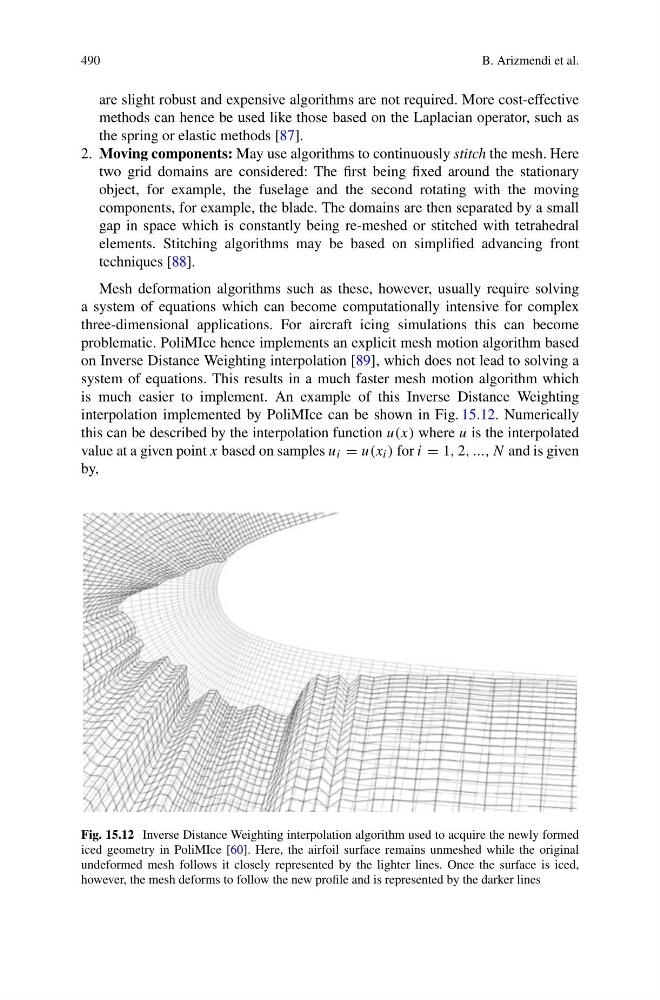
problematic. PoliMIce hence implements an explicit mesh motion algorithm based
on Inverse Distance Weighting interpolation [89], which does not lead to solving a
system of equations. This results in a much faster mesh motion algorithm which
is much easier to implement. An example of this Inverse Distance Weighting
interpolation implemented by PoliMIce can be shown in Fig. 15.12. Numerically
this can be described by the interpolation function u(x) where u is the interpolated
value at a given point x based on samples u i = u(x i ) for i = 1, 2, ..., N and is given
by,
Fig. 15.12 Inverse Distance Weighting interpolation algorithm used to acquire the newly formed
iced geometry in PoliMIce [60]. Here, the airfoil surface remains unmeshed while the original
undeformed mesh follows it closely represented by the lighter lines. Once the surface is iced,
however, the mesh deforms to follow the new profile and is represented by the darker lines
B. Arizmendi et al.
are slight robust and expensive algorithms are not required. More cost-effective
methods can hence be used like those based on the Laplacian operator, such as
the spring or elastic methods [87].
2. Moving components: May use algorithms to continuously stitch the mesh. Here
two grid domains are considered: The first being fixed around the stationary
object, for example, the fuselage and the second rotating with the moving
components, for example, the blade. The domains are then separated by a small
gap in space which is constantly being re-meshed or stitched with tetrahedral
elements. Stitching algorithms may be based on simplified advancing front
techniques [88].
Mesh deformation algorithms such as these, however, usually require solving
a system of equations which can become computationally intensive for complex
three-dimensional applications. For aircraft icing simulations this can become
problematic. PoliMIce hence implements an explicit mesh motion algorithm based
on Inverse Distance Weighting interpolation [89], which does not lead to solving a
system of equations. This results in a much faster mesh motion algorithm which
is much easier to implement. An example of this Inverse Distance Weighting
interpolation implemented by PoliMIce can be shown in Fig. 15.12. Numerically
this can be described by the interpolation function u(x) where u is the interpolated
value at a given point x based on samples u i = u(x i ) for i = 1, 2, ..., N and is given
by,
Fig. 15.12 Inverse Distance Weighting interpolation algorithm used to acquire the newly formed
iced geometry in PoliMIce [60]. Here, the airfoil surface remains unmeshed while the original
undeformed mesh follows it closely represented by the lighter lines. Once the surface is iced,
however, the mesh deforms to follow the new profile and is represented by the darker lines