

15 In-flight Icing: Modeling, Prediction, and Uncertainty
489
−
∂ϑ
∂z
B(t) +
=
¯
H 1 (T f reezing − T ∞ ) + ¯
H 2 (T f reezing − T local ) − ( ˙
Q aw + ˙
Q k )
K w
(15.37)
=
˙
Q
(n)
up
K w
,
(15.38)
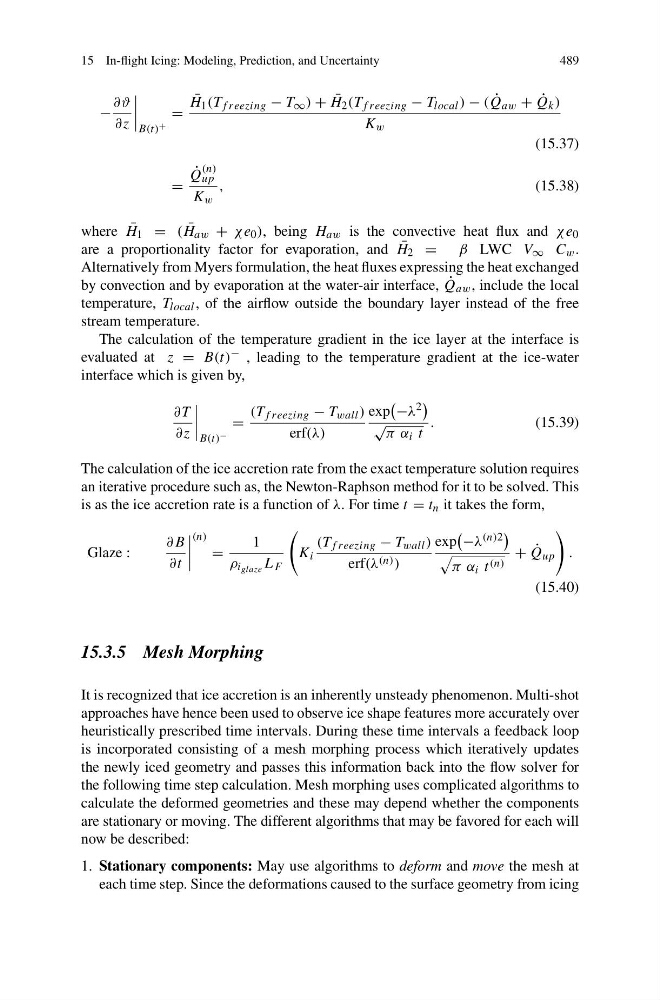
where ¯
H 1 = ( ¯
H aw + χe 0 ), being H aw is the convective heat flux and χe 0
are a proportionality factor for evaporation, and ¯
H 2 = β LWC V ∞ C w .
Alternatively from Myers formulation, the heat fluxes expressing the heat exchanged
by convection and by evaporation at the water-air interface, ˙
Q aw , include the local
temperature, T local , of the airflow outside the boundary layer instead of the free
stream temperature.
The calculation of the temperature gradient in the ice layer at the interface is
evaluated at z = B(t) − , leading to the temperature gradient at the ice-water
interface which is given by,
∂T
∂z
B(t) −
=
(T f reezing − T wall )
erf(λ)
exp
−λ 2
√
π α i t
.
(15.39)
The calculation of the ice accretion rate from the exact temperature solution requires
an iterative procedure such as, the Newton-Raphson method for it to be solved. This
is as the ice accretion rate is a function of λ. For time t = t n it takes the form,
Glaze :
∂B
∂t
(n)
=
1
ρ i glaze L F
K i
(T f reezing − T wall )
erf(λ (n) )
exp
−λ (n)2
π α i t (n)
+ ˙
Q up
.
(15.40)
15.3.5 Mesh Morphing
It is recognized that ice accretion is an inherently unsteady phenomenon. Multi-shot
approaches have hence been used to observe ice shape features more accurately over
heuristically prescribed time intervals. During these time intervals a feedback loop
is incorporated consisting of a mesh morphing process which iteratively updates
the newly iced geometry and passes this information back into the flow solver for
the following time step calculation. Mesh morphing uses complicated algorithms to
calculate the deformed geometries and these may depend whether the components
are stationary or moving. The different algorithms that may be favored for each will
now be described:
1. Stationary components: May use algorithms to deform and move the mesh at
each time step. Since the deformations caused to the surface geometry from icing
489
−
∂ϑ
∂z
B(t) +
=
¯
H 1 (T f reezing − T ∞ ) + ¯
H 2 (T f reezing − T local ) − ( ˙
Q aw + ˙
Q k )
K w
(15.37)
=
˙
Q
(n)
up
K w
,
(15.38)
where ¯
H 1 = ( ¯
H aw + χe 0 ), being H aw is the convective heat flux and χe 0
are a proportionality factor for evaporation, and ¯
H 2 = β LWC V ∞ C w .
Alternatively from Myers formulation, the heat fluxes expressing the heat exchanged
by convection and by evaporation at the water-air interface, ˙
Q aw , include the local
temperature, T local , of the airflow outside the boundary layer instead of the free
stream temperature.
The calculation of the temperature gradient in the ice layer at the interface is
evaluated at z = B(t) − , leading to the temperature gradient at the ice-water
interface which is given by,
∂T
∂z
B(t) −
=
(T f reezing − T wall )
erf(λ)
exp
−λ 2
√
π α i t
.
(15.39)
The calculation of the ice accretion rate from the exact temperature solution requires
an iterative procedure such as, the Newton-Raphson method for it to be solved. This
is as the ice accretion rate is a function of λ. For time t = t n it takes the form,
Glaze :
∂B
∂t
(n)
=
1
ρ i glaze L F
K i
(T f reezing − T wall )
erf(λ (n) )
exp
−λ (n)2
π α i t (n)
+ ˙
Q up
.
(15.40)
15.3.5 Mesh Morphing
It is recognized that ice accretion is an inherently unsteady phenomenon. Multi-shot
approaches have hence been used to observe ice shape features more accurately over
heuristically prescribed time intervals. During these time intervals a feedback loop
is incorporated consisting of a mesh morphing process which iteratively updates
the newly iced geometry and passes this information back into the flow solver for
the following time step calculation. Mesh morphing uses complicated algorithms to
calculate the deformed geometries and these may depend whether the components
are stationary or moving. The different algorithms that may be favored for each will
now be described:
1. Stationary components: May use algorithms to deform and move the mesh at
each time step. Since the deformations caused to the surface geometry from icing