

15 In-flight Icing: Modeling, Prediction, and Uncertainty
483
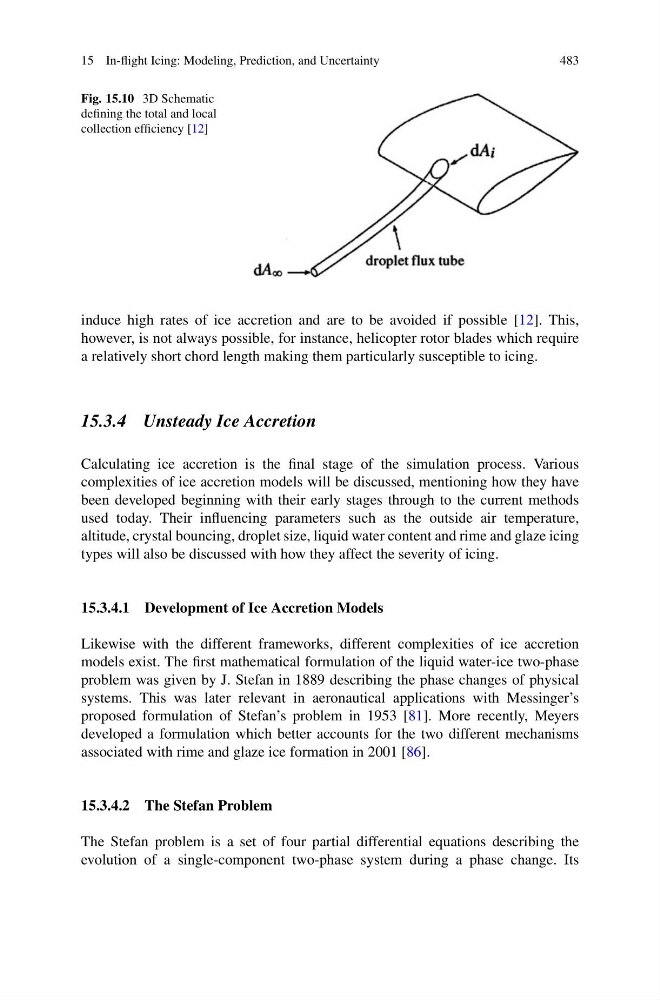
Fig. 15.10 3D Schematic
defining the total and local
collection efficiency [12]
induce high rates of ice accretion and are to be avoided if possible [12]. This,
however, is not always possible, for instance, helicopter rotor blades which require
a relatively short chord length making them particularly susceptible to icing.
15.3.4 Unsteady Ice Accretion
Calculating ice accretion is the final stage of the simulation process. Various
complexities of ice accretion models will be discussed, mentioning how they have
been developed beginning with their early stages through to the current methods
used today. Their influencing parameters such as the outside air temperature,
altitude, crystal bouncing, droplet size, liquid water content and rime and glaze icing
types will also be discussed with how they affect the severity of icing.
15.3.4.1 Development of Ice Accretion Models
Likewise with the different frameworks, different complexities of ice accretion
models exist. The first mathematical formulation of the liquid water-ice two-phase
problem was given by J. Stefan in 1889 describing the phase changes of physical
systems. This was later relevant in aeronautical applications with Messinger’s
proposed formulation of Stefan’s problem in 1953 [81]. More recently, Meyers
developed a formulation which better accounts for the two different mechanisms
associated with rime and glaze ice formation in 2001 [86].
15.3.4.2 The Stefan Problem
The Stefan problem is a set of four partial differential equations describing the
evolution of a single-component two-phase system during a phase change. Its
483
Fig. 15.10 3D Schematic
defining the total and local
collection efficiency [12]
induce high rates of ice accretion and are to be avoided if possible [12]. This,
however, is not always possible, for instance, helicopter rotor blades which require
a relatively short chord length making them particularly susceptible to icing.
15.3.4 Unsteady Ice Accretion
Calculating ice accretion is the final stage of the simulation process. Various
complexities of ice accretion models will be discussed, mentioning how they have
been developed beginning with their early stages through to the current methods
used today. Their influencing parameters such as the outside air temperature,
altitude, crystal bouncing, droplet size, liquid water content and rime and glaze icing
types will also be discussed with how they affect the severity of icing.
15.3.4.1 Development of Ice Accretion Models
Likewise with the different frameworks, different complexities of ice accretion
models exist. The first mathematical formulation of the liquid water-ice two-phase
problem was given by J. Stefan in 1889 describing the phase changes of physical
systems. This was later relevant in aeronautical applications with Messinger’s
proposed formulation of Stefan’s problem in 1953 [81]. More recently, Meyers
developed a formulation which better accounts for the two different mechanisms
associated with rime and glaze ice formation in 2001 [86].
15.3.4.2 The Stefan Problem
The Stefan problem is a set of four partial differential equations describing the
evolution of a single-component two-phase system during a phase change. Its