

482
B. Arizmendi et al.
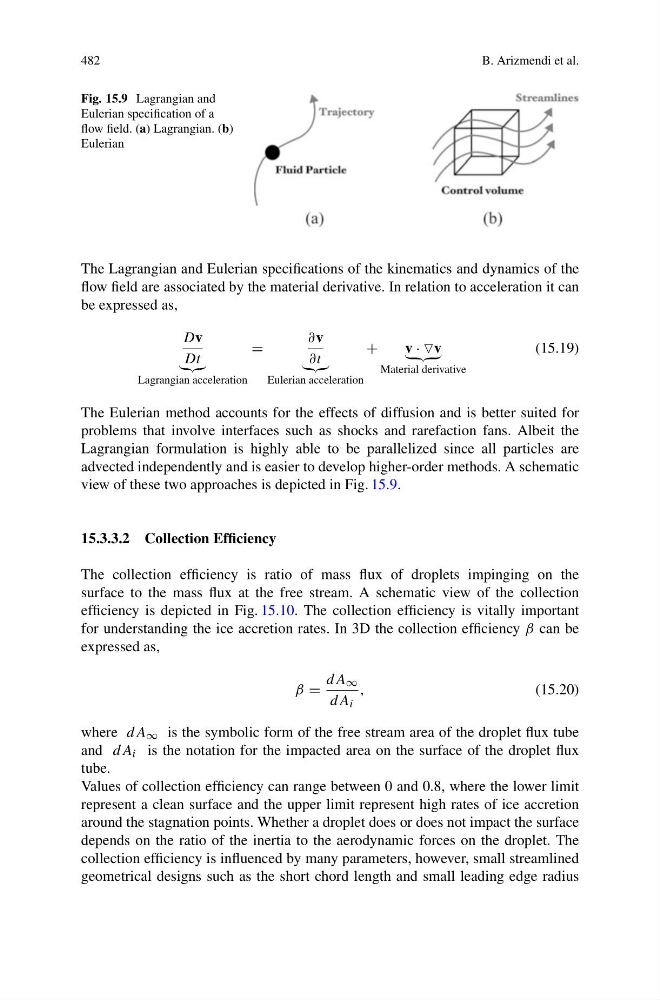
Fig. 15.9 Lagrangian and
Eulerian specification of a
flow field. (a) Lagrangian. (b)
Eulerian
The Lagrangian and Eulerian specifications of the kinematics and dynamics of the
flow field are associated by the material derivative. In relation to acceleration it can
be expressed as,
Dv
Dt
Lagrangian acceleration
=
∂v
∂t
Eulerian acceleration
+
v ·
Material derivative
(15.19)
The Eulerian method accounts for the effects of diffusion and is better suited for
problems that involve interfaces such as shocks and rarefaction fans. Albeit the
Lagrangian formulation is highly able to be parallelized since all particles are
advected independently and is easier to develop higher-order methods. A schematic
view of these two approaches is depicted in Fig. 15.9.
15.3.3.2 Collection Efficiency
The collection efficiency is ratio of mass flux of droplets impinging on the
surface to the mass flux at the free stream. A schematic view of the collection
efficiency is depicted in Fig. 15.10. The collection efficiency is vitally important
for understanding the ice accretion rates. In 3D the collection efficiency β can be
expressed as,
β =
dA ∞
dA i
,
(15.20)
where dA ∞ is the symbolic form of the free stream area of the droplet flux tube
and dA i is the notation for the impacted area on the surface of the droplet flux
tube.
Values of collection efficiency can range between 0 and 0.8, where the lower limit
represent a clean surface and the upper limit represent high rates of ice accretion
around the stagnation points. Whether a droplet does or does not impact the surface
depends on the ratio of the inertia to the aerodynamic forces on the droplet. The
collection efficiency is influenced by many parameters, however, small streamlined
geometrical designs such as the short chord length and small leading edge radius
B. Arizmendi et al.
Fig. 15.9 Lagrangian and
Eulerian specification of a
flow field. (a) Lagrangian. (b)
Eulerian
The Lagrangian and Eulerian specifications of the kinematics and dynamics of the
flow field are associated by the material derivative. In relation to acceleration it can
be expressed as,
Dv
Dt
Lagrangian acceleration
=
∂v
∂t
Eulerian acceleration
+
v ·
Material derivative
(15.19)
The Eulerian method accounts for the effects of diffusion and is better suited for
problems that involve interfaces such as shocks and rarefaction fans. Albeit the
Lagrangian formulation is highly able to be parallelized since all particles are
advected independently and is easier to develop higher-order methods. A schematic
view of these two approaches is depicted in Fig. 15.9.
15.3.3.2 Collection Efficiency
The collection efficiency is ratio of mass flux of droplets impinging on the
surface to the mass flux at the free stream. A schematic view of the collection
efficiency is depicted in Fig. 15.10. The collection efficiency is vitally important
for understanding the ice accretion rates. In 3D the collection efficiency β can be
expressed as,
β =
dA ∞
dA i
,
(15.20)
where dA ∞ is the symbolic form of the free stream area of the droplet flux tube
and dA i is the notation for the impacted area on the surface of the droplet flux
tube.
Values of collection efficiency can range between 0 and 0.8, where the lower limit
represent a clean surface and the upper limit represent high rates of ice accretion
around the stagnation points. Whether a droplet does or does not impact the surface
depends on the ratio of the inertia to the aerodynamic forces on the droplet. The
collection efficiency is influenced by many parameters, however, small streamlined
geometrical designs such as the short chord length and small leading edge radius