

480
B. Arizmendi et al.
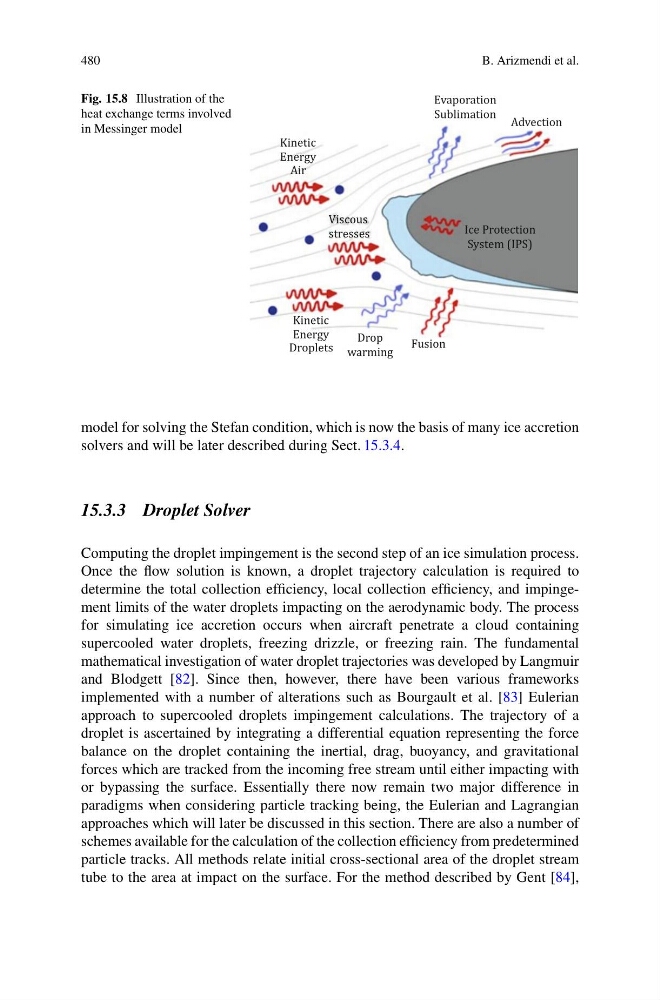
Fig. 15.8 Illustration of the
heat exchange terms involved
in Messinger model
Kinetic
Energy
Air
Viscous
stresses
Kinetic
Energy
Droplets
Drop
warming
Fusion
Evaporation
Sublimation Advection
Ice Protection
System (IPS)
model for solving the Stefan condition, which is now the basis of many ice accretion
solvers and will be later described during Sect. 15.3.4.
15.3.3 Droplet Solver
Computing the droplet impingement is the second step of an ice simulation process.
Once the flow solution is known, a droplet trajectory calculation is required to
determine the total collection efficiency, local collection efficiency, and impingement limits of the water droplets impacting on the aerodynamic body. The process
for simulating ice accretion occurs when aircraft penetrate a cloud containing
supercooled water droplets, freezing drizzle, or freezing rain. The fundamental
mathematical investigation of water droplet trajectories was developed by Langmuir
and Blodgett [82]. Since then, however, there have been various frameworks
implemented with a number of alterations such as Bourgault et al. [83] Eulerian
approach to supercooled droplets impingement calculations. The trajectory of a
droplet is ascertained by integrating a differential equation representing the force
balance on the droplet containing the inertial, drag, buoyancy, and gravitational
forces which are tracked from the incoming free stream until either impacting with
or bypassing the surface. Essentially there now remain two major difference in
paradigms when considering particle tracking being, the Eulerian and Lagrangian
approaches which will later be discussed in this section. There are also a number of
schemes available for the calculation of the collection efficiency from predetermined
particle tracks. All methods relate initial cross-sectional area of the droplet stream
tube to the area at impact on the surface. For the method described by Gent [84],
B. Arizmendi et al.
Fig. 15.8 Illustration of the
heat exchange terms involved
in Messinger model
Kinetic
Energy
Air
Viscous
stresses
Kinetic
Energy
Droplets
Drop
warming
Fusion
Evaporation
Sublimation Advection
Ice Protection
System (IPS)
model for solving the Stefan condition, which is now the basis of many ice accretion
solvers and will be later described during Sect. 15.3.4.
15.3.3 Droplet Solver
Computing the droplet impingement is the second step of an ice simulation process.
Once the flow solution is known, a droplet trajectory calculation is required to
determine the total collection efficiency, local collection efficiency, and impingement limits of the water droplets impacting on the aerodynamic body. The process
for simulating ice accretion occurs when aircraft penetrate a cloud containing
supercooled water droplets, freezing drizzle, or freezing rain. The fundamental
mathematical investigation of water droplet trajectories was developed by Langmuir
and Blodgett [82]. Since then, however, there have been various frameworks
implemented with a number of alterations such as Bourgault et al. [83] Eulerian
approach to supercooled droplets impingement calculations. The trajectory of a
droplet is ascertained by integrating a differential equation representing the force
balance on the droplet containing the inertial, drag, buoyancy, and gravitational
forces which are tracked from the incoming free stream until either impacting with
or bypassing the surface. Essentially there now remain two major difference in
paradigms when considering particle tracking being, the Eulerian and Lagrangian
approaches which will later be discussed in this section. There are also a number of
schemes available for the calculation of the collection efficiency from predetermined
particle tracks. All methods relate initial cross-sectional area of the droplet stream
tube to the area at impact on the surface. For the method described by Gent [84],